When someone deliberately causes you severe emotional suffering, you deserve legal recourse. Emotional distress lawyers specialize in holding wrongdoers accountable for the psychological harm they inflict. In Georgia, emotional distress lawyers can pursue claims under intentional infliction of emotional distress (IIED) or negligent infliction of emotional distress (NIED). These are not simple cases—they require experienced legal representation to prove that another person’s conduct crossed the line from offensive to actionable. At HB Injury Lawyers, our team understands how trauma ripples through your life. We’ve helped clients recover compensation for anxiety, depression, PTSD, and lost wages resulting from emotional suffering caused by workplace harassment, accidents, medical negligence, and intentional wrongdoing.
What Is Intentional Infliction of Emotional Distress?
Intentional infliction of emotional distress (IIED) occurs when someone acts intentionally or recklessly and their conduct is so extreme that it goes beyond the bounds of decency. Georgia law recognizes IIED as a valid tort, meaning you can sue for damages even without physical injury. The key is proving three things: intent or recklessness, extreme and outrageous conduct, and severe emotional distress as a result.
IIED claims are different from typical personal injury cases. A rude boss doesn’t cross the line. But a boss who systematically humiliates you in front of coworkers, threatens your safety, or creates a pattern of abusive behavior might. Courts examine whether the conduct would be highly offensive to a reasonable person. This is why emotional distress lawyers must build a detailed narrative showing a pattern of harmful behavior, not just one bad day.
Practical rule: IIED requires “extreme and outrageous” conduct that goes beyond social norms. Garden-variety rudeness, insults, or even discrimination alone typically don’t meet this standard—there must be a pattern of escalating abuse.
Types of Emotional Distress Claims
Georgia recognizes multiple forms of emotional distress that can lead to legal recovery. Understanding which type applies to your situation is crucial for building a strong case. Emotional distress lawyers evaluate your facts against each category to identify the strongest legal theory.
Intentional Infliction of Emotional Distress (IIED)
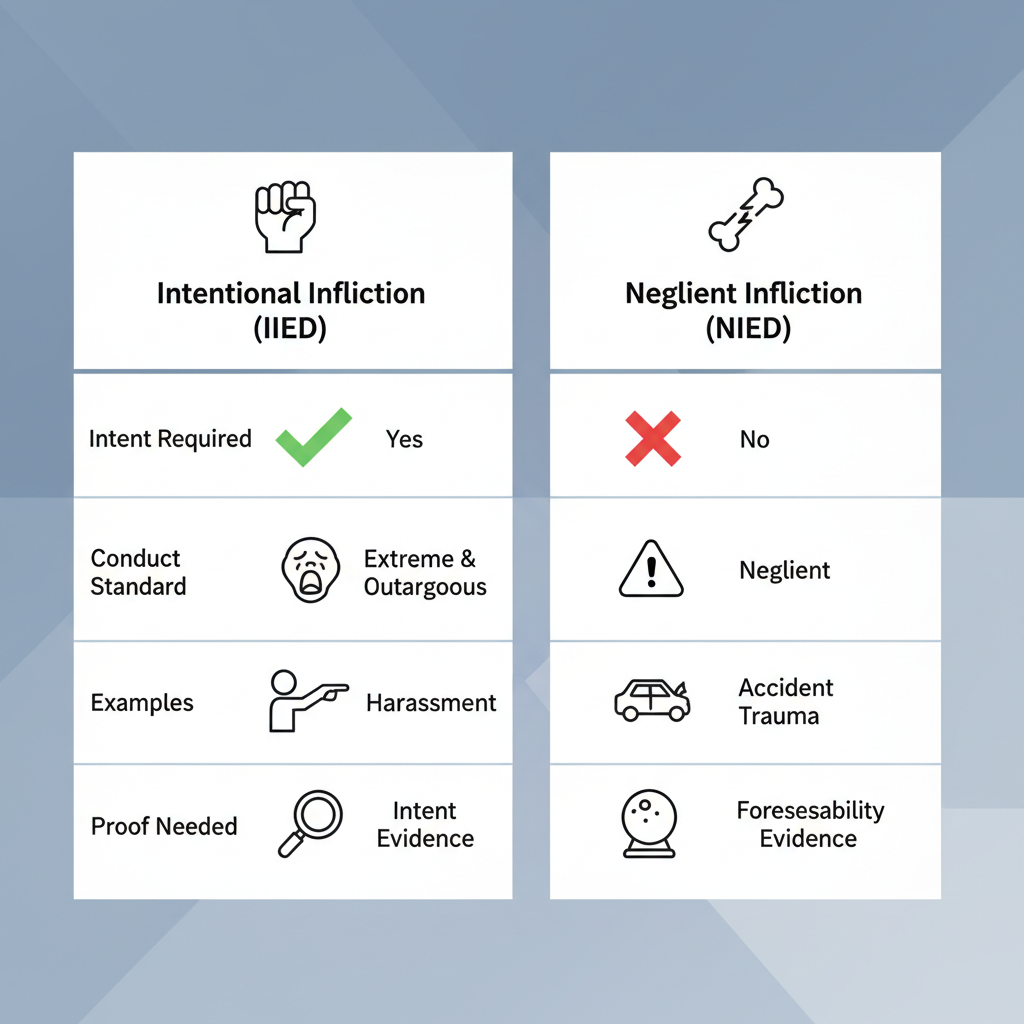
This is the most extreme form. It requires intentional or reckless conduct that is extreme and outrageous, causing severe emotional distress. Examples include workplace campaigns to drive someone out, systematic sexual harassment, or deliberate humiliation that causes debilitating anxiety or PTSD.
Negligent Infliction of Emotional Distress (NIED)
NIED applies when someone’s negligent behavior (not intentional) causes you severe emotional harm. Classic examples: witnessing a serious accident caused by negligence, receiving a wrong medical diagnosis, or discovering a loved one was injured because of someone’s carelessness. The emotional injury must be severe—not every upsetting situation qualifies.
Bystander NIED
In Georgia, you can sometimes recover for emotional distress even if you weren’t directly harmed, but witnessed harm to someone else. If you see a family member injured in a negligent accident and suffer PTSD as a result, you may have a bystander NIED claim. These cases are highly fact-specific.
Loss of Consortium
When a family member suffers injury or emotional distress because of wrongdoing, you (the spouse or parent) may claim loss of consortium—loss of companionship, affection, and support. This is a related but distinct form of emotional harm recovery.
How to Prove Emotional Distress in Georgia
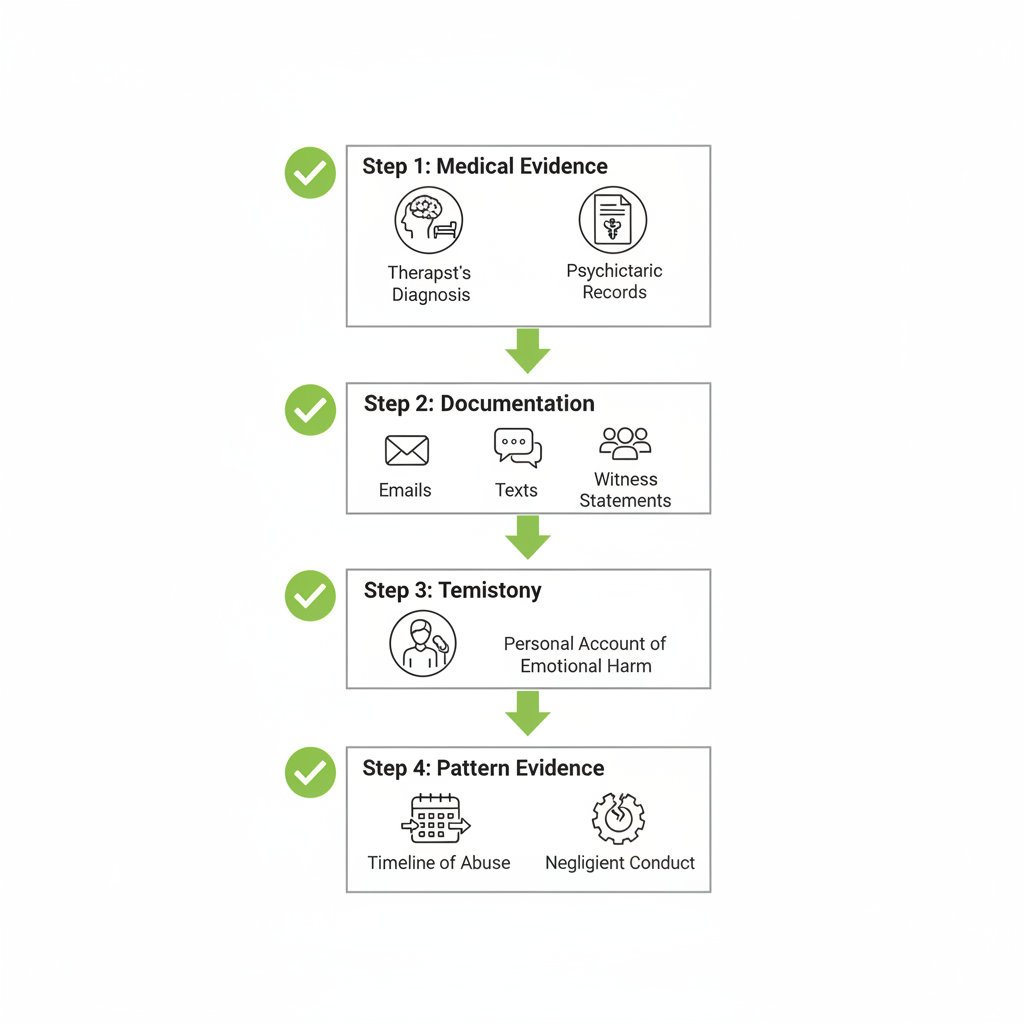
Proving emotional distress is harder than showing a broken arm. You can’t just say you’re upset. Courts require concrete evidence that the emotional harm is real, severe, and caused by the defendant’s actions. Emotional distress lawyers use multiple forms of evidence to build a credible case.
 emotional distress claims in Georgia: medical evidence, documentation, testimony, and pattern evidence” style=”max-width: 100%; height: auto; border-radius: 8px; box-shadow: 0 2px 8px rgba(0,0,0,0.1);” />
Medical and Psychological Evidence
The strongest proof comes from mental health professionals. A psychologist’s diagnosis of PTSD, major depression, or anxiety disorder carries weight. Medical records showing treatment, medication, and ongoing therapy demonstrate that your emotional injuries required professional intervention. Hospital or psychiatric treatment records are powerful.
Testimony and Documentation
Your own testimony about how the distress affected your daily life matters. Describe specific symptoms: sleep loss, appetite changes, inability to work, withdrawal from family. Gather statements from family members, coworkers, or friends who witnessed your emotional decline. Emails, texts, or recordings documenting the defendant’s harmful conduct strengthen your case.
Employment and Financial Records
If emotional distress caused you to lose your job, take medical leave, or lose income, that creates a financial trail. Payroll records, medical leave documentation, and lost wage calculations show real consequences. Lost promotions, demotion, or termination linked to the distress are powerful evidence.
Pattern Evidence
For workplace IIED claims, show a pattern of abuse over time. Single incidents rarely qualify. But a documented series of humiliating meetings, written warnings for retaliatory reasons, exclusion from work activities, or escalating threats shows systematic intent to cause harm.
Practical rule: Emotional distress claims require professional mental health documentation. Without a therapist’s diagnosis or psychiatric records, Georgia courts are unlikely to award substantial damages.
Common Scenarios Where Emotional Distress Claims Succeed
Not every stressful situation leads to a valid emotional distress claim, but certain patterns do. Emotional distress lawyers recognize scenarios with stronger legal footing. Understanding where courts have found liability helps you assess your case.
Workplace Harassment and Hostile Work Environment
Sexual harassment, racial harassment, or disability harassment that creates an abusive work environment can trigger IIED claims, especially if management ignored complaints or retaliated. A single offensive remark doesn’t qualify—there must be a pattern creating an environment no reasonable person should endure.
Medical Negligence
A doctor’s gross negligence causing serious emotional trauma may support an NIED claim. Example: A surgeon operates on the wrong body part, causing you severe shock and lasting psychological injury. The medical error itself plus the emotional aftermath create liability.
Accident Witnessing
Seeing a family member severely injured in a car accident caused by someone’s recklessness can create a valid bystander NIED claim. You must have been present or nearby, learned of the injury shortly after, and suffered verifiable emotional distress (not just sympathy).
False Imprisonment or Assault
Being unlawfully detained, threatened with violence, or assaulted causes extreme emotional harm. These cases often combine IIED with other torts. The wrongdoer’s intent to cause emotional suffering is typically clear.
Defamation or Public Humiliation
Being falsely accused of a crime, publicly shamed with false statements about your character, or subjected to a smear campaign can support emotional distress claims. Georgia recognizes these as particularly harmful because they destroy reputation and social relationships.
Practical rule: Workplace IIED claims succeed when you document a pattern of abuse over weeks or months. Single incidents or one-time rudeness typically fail, even if upsetting.
Damages You Can Recover for Emotional Distress
If you win an emotional distress claim, Georgia law allows you to recover compensatory damages covering your actual losses. Emotional distress lawyers calculate damages based on the severity of harm and the impact on your life. Damages are not capped in Georgia for intentional torts like IIED.
Medical and Therapy Costs
You can recover all past and future mental health treatment: therapy sessions, psychiatric medications, hospitalization, and counseling. These are documented, easy to prove, and often substantial. If you’ll need therapy for years, courts consider long-term treatment costs.
Lost Wages and Lost Earning Capacity
If emotional distress caused you to miss work, take medical leave, or lose your job entirely, you recover lost wages. You also recover lost earning capacity if the emotional injury permanently reduces your ability to work. If you had a promotion coming and lost it due to the harassment, that’s part of your claim.
Pain and Suffering
This is compensation for the emotional anguish itself: anxiety, depression, PTSD, sleep loss, loss of enjoyment of life. Georgia juries award substantial sums for severe emotional suffering. Cases with long-term PTSD or major depression often award $50,000 to $500,000+ in pain and suffering alone, depending on severity.
Loss of Consortium
Your spouse can recover separately for loss of companionship, support, and affection caused by your emotional distress. These damages go to your family member, not to you directly.
Punitive Damages
In IIED cases, Georgia allows punitive damages to punish outrageous conduct and deter similar behavior. Punitive damages are separate from compensatory damages and are often the largest award. Juries sometimes award punitive damages equal to or exceeding compensatory damages in particularly egregious cases, especially where the defendant acted with malice.
Practical rule: A severe IIED case with documented PTSD, job loss, and ongoing therapy costs could recover $150,000 to $750,000+ in total damages depending on the facts and defendant’s conduct.
Why You Need Emotional Distress Lawyers on Your Side
Emotional distress claims require legal expertise that goes beyond standard personal injury practice. Emotional distress lawyers bring specialized knowledge of Georgia’s case law, jury expectations, and strategic approaches to proving harm that exists only in the mind. Without skilled representation, you face significant hurdles.
Navigating Georgia’s Strict Standards
Georgia courts apply a high bar to emotional distress claims. “Extreme and outrageous” is a strict legal standard. Judges can dismiss cases before trial if they find the conduct not outrageous enough as a matter of law. Your lawyer must present evidence and argument that meets this bar, not just show you were hurt.
Building Credible Evidence
Juries are skeptical of emotional damage claims. Without strong medical evidence, your case falls apart. Experienced emotional distress lawyers know which mental health experts carry weight with juries, how to structure testimony to prove severity, and how to use documentation to corroborate your account. We coordinate with psychologists and psychiatrists to build a compelling narrative.
Handling Defense Tactics
Defendants will argue you’re exaggerating, that you have pre-existing mental health issues, or that your emotional response is too sensitive. Insurance companies fight emotional distress claims hard because damages can be high. Your lawyer counters these arguments with evidence and expert testimony showing your emotional injury was real and caused by the defendant.
Achieving Fair Compensation
Without representation, you’re unlikely to recover punitive damages or substantial pain and suffering awards. Defendants and insurers offer low settlements to unrepresented claimants. Our team knows what similar cases settle or award at trial, and we fight for fair value. We also consider long-term costs: if your emotional injury is permanent, we calculate future therapy costs and lost earning capacity.
Practical rule: Unrepresented emotional distress claimants typically recover 20-40% of what represented claimants receive. Legal counsel is essential to maximize your award.
The Process of Filing an Emotional Distress Claim
Emotional distress claims follow Georgia’s civil litigation process, but require early attention to gathering evidence and expert coordination. Emotional distress lawyers manage each phase strategically to build your case from the ground up.
Initial Consultation and Case Evaluation
We listen to your story in detail and evaluate whether Georgia law supports a viable claim. We review any documentation you have: emails, medical records, witness statements. We assess the strength of evidence and discuss realistic outcomes. If your case has merit, we explain the litigation process and timeline.
Investigation and Evidence Gathering
Our team investigates the defendant’s conduct thoroughly. For workplace cases, we obtain personnel files, complaint records, and management communications. We identify witnesses who observed the wrongdoing or witnessed your emotional decline. We begin coordinating with mental health professionals who can testify about your emotional injury and connect it to the defendant’s conduct.
Pre-Suit Negotiation
Before filing, we often demand compensation directly from the defendant or their insurance company. A well-crafted demand letter backed by strong evidence can lead to settlement. Many emotional distress cases settle at this stage if evidence is compelling and damages demand is reasonable.
Litigation
If settlement fails, we file a complaint in Georgia Superior Court. Discovery allows us to obtain the defendant’s documents and take depositions. We prepare expert witness testimony from your mental health provider. We file motions to survive any dismissal attempts. We prepare for trial or achieve settlement once the defendant understands the strength of your case.
Trial
If necessary, we present your case to a jury. We walk them through the pattern of the defendant’s conduct, show the emotional harm you suffered, present expert testimony, and argue for appropriate damages including punitive damages in IIED cases. We cross-examine the defendant’s witnesses and experts.
Practical rule: Most emotional distress cases settle before trial, but trial preparation is essential. Defendants take cases seriously when they know you’re ready for jury trial.
Special Considerations for Workplace Emotional Distress
Workplace harassment and emotional distress are among the most common scenarios where emotional distress lawyers pursue recovery. Georgia employers have a duty to maintain a safe work environment, including protection from harassment and abuse by supervisors or coworkers. When management ignores complaints or retaliates against victims, liability increases significantly. Emotional distress lawyers specializing in workplace claims understand employment law and retaliation statutes alongside tort doctrine.

Manager-to-Employee Harassment
A supervisor’s systematic harassment of an employee creates a hostile work environment and can support IIED claims. When a manager yells, demeans, makes threats, or publicly humiliates an employee repeatedly, that pattern meets Georgia’s “extreme and outrageous” standard. Courts recognize that supervisors hold power over employees’ livelihoods, making their harassment especially harmful. Emotional distress lawyers in Atlanta understand that supervisor abuse often causes debilitating anxiety and depression.
Peer Harassment and Mobbing
Sometimes coworkers gang up on a target, creating a hostile environment through exclusion, gossip, and humiliation. If management knowingly allows this mobbing to continue, both the coworkers and the employer may be liable. Emotional distress lawyers have helped employees recover when companies failed to stop workplace bullying despite complaints.
Practical rule: Workplace IIED requires both extreme conduct AND knowledge/approval by management. A terrible coworker isn’t liable unless their conduct is also extreme and outrageous. But an employer who knows about harassment and does nothing can be liable.
Emotional Distress from Accidents and Negligence
You don’t always need to prove intentional wrongdoing to recover for emotional distress. Negligent acts that cause severe emotional harm support NIED claims under Georgia law. When someone’s carelessness causes you to witness a horrific injury, receive false medical diagnosis, or suffer aftermath shock, emotional distress lawyers can pursue recovery. These cases differ from IIED because they don’t require proof of intent or “extreme” conduct—only negligence that foreseeably causes emotional trauma.
Motor Vehicle Accident Trauma
Surviving a severe car accident causes legitimate emotional distress. If the other driver was negligent and caused the crash, you may recover for PTSD, anxiety, or depression resulting from the accident. Emotional distress lawyers handling accident cases coordinate medical evidence and expert testimony showing the psychological aftermath of the collision.
Medical Negligence and Misdiagnosis
When a doctor commits negligence causing emotional trauma, NIED claims apply. Example: A radiologist misses cancer on a CT scan, and the patient learns months later that early detection was possible. The shock and emotional anguish of a preventable diagnosis support recovery. Emotional distress lawyers with medical knowledge understand the intersection of medical malpractice and emotional injury.
Practical rule: NIED claims for accidents don’t require “extreme” conduct. They require only negligence that foreseeably causes severe emotional distress and proof that you suffered that distress.
Why Settlement Negotiations Matter for Emotional Distress Claims
Many emotional distress cases settle before trial. Defendants and insurers understand that juries award substantial damages for proven emotional harm, especially with strong expert testimony. Emotional distress lawyers use demand letters and negotiation strategy to convince defendants of liability and extract fair settlement value. A well-drafted demand backed by evidence often succeeds where unrepresented claimants would receive lowball offers.
Settlement negotiations require detailed presentation of damages. We calculate past therapy costs, document lost wages, obtain expert projections of future treatment needs, and present medical records proving emotional injury severity. We research comparable cases showing what juries award for similar facts. When the defendant sees a professional demand letter and case summary, settlement discussions become realistic.
Emotional distress lawyers sometimes achieve settlements of $100,000–$500,000+ for serious cases, even before filing suit. The key is demonstrating that trial would be expensive and risky for the defendant, while your evidence is strong. Settlement negotiations often resolve cases faster than litigation and provide certainty of recovery.
Practical rule: Most emotional distress cases settle during pre-suit negotiation or early discovery. Litigation is lengthy and expensive. Strong evidence and skilled negotiation can often resolve cases faster.
For additional information on emotional distress and mental health recovery, see the American Psychological Association’s stress resources, Georgia Department of Labor, and Georgia Judicial Council.
Additional Resources on Emotional Distress and Legal Rights
For more information on emotional distress, mental health recovery, and Georgia legal standards, consult these authoritative resources:
- American Psychological Association – Understanding Stress and Its Effects
- Georgia Department of Labor – For workplace rights and harassment reporting
- Georgia Judicial Council – For court procedures and case information
- University of Georgia School of Law – Legal education and research
- State Bar of Georgia – Attorney resources and ethical standards
Frequently Asked Questions About Emotional Distress Claims
| Question | Answer |
|---|---|
| Can I sue for emotional distress without physical injury? | Yes. Georgia recognizes intentional and negligent infliction of emotional distress as separate torts. You do not need physical injury, but you must prove the emotional harm is severe and caused by the defendant’s conduct. |
| What counts as “extreme and outrageous” conduct? | Georgia courts look at whether the conduct goes beyond the bounds of decency and would be highly offensive to a reasonable person. A pattern of harassment, deliberate humiliation, or threats qualifies. Single rude remarks or typical workplace stress usually do not. |
| How much can I recover for emotional distress in Georgia? | Damages depend on severity. A documented case with PTSD, significant therapy costs, and job loss might recover $150,000–$750,000+. Punitive damages can double or triple the award in IIED cases with outrageous conduct. |
| Do I need a mental health professional to support my claim? | Yes, strongly recommended. A therapist’s or psychiatrist’s diagnosis and testimony that the emotional harm was caused by the defendant’s conduct significantly strengthens your case. Without professional documentation, juries are skeptical. |
| What is the statute of limitations for emotional distress claims in Georgia? | For intentional torts like IIED, the statute of limitations is typically 4 years from the date of the wrongful conduct. For negligence-based claims (NIED), it may vary. Do not delay—contact an attorney immediately to preserve your rights. |
| Can I recover for emotional distress in a wrongful death case? | Family members (spouse, parents, children) can sometimes recover for loss of consortium and emotional distress in wrongful death cases. The rules are complex and fact-dependent. Speak with an attorney to understand your rights. |
Getting Help from HB Injury Lawyers
If you’ve suffered emotional distress caused by another person’s wrongful conduct, you don’t have to suffer alone. Emotional distress lawyers at HB Injury Lawyers are here to listen, evaluate your case, and fight for the compensation you deserve. We handle cases involving workplace harassment, accidents, medical negligence, and intentional wrongdoing. We work on contingency—you pay nothing unless we recover for you. Call (404) 446-9854 today for a free consultation. Let us show you how the law protects you and what recovery is possible.
About HB Injury Lawyers: HB Injury Lawyers is a personal injury law firm serving Atlanta and throughout Georgia. Founded by Desmond Humphrey and David Ballard, we specialize in helping injury victims recover fair compensation. Our team handles car accidents, truck crashes, slip and falls, workplace injuries, medical negligence, and intentional harm cases. We serve the Atlanta community with aggressive representation and compassionate support.
