A motorcycle accident can turn your life upside down in seconds. If you’ve been injured in a motorcycle crash in Atlanta, you’re probably facing mounting medical bills, lost wages, and the stress of recovery. A motorcycle accident lawyer can help you navigate the legal process and fight for the compensation you deserve. The injuries from motorcycle accidents are often severe, and the path to full recovery—both physically and financially—requires expert legal guidance.
Unlike car accidents, motorcycle crashes present unique challenges. Riders have minimal protection, and injuries tend to be catastrophic. Insurance companies know this, and they often try to minimize payouts to motorcycle accident victims. A motorcycle accident lawyer in Atlanta understands these tactics and knows how to counter them effectively. This guide explains what you need to know after a motorcycle crash and why legal representation is essential.
Why Motorcycle Accidents Are Different From Car Accidents
Motorcycle accidents carry higher stakes than typical vehicle collisions. Without the metal frame, airbags, and safety systems that protect car occupants, motorcycle riders face severe injury or death even at moderate speeds. The physics of a motorcycle crash creates a different liability landscape.
The Severity of Motorcycle Injuries
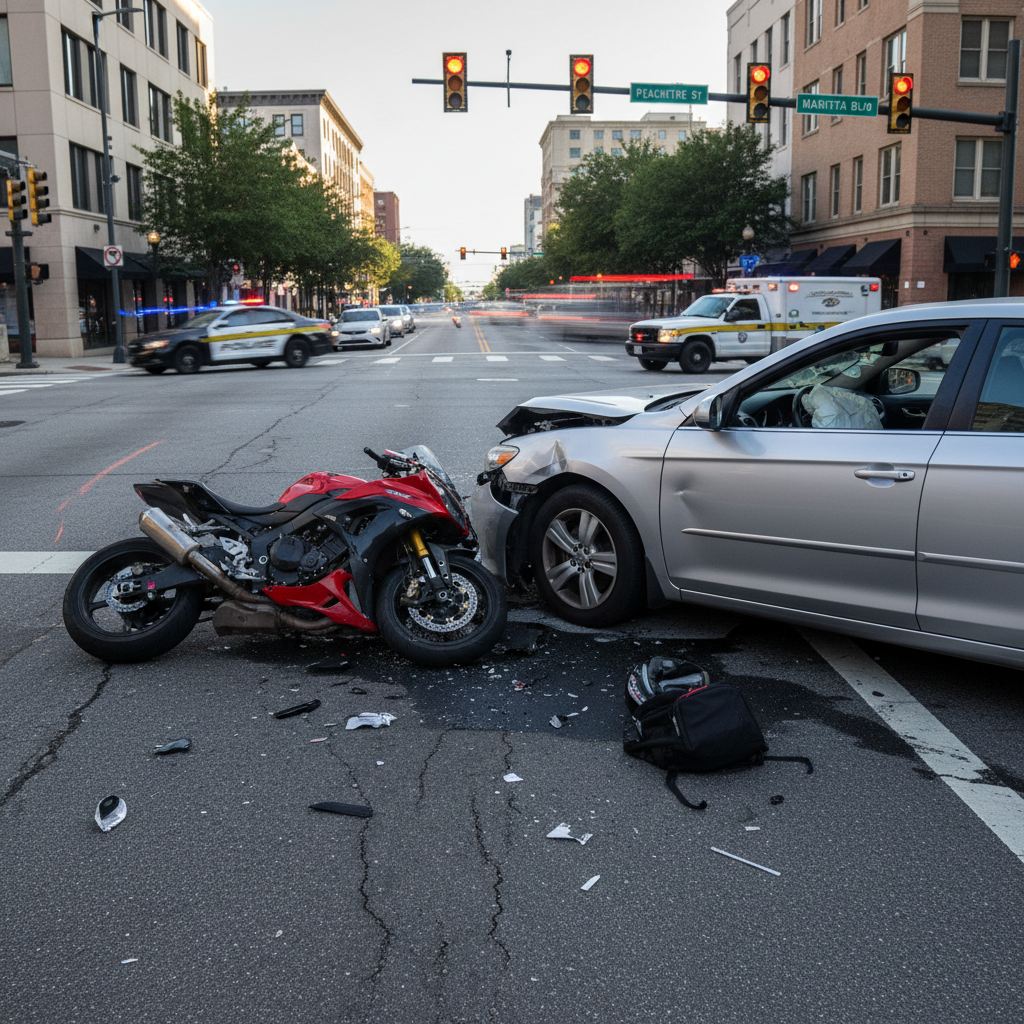
When a motorcycle collides with another vehicle, the rider absorbs the full impact. Common injuries include broken bones, spinal cord damage, traumatic brain injuries, road rash (severe abrasions), and internal bleeding. Many victims spend weeks in the hospital and months in rehabilitation. Some injuries are permanent, affecting earning capacity and quality of life for years.
A motorcycle accident lawyer understands the full scope of motorcycle-related injuries and knows how to calculate damages that reflect long-term medical care, disability, and lost income. Insurance adjusters may only consider immediate hospital costs; your attorney ensures that future care, pain and suffering, and emotional trauma are fully compensated.
Why Insurance Companies Treat Motorcycle Claims Differently
Insurance companies often approach motorcycle accident claims with skepticism. Some adjusters hold a bias against motorcyclists, assuming they are reckless or responsible for their own crashes. This prejudice affects claim valuations and settlement offers.
Motorcycle accident lawyer representation immediately changes this dynamic. When an insurance company sees you have legal counsel, they recognize you’re serious about fair compensation. They stop trying to settle claims cheaply and engage in honest negotiation.
Practical rule: Insurance companies treat motorcycle injury claims differently than car accidents—biases are common. Legal representation shifts negotiations toward fair settlement values.
Head Injuries and Helmets
Even helmeted riders suffer severe head trauma in motorcycle crashes. A helmet reduces the risk of death, but it does not prevent traumatic brain injury, concussions, or spinal injuries. Some victims recover fully; others face permanent cognitive changes, memory loss, or personality shifts.
Proving that a head injury caused by the accident led to long-term disability requires medical experts. Your motorcycle accident lawyer Atlanta will coordinate with neurologists, neuropsychologists, and rehabilitation specialists to document the full extent of the injury and its impact on your life.
Legal Liability in Georgia Motorcycle Accidents
Georgia follows a “modified comparative negligence” rule. This means you can recover damages even if you share some responsibility for the accident—as long as you are less than 50% at fault. However, your recovery is reduced by your percentage of fault.
Determining Fault in Motorcycle Crashes
Establishing fault requires investigating the accident thoroughly. This includes police reports and accident reconstruction, witness statements, traffic camera footage, vehicle maintenance records, and driver background checks for violations or previous accidents.
Many motorcycle crashes involve a car making a left turn in front of the rider, a vehicle changing lanes without checking blind spots, or a driver making an unsafe pass. A motorcycle accident lawyer conducts independent investigations to gather evidence before it disappears.
Georgia’s Negligence Standard
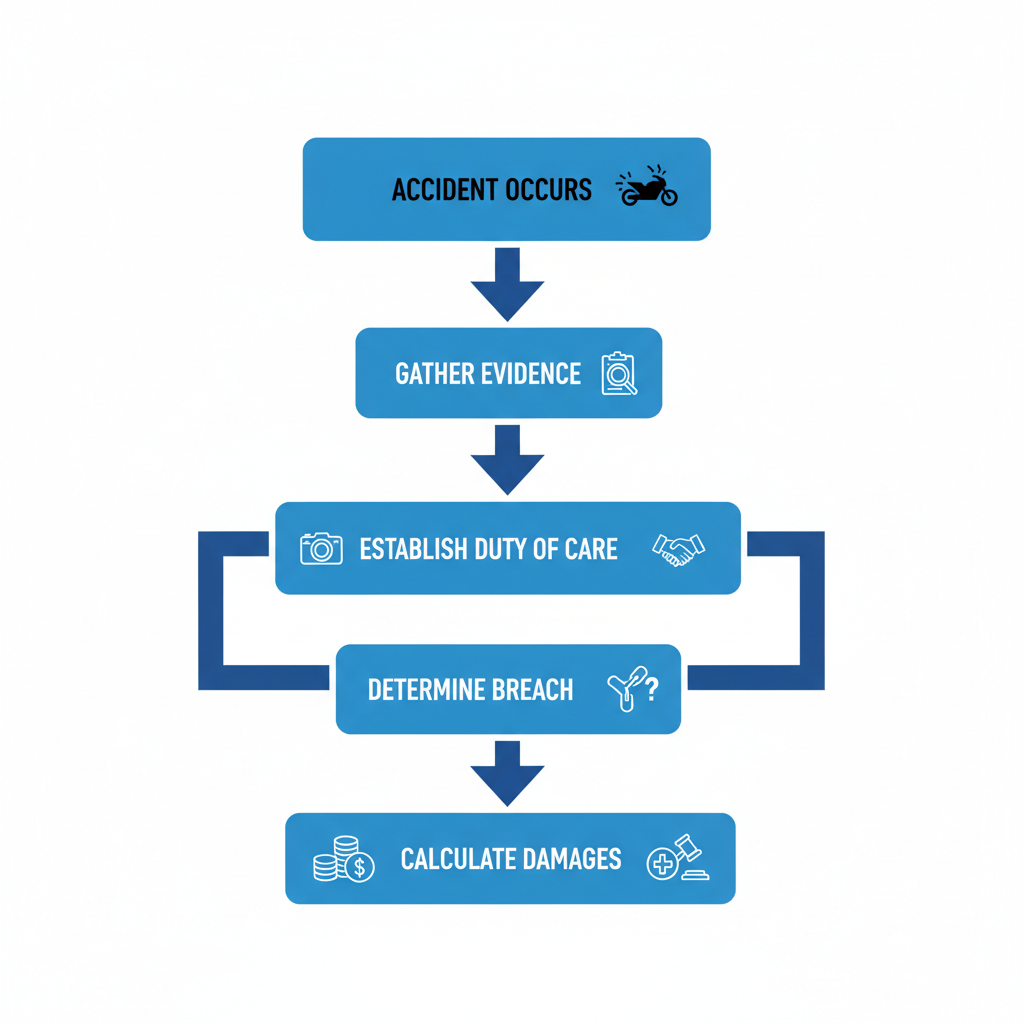
To win a negligence claim in Georgia, you must prove four elements: the defendant owed you a duty of care, the defendant breached that duty, the breach caused your injuries, and you suffered damages.
In motorcycle accidents, the duty of care is straightforward: all drivers must operate their vehicles safely and follow traffic laws. If another driver violated traffic laws or drove recklessly, they likely breached that duty. Your attorney will present evidence of this breach to insurance companies or in court.
Comparative Fault and Your Recovery
If you share some fault—say, you were speeding or not wearing protective gear—the other party’s insurance will argue your fault percentage. Georgia law reduces your recovery proportionally. If you were 20% at fault and your total damages are $100,000, your recovery drops to $80,000.
A motorcycle accident lawyer fights to minimize your fault percentage. Through evidence and expert testimony, they demonstrate that the other driver’s actions were the primary cause of the crash, preserving your maximum recovery.
Practical rule: Georgia’s comparative negligence allows recovery if you’re less than 50% at fault. Your attorney fights to reduce your assigned fault percentage and maximize compensation.
Documenting Your Motorcycle Accident
The moments after a crash are chaotic, but the evidence you gather immediately becomes critical to your claim. Proper documentation protects your rights and strengthens your case.
Evidence to Collect at the Scene
If you’re physically able, collect this information immediately after the crash: other driver’s name, phone number, address, and insurance information; vehicle make, model, color, and license plate; the accident location and time; photos of all vehicle damage from multiple angles; photos of the accident scene, road conditions, traffic signals, and landmarks; contact information from witnesses; and police report number.
Do not admit fault or apologize excessively, even if you think you shared some responsibility. Statements like “I’m sorry” can be used against you later. Stick to facts: “A vehicle turned left in front of me” or “I was in the other driver’s blind spot.”
Medical Documentation
Seek immediate medical care, even if injuries seem minor. Some injuries—internal bleeding, spinal injuries, head trauma—may not be immediately apparent. Medical records create a timeline of your injuries and treatment.
Save all medical documents: emergency room reports and test results, hospitalization records, surgery reports and discharge summaries, physical therapy and rehabilitation notes, doctor’s recommendations for future care, and prescription records.
Medical records are the foundation of your damages claim. They prove the severity of your injuries and the cost of care, which directly translates to compensation.
Practical rule: Document everything after a motorcycle accident: scene photos, witness contact info, police reports, and all medical care. This evidence directly determines claim value.
Types of Damages in Motorcycle Accident Claims
Georgia law allows you to recover several categories of damages for motorcycle accident injuries. Understanding each type helps you recognize when an insurance settlement is fair or when you need to push harder.
Economic Damages
Economic damages are quantifiable costs directly caused by the accident: medical expenses (emergency care, surgery, hospitalization, rehabilitation, ongoing medical treatment, and future care needs); lost wages (income lost during recovery and inability to work); property damage (repair or replacement of your motorcycle); home modifications (wheelchair ramps, accessible bathrooms); and medical equipment (prosthetics, wheelchairs, braces).
These damages are straightforward to calculate because they’re based on receipts, pay stubs, and medical invoices. Insurance companies rarely dispute economic damages if the documentation is clear.
Non-Economic Damages
Non-economic damages address the intangible harm caused by the accident: pain and suffering, emotional distress, loss of enjoyment of life, scarring and disfigurement, and loss of consortium.
Non-economic damages don’t have a receipt, so insurance companies often argue for minimal awards. Your motorcycle accident lawyer works with medical experts to place a dollar value on your suffering, supported by evidence of your pre-accident lifestyle and post-accident limitations.
Punitive Damages (Rare)
If the other driver’s behavior was grossly negligent or intentional—such as driving under the influence or recklessly—you may pursue punitive damages. These are designed to punish the defendant and deter similar conduct, not to compensate you for losses. Punitive damages are uncommon in motorcycle cases but possible when the evidence shows extreme negligence.
Practical rule: Economic damages (medical costs, lost wages) are easily calculated. Non-economic damages (pain, suffering, lost quality of life) require expert valuation and strong evidence.
Insurance and Settlement Issues Specific to Motorcycles
Motorcycle insurance and settlement negotiations have nuances that differ from car accident claims. Understanding these differences protects your financial recovery.
Underinsured and Uninsured Motorist Coverage
Many motorcycle riders carry underinsured motorist (UIM) coverage. If the at-fault driver’s liability insurance is insufficient to cover your damages, your UIM coverage bridges the gap. Georgia requires insurers to offer this protection.
Example: You suffer $150,000 in damages. The at-fault driver has only $25,000 in liability coverage. Your UIM coverage pays the additional $125,000 (minus your deductible). Without UIM coverage, you would lose $125,000.
Check your motorcycle insurance policy immediately after an accident. Confirm your UIM limits and file a claim if the other driver’s insurance is inadequate.
Georgia-Specific Motorcycle Insurance Requirements
Georgia law requires all motorcycle riders to carry liability insurance with minimum limits of $25,000 per person (bodily injury) and $50,000 per accident (bodily injury). Many riders carry only these minimums, leaving injured victims undercompensated if damages exceed policy limits.
Uninsured motorist (UM) and underinsured motorist (UIM) coverage are optional in Georgia but highly recommended. These coverage types protect you if the at-fault driver has no insurance or insufficient insurance. Many motorcycle riders neglect this protection, creating significant financial risk.
Georgia also allows riders to satisfy insurance requirements through self-insurance or a surety bond, though liability insurance is the standard approach. Verify the at-fault driver’s coverage limits immediately after the accident, as this determines the maximum recovery from their policy.
Practical rule: Georgia’s minimum motorcycle liability is $25,000 per person. Check the at-fault driver’s policy limits immediately—they may be insufficient for your damages.
Motorcycle-Specific Settlement Traps
Insurance adjusters sometimes use tactics specific to motorcycle claims: “Motorcycles are inherently dangerous; the rider assumed that risk.” “You weren’t wearing proper protective equipment, so your injuries are your own fault.” “Riders go too fast; you must have been speeding.”
None of these arguments excuse the other driver’s negligence. A motorcycle accident lawyer counters these biases with legal arguments and evidence. Georgia’s comparative negligence law allows recovery even if you share fault, and your equipment choices don’t eliminate the other driver’s duty to avoid hitting you.

Settlement Offers and Negotiation
Insurance companies often make quick, low settlement offers early. These offers rarely cover your full damages. Before accepting any offer, understand the full extent of your injuries and future care needs, all medical expenses and lost income, the pain and suffering experienced, and permanent disabilities or limitations.
A motorcycle accident lawyer negotiates aggressively to increase the settlement offer. They know the true value of your claim and refuse to let insurance companies profit at your expense.
Practical rule: Initial settlement offers from insurers are typically 30-50% below fair value. Your lawyer’s negotiation skills directly increase what you receive.
The Role of a Motorcycle Accident Lawyer
Hiring a motorcycle accident lawyer transforms your recovery from a stressful solo effort into a professionally managed process. Your attorney handles investigation, negotiation, and litigation, allowing you to focus on healing.
Investigation and Evidence Gathering
A lawyer’s first step is a thorough investigation: obtaining police reports and accident reconstruction analysis, interviewing witnesses while memories are fresh, collecting surveillance footage from nearby cameras, subpoenaing vehicle maintenance and inspection records, consulting medical experts to evaluate injury severity, and analyzing insurance policies to identify available coverage.
This investigation often reveals evidence that strengthens your claim. Surveillance footage might show the other driver ran a red light. Maintenance records might prove their vehicle had faulty brakes. These discoveries shift negotiations in your favor.
Negotiation with Insurance Companies
Insurance adjusters negotiate differently when an attorney is involved. They know lawyers will file lawsuits if necessary, so they engage more seriously in settlement discussions. Your attorney calculates your true damages based on medical evidence and legal standards, prepares a detailed demand letter with supporting documentation, negotiates multiple rounds to reach fair value, and advises you when offers fall short of your claim’s worth.
Litigation and Trial Preparation
If insurance negotiations fail, your attorney prepares for trial. This includes filing a lawsuit in Georgia state court, conducting discovery (exchanging evidence with the defendant), taking depositions from witnesses and the defendant, hiring expert witnesses (medical doctors, accident reconstructionists, economists), preparing evidence exhibits and trial strategy, and representing you before a judge and jury.
The threat of trial gives you leverage. Many cases settle at higher values once litigation begins, because defendants and insurers recognize trial costs and risks.
What to Expect in the Recovery Process
Motorcycle accident recovery involves medical healing, legal process, and financial recovery. Understanding the timeline reduces stress and sets realistic expectations.
Immediate Aftermath (Days to Weeks)
You’ll likely be hospitalized and undergoing urgent treatment. Focus on medical care. Your lawyer handles initial investigation and begins gathering evidence. You’ll provide your account of the accident to police and your attorney.
Medical Treatment and Rehabilitation (Weeks to Months)
Recovery from motorcycle injuries is often long. Physical therapy, surgery, medication adjustments, and specialist consultations consume this phase. Keep detailed records of all medical visits, expenses, and work absences. Your lawyer uses this documentation to calculate damages.
Insurance Negotiation (Months)
Your attorney gathers all medical records and begins negotiations with the insurance company. This phase involves exchanging documentation, discussing liability, and proposing settlement amounts. Many cases settle during this phase without trial.
Settlement or Litigation (Months to Years)
If negotiations succeed, you receive a settlement check. If not, your attorney files a lawsuit. Litigation can take one to three years, but many cases settle once the discovery process begins. Your attorney keeps you informed of progress and developments.
Post-Settlement Life
Once settled or awarded damages, you receive compensation. Your attorney deducts their fees (typically 33% of the recovery) and reimburses medical lien holders and outstanding bills. The remaining funds are yours to cover medical care, replace lost income, and move forward.
Types of Motorcycle and Impact on Injuries
The type of motorcycle matters when calculating injury severity. A lightweight sport bike offers minimal protection compared to a heavy cruiser or touring motorcycle. The rider’s position varies significantly: sport bikes position riders in a forward-leaning posture, cruisers in an upright position, and touring bikes in a more protected seated posture.
Speed and impact angles differ by motorcycle type. Sport bikes accelerate quickly and are often involved in high-speed collisions. Cruisers are heavier, transferring more momentum to the rider on impact. Touring motorcycles, with passengers and cargo, create different weight dynamics and injury patterns.
Your motorcycle accident lawyer Atlanta considers these factors when arguing injury severity. The type of motorcycle and how the collision occurred directly influence whether injuries are catastrophic or moderate.
Practical rule: The motorcycle type and riding position affect injury patterns. Sport bikes create different crash dynamics than cruisers or touring models.
FAQ: Motorcycle Accident Claims in Georgia
| Question | Answer |
|---|---|
| How long do I have to file a motorcycle accident lawsuit in Georgia? | Georgia’s statute of limitations is two years from the date of the accident. File sooner rather than later—evidence degrades and witnesses’ memories fade. |
| Will I lose my motorcycle if I file a claim? | No. Compensation for property damage (your motorcycle) is separate from personal injury damages. You can replace your bike without affecting your injury claim. |
| What if the other driver has no insurance? | Georgia law requires all drivers to carry liability insurance or post a bond. If uninsured, you can pursue your own uninsured motorist coverage or file a civil lawsuit directly. |
| Can I recover damages if I was partially at fault? | Yes. Georgia’s modified comparative negligence rule allows recovery if you are less than 50% at fault. Your recovery is reduced by your percentage of responsibility. |
| How much is my motorcycle accident claim worth? | Claim value depends on medical expenses, lost income, severity of injury, and non-economic damages like pain and suffering. Your attorney evaluates these factors and determines realistic settlement range. |
| Do I have to go to trial? | No. Most cases settle. Your attorney negotiates aggressively, but you retain the right to reject offers and pursue trial if terms are unfair. |
Understanding Settlement Calculations and Cost Breakdown
Motorcycle accident damages break down into specific cost categories. Medical expenses might total $75,000 (emergency care, hospitalization, surgery, rehabilitation). Lost wages might be $30,000 (6 months unable to work at $5,000/month). Pain and suffering is often calculated as 2-5x medical expenses, so $150,000-$375,000 for a severe case. Property damage (motorcycle replacement) might be $15,000.
A total damages calculation for a moderate-to-severe accident might be: Medical $75,000 + Lost Wages $30,000 + Pain/Suffering $200,000 + Property $15,000 = $320,000. Insurance companies initially offer 40-50% of this amount ($128,000-$160,000). Your attorney negotiates to increase this toward the full calculation.
Complex cases with permanent disability multiply these numbers significantly. A rider with spinal injury requiring lifelong care might have total damages exceeding $1 million when factoring in future medical care, home modifications, and lost earning capacity over a lifetime.
Your motorcycle accident lawyer Atlanta calculates these detailed cost projections and uses them as leverage in settlement negotiations. Insurance companies take settlements more seriously when they see comprehensive damage calculations backed by medical evidence.
Getting Full Compensation After a Motorcycle Accident
The path to full compensation after a motorcycle crash requires expert legal representation. Insurance companies profit when they minimize payouts to injured riders. A motorcycle accident lawyer Atlanta ensures you’re not shortchanged on the damages you’ve earned through your suffering.
From evidence gathering to trial preparation, your attorney navigates every step of the legal process. They counter insurance company tactics, fight for fair valuations of your pain and suffering, and negotiate or litigate to maximize your recovery.
If you’ve been injured in a motorcycle accident in Georgia, contact Humphrey & Ballard Law today. Call (404) 446-9854 or visit our contact page to schedule your free consultation. We’re here to fight for you.
About Humphrey & Ballard Law
Humphrey & Ballard Law is a personal injury law firm serving the Atlanta area. Led by principals Desmond Humphrey and David Ballard, the firm specializes in motorcycle accidents, car crashes, truck collisions, and catastrophic injury cases. With extensive experience in Georgia litigation, the firm recovers maximum compensation for injured clients and families. Located in Atlanta, Humphrey & Ballard Law serves clients throughout Georgia.
