A soft tissue injury settlement Georgia crash victims receive typically ranges between $2,500 and $25,000 for standard claims. Severe cases reach $100,000 or more in financial recovery. As a former prosecutor, I have watched insurance carriers minimize these claims for years. Victims often assume sprains and strains carry low monetary worth. That is exactly what insurance companies want you to believe. Your total payout depends on medical evidence, lost pay, and treatment consistency. Understanding how insurers evaluate a soft tissue injury settlement Georgia claim helps you fight back effectively. Here is how we maximize your recovery.
What Counts as a Soft Tissue Injury
Soft tissue injuries involve damage to muscles, ligaments, and tendons throughout your body. Unlike broken bones, these injuries do not always appear on standard X-rays. Insurance defense teams exploit this lack of visible proof to delay payouts.
Establishing proof of soft tissue damage requires immediate medical care and detailed clinical evaluations. Doctors document localized tenderness, muscle guarding, and restricted mobility during physical examinations. These clinical notes create an objective paper trail that insurance representatives cannot ignore.
Whiplash and Neck Sprains
Whiplash occurs when your head snaps backward and forward violently during a crash. This sudden motion strains cervical muscles and tears surrounding spinal ligaments. A typical whiplash settlement covers immediate emergency care and follow-up physical therapy sessions.
Symptoms like neck stiffness, severe headaches, and shoulder pain often surface hours after impact. Insurers frequently argue that delayed pain means your injury happened somewhere else. Immediate medical evaluation defeats this defense strategy immediately.
Practical rule: Visit an emergency room or urgent care clinic within twenty-four hours of your collision.
Lumbar Strains and Back Pain
Lumbar strains happen when impact forces stretch or tear lower back muscle fibers. Victims experience severe muscle spasms, reduced mobility, and constant lower back soreness. These injuries frequently stem from a sudden Georgia car accident impact.
Treating back strains requires chiropractic adjustments, pain medications, and physical rehabilitation. If your lumbar pain lasts for months, your total medical bills will rise significantly. Higher medical costs directly increase your overall injury claim value.
Deep Muscle Contusions and Bruising
Deep muscle contusions occur when blunt force crushing damages inner muscle fibers and blood vessels. Heavy impact against steering wheels, doors, or seatbelts causes severe internal bruising. These injuries cause intense localized pain and skin discoloration.
Severe contusions can lead to internal bleeding or tissue swelling known as compartment syndrome. Doctors must monitor severe bruising to rule out permanent muscle damage. Documenting every bruise with photos builds strong evidence for your personal injury compensation claim.
Ligament Tears and Tendonitis
Sprains involve stretched or torn ligaments, while strains affect torn muscle fibers and tendons. Partial ligament tears in knees, shoulders, or wrists take many months to heal completely. Some severe tears require surgical intervention to restore full joint stability.
Chronic inflammation or tendonitis often develops after acute soft tissue trauma. Medical specialists use detailed MRI scans to detect hidden soft tissue tears. Clear objective imaging prevents an insurance adjuster from dismissing your pain as minor. Advanced procedures significantly increase your final soft tissue injury settlement Georgia payout.
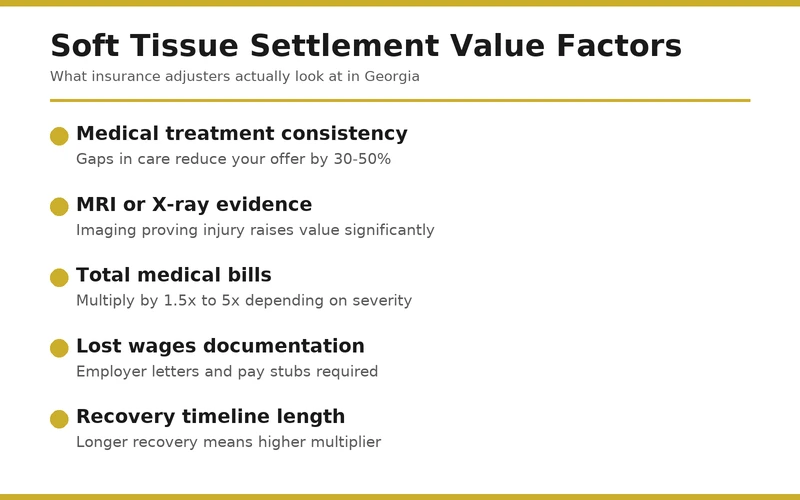
How Georgia Settlement Values Are Calculated- Medical treatment consistency: gaps in care reduce offers by 30-50%
- MRI or X-ray evidence: imaging proving injury raises value
- Total medical bills: multiply by 1.5x to 5x based on severity
- Lost wages documentation: employer letters and pay stubs required
- Recovery timeline: longer recovery means higher multiplier
Calculating injury payouts requires evaluating both economic and non-economic losses. Georgia law permits crash victims to seek complete financial recovery from negligent drivers. Under O.C.G.A. Title 51 Chapter 12, injured parties can recover all proven damages.
Insurers rely on strict calculation rules designed to limit their corporate financial exposure. Understanding how adjusters divide your claim helps us build a solid evidentiary foundation. Methodical preparation forces the insurance carrier to evaluate your claim at its true worth.
Medical Specials and Out-of-Pocket Expenses
Economic damages begin with your total quantifiable medical expenses. This includes ambulance fees, emergency room medical bills, chiropractic care, and physical therapy sessions. Every dollar spent treating your crash injuries counts toward your economic recovery.
Out-of-pocket costs like prescription drugs and medical equipment also build your total bill. Keep every receipt and billing statement from your medical providers. Accurately tracking expenses establishes a firm baseline for your final soft tissue injury settlement Georgia payout.
Pain and Suffering Multiplier Method
Insurance companies apply a multiplier to your medical expenses to estimate non-economic pain. For mild soft tissue injuries, they multiply total treatment costs by 1.5 to 2. Moderate or severe injuries receive multipliers ranging from 3 to 5 times totals.
An insurance adjuster attempts to keep this multiplier as low as possible. They claim soft tissue trauma causes minimal disruption to your daily life. Detailed daily pain journals help our team fight for a higher multiplier calculation.
Practical rule: Keep a daily journal detailing your physical pain and daily activity limitations after the crash.
Lost Wages and Property Damage
If neck or back pain keeps you away from work, you can recover lost income. Your claim includes missed regular hourly pay, lost overtime earnings, and used paid time off. Employer pay stubs and tax records prove your full wage loss amount.
Property damage repair costs reflect the physical impact severity of your car collision. High vehicle repair bills help demonstrate the heavy forces exerted on your body. You can review national crash data through the National Highway Traffic Safety Administration to understand impact dynamics. Strong vehicle damage proof directly boosts your overall injury claim value.
Comparative Fault Rules Under Georgia Law
Georgia follows a modified comparative negligence system for personal injury disputes. Under state law, you can recover damages if you are less than fifty percent at fault. However, your total payout decreases by your specific percentage of fault.
If an insurance adjuster proves you were twenty percent responsible, your payout drops by twenty percent. Defense lawyers love using comparative fault to cut settlement payouts. Proving the other driver was entirely responsible protects your final soft tissue injury settlement Georgia check.
Realistic Settlement Ranges for Soft Tissue Cases
Every injury case presents a unique combination of crash facts and medical treatment history. Historical Georgia payout data shows clear settlement tiers based on injury severity. Knowing typical ranges keeps your expectations realistic during settlement negotiations.
- Emergency room visit: initial diagnosis within 72 hours of the crash
- Follow-up appointments: consistent visits every 2-4 weeks
- Physical therapy: documented sessions with a licensed therapist
- Pain management: prescriptions and injections if needed
- Final evaluation: maximum medical improvement before settlement
An insurance adjuster wants you to accept quick settlement offers before you understand your long-term prognosis. Never sign a full liability release while receiving medical care. Here is the realistic settlement range for most soft tissue claims.
Minor Soft Tissue Injury Claims ($2,500 to $10,000)
Minor claims involve simple sprains or strains that resolve fully within four to six weeks. Victims usually require an urgent care visit, basic medication, and physical therapy sessions. Total medical bills in these minor cases rarely exceed $3,000.
A minor soft tissue injury settlement Georgia payout covers all medical bills and modest pain compensation. Expect an offer between $2,500 and $10,000 when healing finishes quickly without complications. Quick claims resolve fast, but you must ensure all symptoms have cleared entirely.
Moderate Soft Tissue Injury Claims ($10,000 to $30,000)
Moderate claims involve severe muscle tears, persistent neck pain, or intense lumbar back sprains. Treatment extends over several months and requires chiropractic adjustments or continuous physical therapy. Medical costs in this category typically fall between $4,000 and $10,000.
A moderate soft tissue injury settlement Georgia payout usually lands between $10,000 and $30,000. These settlements reflect longer recovery periods and higher total wage losses. Having consistent medical treatment records is essential to secure payouts in this upper settlement range.
Severe Soft Tissue Injury Claims ($30,000 to $100,000+)
Severe soft tissue injuries cause debilitating chronic pain, nerve root compression, or disc bulges. Patients often need spinal epidural injections or specialized pain management treatment. Total medical bills frequently exceed $15,000 or $20,000 in these serious cases.
A severe soft tissue injury settlement Georgia package can reach $30,000 to $100,000 or more. When soft tissue trauma prevents you from working, your total compensation increases significantly. Our legal team aggressively pursues full personal injury compensation for severe ongoing physical limitations.
Practical rule: Complete every recommended physical therapy session before discussing final settlement numbers with insurers.
High-Value Claims with Permanent Physical Impact
Some soft tissue injuries result in permanent tissue scarring or chronic regional pain syndrome. When doctors confirm permanent impairment, your injury claim value increases dramatically. Long-term medical care requirements add substantial future economic costs to your claim.
You can learn more about severe soft tissue trauma on the American Academy of Orthopaedic Surgeons educational portal. Permanent injuries demand expert medical testimony to prove lifelong physical limitations. Objective expert testing converts disputed injuries into an elevated soft tissue injury settlement Georgia payout.
What Insurance Adjusters Do With Soft Tissue Claims

An insurance adjuster is a trained corporate negotiator whose primary job is protecting company profits. They do not work for you, and they do not want to pay full value. Understanding their internal methods allows us to counteract their strategies step by step.
Adjusters operate under strict quarterly targets set by insurance corporate executives. Their success is measured by how little money they pay out on valid injury claims. Knowing internal corporate pressures helps us structure demands that force them to negotiate fairly.
The Colossus Software System Strategy
Most major insurance companies use automated software like Colossus to value injury claims. Adjusters enter medical codes, crash details, and treatment durations into the computer system. The software then outputs a rigid settlement range based on strict corporate algorithms.
Software programs intentionally undervalue subjective pain descriptions and soft tissue damage symptoms. An insurance adjuster cannot exceed software limits without higher management approval. Documenting specific symptoms like muscle spasms converts low computer estimates into a substantial soft tissue injury settlement Georgia payout.
Delayed Treatment and Gap Arguments
If you wait several days to see a doctor after a crash, insurers take advantage. Every insurance adjuster looks for treatment gaps to argue your injuries were not severe. They may even claim you got hurt in an unrelated event days later.
According to health statistics from the Centers for Disease Control and Prevention, early injury diagnosis improves recovery outcomes. Continuing medical care without missed appointments deprives insurers of their favorite defense argument. Consistent treatment records make your injury claim virtually impossible to dismiss.
Pre-Existing Condition Defense Tactics
An insurance adjuster routinely obtains past medical records to search for prior back or neck pain. They will claim your current pain stems entirely from aging or prior workplace accidents. This is one of the oldest insurance tactics in the book.
Georgia law protects injury victims through the eggshell plaintiff rule. If a Georgia car accident aggravates a pre-existing condition, the at-fault driver remains fully responsible for that worsening. Highlighting new physical symptoms defeats the pre-existing condition defense line effectively.
Factors That Raise or Lower Your Settlement
Small details in your medical records and crash report can alter your final payout. Knowing which factors help or harm your claim enables you to take smart actions early. Here are key elements that influence your final monetary recovery.
- Whiplash: $2,500 to $10,000 for minor cases, up to $25,000 with ongoing symptoms
- Cervical sprain: $5,000 to $30,000 depending on treatment duration
- Lumbar strain: $5,000 to $40,000 with MRI evidence
- Herniated disc: $50,000 to $100,000 if surgery is required
Building a successful injury claim requires proactive evidence gathering from day one. I advise clients to focus on objective facts rather than emotional arguments. Strong physical proof always drives higher insurance settlement payments.
Immediate and Consistent Medical Care
Prompt medical care immediately following your accident creates an undeniable link to the crash. Following your doctor’s orders shows that you are actively trying to recover. Missing therapy sessions or skipping doctor appointments severely damages your legal position.
If you stop treatment prematurely, an insurance adjuster will assume you have recovered completely. Always consult your treating physician before ending physical therapy or chiropractic treatments. Continuous medical records demonstrate the real physical impact of your soft tissue damage. Strong medical proof keeps your soft tissue injury settlement Georgia claim resilient.
Practical rule: Never skip scheduled doctor visits or physical therapy appointments during an open injury claim.
Objective Diagnostic Testing and Doctor Notes
While standard X-rays miss soft tissue damage, advanced MRIs and CT scans reveal deep muscle tears. Objective imaging offers visible proof that an insurance adjuster cannot easily dismiss or ignore. You can review medical imaging standards on the Mayo Clinic whiplash diagnosis guidelines page.
Detailed physician notes regarding your reduced range of motion also strengthen your position. When a doctor records objective physical restrictions, your claim gains substantial credibility. Clear doctor testimony leaves the insurance carrier with zero room to dispute your claim.
Credibility and Clear Vehicle Damage Proof
Your personal credibility plays a major role during settlement negotiations with insurance representatives. Honest, consistent statements about your pain levels encourage fair settlement offers. Exaggerating symptoms or giving conflicting reports will destroy your claim credibility quickly.
Photographs showing severe vehicle damage provide strong visual support for soft tissue claims. Heavy bumper impact photos prove that powerful physical forces caused your spinal trauma. Strong physical evidence forces an insurance adjuster to offer maximum financial settlements.
What to Do If the Adjuster Calls Your Injury ‘Minor’

Adjusters frequently call neck sprains or back strains minor to justify initial low payouts. They hope you will accept a quick thousand dollars before understanding your full medical costs. Do not let an insurance adjuster dictate the true value of your physical suffering.
I have seen insurers use this aggressive posture to pressure unrepresented crash victims daily. You do not have to accept their low opinions or low offers. Here is how you respond when an insurance adjuster minimizes your soft tissue pain.
Reject the Initial Lowball Settlement Offer
The initial settlement offer from an insurance company is almost always a low estimate. Adjusters test victims to see if they are desperate or uninformed about rights. Accepting a quick check closes your claim forever, even if your pain worsens later.
Politely decline initial low offers in writing and state that your medical care continues. Never sign liability waivers until your doctor releases you from care. Patience and firm negotiation always yield a higher final soft tissue injury settlement Georgia payout.
Gather Full Medical and Financial Records
Fight low offers by presenting detailed documentation of every crash expense and loss. Collect complete hospital medical bills, prescription receipts, therapy invoices, and employer wage loss verification forms. Organize all documents chronologically to build a clear, compelling financial paper trail.
Include medical narrative letters from your treating physicians explaining your long-term prognosis. Detailed physician statements linking your pain directly to the collision defeat insurance arguments. Objective financial and medical evidence forces adjusters to recalculate settlement limits.
Hire a Strategic Atlanta Personal Injury Attorney
Insurance companies treat represented claimants very differently than unrepresented accident victims. When an experienced Atlanta personal injury lawyer takes your case, adjusters know litigation is possible. They immediately take your settlement demands much more seriously.
Our firm handles all insurance communications so you can focus on physical recovery. We analyze insurance coverage, gather crash evidence, and build undeniable legal demands. An experienced attorney protects you from aggressive insurance adjuster tactics at every step. Hiring counsel maximizes your soft tissue injury settlement Georgia payout.
Practical rule: Forward all insurance company calls directly to your attorney once legal representation begins.
Getting Legal Help for a Soft Tissue Claim
Handling an insurance dispute on your own often leaves significant money on the table. Insurers rely on technical legal procedures to delay, deny, or reduce legitimate claims. Professional legal assistance levels the playing field against wealthy insurance corporations.
| Factor | Impact on Value |
| Treatment gaps over 30 days | Reduces settlement by 30-50% |
| No MRI or imaging | Reduces settlement by 20-40% |
| Pre-existing condition | Reduces unless aggravation is documented |
| Permanent injury documentation | Increases settlement by 50-100% |
| Attorney representation | Increases average offer by 3-4x |
At our firm, we apply my background as a prosecutor to outthink defense strategies. We anticipate insurer arguments before they make them and prepare counter-evidence immediately. Partnering with a skilled attorney ensures your rights remain fully protected throughout the process.
How Legal Representation Increases Settlement Value
Industry statistics show that accident victims represented by lawyers receive higher average payouts. Attorneys know how to calculate full future medical expenses and hidden wage losses. We also pursue non-economic damages like emotional stress with an experienced Atlanta emotional distress attorney approach.
We present clear legal arguments that demonstrate real court risk to the insurance company. When adjusters realize we are ready for trial, settlement offers increase significantly. Legal representation turns unfair insurance offers into maximum personal injury compensation packages. Proper counsel secures a higher soft tissue injury settlement Georgia recovery.
What Our Legal Team Does to Build Your Case
Our team conducts a thorough investigation into your accident from the moment you hire us. We secure police accident reports, interview witnesses, and preserve vital crash scene evidence. If you suffered injuries in an auto collision, our Atlanta car accident lawyer team takes action.
We coordinate directly with your medical providers to obtain complete medical billing records. Our staff builds a detailed settlement demand package detailing all physical losses. We fight tirelessly until you receive every dollar state law allows.
Contingency Fee Structure and No Upfront Costs
Many crash victims worry about legal costs associated with hiring a law firm. We operate strictly on a contingency fee basis, meaning you pay zero upfront costs. You never owe us legal fees unless we successfully win your settlement payout.
Our law firm advances all necessary case expenses, including medical record retrieval fees. This fee structure allows you to fight powerful insurance companies without financial risk. You can focus entirely on your health while we fight for your financial recovery.
Frequently Asked Questions About Georgia Soft Tissue Claims
Here are answers to common questions crash victims ask about soft tissue settlements in Georgia.
| Question | Answer |
|---|---|
| What is average soft tissue settlement value? | Most minor to moderate claims range between $2,500 and $30,000 based on total medical bills. |
| How long do soft tissue claims take? | Most claims resolve within three to nine months after completing all required medical care. |
| Can I recover damages without an MRI? | Yes, doctor notes, physical therapy records, and diagnostic notes support valid injury claims. |
| What if I had prior back pain? | Georgia law allows compensation if the crash aggravated or worsened your pre-existing condition. |
| Should I give a recorded statement? | No, an insurance adjuster uses recorded statements to undermine your claim. Speak with an attorney first. |
| How long do I have to file a claim? | Georgia has a two-year statute of limitations for personal injury claims following an accident. |
| Will my case go to trial? | Over ninety percent of soft tissue claims settle through negotiations without going to trial. |
Maximizing Your Soft Tissue Claim Value in Georgia
Winning a fair soft tissue injury settlement Georgia payout requires strategic action, complete medical proof, and firm negotiation. Do not let insurance companies undervalue your pain or rush you into a low payout. Attorney David Ballard and the team at Humphrey & Ballard Law know how to hold insurers accountable. Call our office today at (404) 446-9854 or visit our contact page to schedule your free consultation.
About David Ballard
David Ballard is a former Atlanta prosecutor who switched to the plaintiff’s side. He has seen exactly how insurance carriers build their arguments to minimize soft tissue claims because he used to be on the other side. As co-founder of Humphrey & Ballard Law, David brings tactical, inside knowledge to every case. Our firm serves injury victims across College Park, South Fulton, East Point, Fairburn, Riverdale, and throughout Georgia.
