Under negligence per se Georgia law, violating a safety statute automatically breaches a driver’s legal duty on the road. When a motorist breaks a traffic rule, you do not need to prove they acted carelessly. Georgia courts view the statutory breach as immediate proof of unreasonable driving conduct. This legal doctrine simplifies your lawsuit by focusing disputes directly on your injuries and financial losses. It prevents insurance adjusters from claiming the car crash was an unavoidable accident. Knowing how this statutory doctrine works gives you significant legal strength when negotiating fair settlement demands.
What Negligence Per Se Means Under Georgia Law
In standard personal injury lawsuits, plaintiffs must prove that a motorist failed to act safely. Under negligence per se Georgia rules, breaking a safety law changes that standard legal process.
The law presumes the driver acted negligently because they violated a written traffic statute. You do not need to debate what a cautious driver would do in that situation. The safety statute sets the legal standard of safety for everyone on the road.
The Legal Definition of Statutory Violations
A statutory violation occurs when a motorist disobeys a codified state law or municipal ordinance. Georgia statutes exist specifically to protect drivers, passengers, and pedestrians from physical harm.
When a driver breaks one of these laws, they commit a clear legal breach. That breach serves as immediate proof of automatic negligence in a civil lawsuit.
In my years advocating for Atlanta injury victims, I have seen how traffic citations shape civil cases. That same ticket creates immediate legal strength when someone breaks a law and hurts you.
How Statutory Duty Differs From Common Law Negligence
Common law negligence requires proving that a driver violated a general duty of care. You must convince a jury that the driver exercised poor judgment while driving.
Statutory claims under negligence per se Georgia precedent eliminate that subjective legal argument entirely. The state legislature has already established that specific conduct is inherently dangerous.
If the at fault driver broke a safety law, courts recognize the breach immediately. The injured victim does not have to construct a custom safety rule from scratch.
Why Traffic Safety Laws Create Automatic Legal Standards
Traffic safety codes establish mandatory conduct rules for all motor vehicle operators. These statutes exist specifically to prevent highway collisions and catastrophic bodily injuries.
When a driver ignores a red signal, they violate a clear statutory safety standard. That violation creates automatic negligence in the eyes of Georgia courts.
The driver cannot argue they were driving carefully while running a red light. The law deems the violation inherently dangerous to the general public.
The Purpose of Georgia Safety Statutes
Georgia safety statutes protect public highways from predictable traffic hazards. Lawmakers passed these acts to shield motorists and pedestrians from preventable motor vehicle crashes.
When a traffic offense occurs, the statute provides a clear blueprint for civil liability. You can view official state statutes on the Georgia Code website.
Courts enforce these safety rules strictly under negligence per se Georgia doctrine to keep roadways safe. A driver who violates traffic statutes must face full legal responsibility for resulting damages.
Practical rule: A broken traffic law replaces the need to prove basic legal fault in Georgia courtrooms.
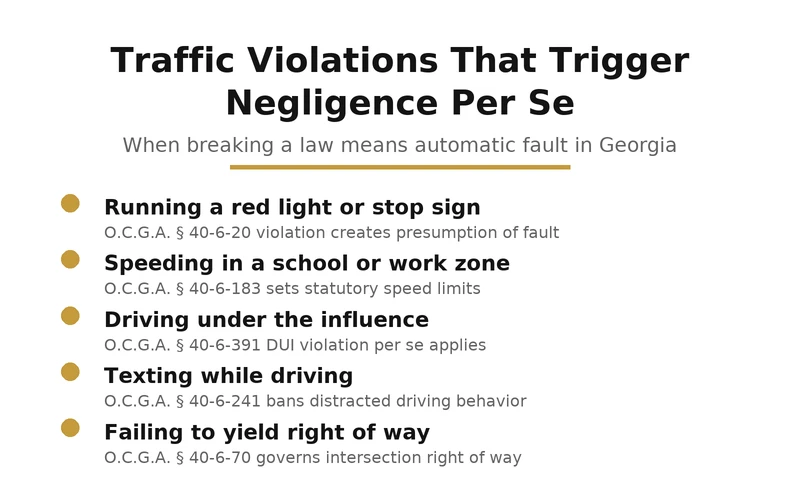
How Georgia Courts Apply the Negligence Per Se Rule- Running a red light: O.C.G.A. 40-6-20 creates an automatic duty violation
- Speeding in school zones: O.C.G.A. 40-6-183 sets statutory limits
- DUI violations: O.C.G.A. 40-6-391 triggers negligence per se
- Texting while driving: O.C.G.A. 40-6-241 prohibits distracted driving
- Failure to yield: O.C.G.A. 40-6-70 governs right of way
Georgia courts follow a structured legal framework when applying negligence per se Georgia principles. Judges review specific criteria before granting automatic legal liability status.
You must establish that the violated statute intended to prevent your specific harm. You must also prove that you belong to the class of protected individuals.
Proving the Statute Intended to Prevent Your Specific Injury
Not every broken traffic law automatically creates civil liability for an injury. The violated statute must exist to prevent the specific type of collision that occurred.
For example, posted speed limits prevent high speed impact collisions and severe physical trauma. If speeding causes a crash, the statute directly matches the harm produced.
Courts analyze statutory intent under O.C.G.A. § 51-1-6 legal guidelines. The injured party must demonstrate a direct link between the statutory purpose and their harm.
Demonstrating You Fall Within the Protected Class of Persons
The injured victim must belong to the exact group the safety statute protects. Georgia traffic laws protect motorists, vehicle passengers, bicycle riders, and pedestrians using public roads.
If you were crossing in a marked crosswalk, pedestrian safety statutes protect you directly. The driver owed you a statutory duty when approaching that roadway intersection.
Establishing protected status is straightforward in an Atlanta car accident lawsuit. Anyone lawfully on public roads falls within the protected class of individuals.
Establishing Direct Cause Between the Breach and Your Harm
Automatic legal fault does not eliminate the requirement to establish proximate causation. You must prove the statutory violation directly produced your personal physical injuries.
If a driver ran a red light and struck your car, legal causation is clear. The illegal intersection entry directly caused the violent side impact collision.
Insurance defense lawyers often try to sever the connection between the violation and harm. You need solid medical records and physical evidence to defeat those defense arguments.
The Role of Police Citations and Traffic Court Guilty Pleas
A police officer issuing a citation at the crash scene provides valuable evidence. However, the ticket alone does not automatically settle your civil lawsuit.
If the cited driver pays the fine or pleads guilty, that plea becomes admissible evidence. A guilty plea in traffic court acts as a formal admission of legal fault.
I have spent years in Atlanta courtrooms fighting for people hurt by reckless drivers. Obtaining a certified copy of a guilty plea solidifies your civil position under negligence per se Georgia rules when a personal injury claim Georgia case goes forward. A certified copy of a guilty plea solidifies your civil position under negligence per se Georgia rules.
Practical rule: Always obtain certified traffic court disposition records to confirm a driver’s guilty plea.

Traffic Violations That Trigger Automatic Legal Liability
Certain roadway offenses frequently form the foundation for negligence per se Georgia injury claims. State statutes clearly define illegal driving behaviors across Georgia highways.
- Statute exists: Georgia law specifically prohibits the defendant’s conduct
- Violation occurred: the defendant broke that specific law
- Causation: the violation directly caused your injuries
- Excuse analysis: the defendant had no legally valid excuse
When drivers violate these specific codes, they create immediate traffic violation liability. Official police reports and witness testimony document these infractions for trial presentation.
Running Red Lights and Stop Signs Under Georgia Code
Disobeying traffic control devices directly violates state highway safety laws. Drivers must stop completely at red lights and posted stop sign intersections.
Failing to yield right of way causes devastating broadside and angle collisions. You can review safety data on the Georgia Governor’s Office of Highway Safety portal.
An officer citing a driver for running a red light helps establish instant fault. That citation supports a strong demand for full medical expense reimbursement.
Driving Under the Influence of Alcohol or Drugs
Operating a vehicle while impaired is one of the most dangerous traffic offenses. Georgia enforces strict blood alcohol concentration limits for all vehicle operators.
A DUI conviction creates undeniable traffic violation liability under Georgia civil statutes. Impaired drivers endanger everyone sharing the road with them.
DUI cases also allow injured victims to seek punitive damages under state law. These financial awards punish drunk drivers and increase your overall settlement value.
Distracted Driving and Hands Free Law Infractions
Georgia enforces a strict Hands Free Law prohibiting mobile phone use while driving. Holding a phone while operating a motor vehicle violates state traffic codes.
Distracted drivers frequently fail to brake before causing severe rear end crashes. National statistics from NHTSA emphasize the extreme dangers of mobile device distractions.
Subpoenaed mobile phone records can prove a driver was texting before the collision. That statutory violation establishes automatic legal responsibility for your recovery under negligence per se Georgia principles.
Excessive Speeding and Following Too Closely Violations
Speeding reduces stopping distance and increases crash impact severity significantly. Drivers who exceed speed limits violate Georgia traffic laws.
Following too closely violates Georgia law when drivers tailgate preceding vehicles. Rear end collisions caused by tailgating trigger automatic legal responsibility.
Commercial vehicle operators must follow strict speed and following distance rules. You can learn more through an Atlanta truck accident lawyer at our office.
Practical rule: Cell phone records and vehicle data recorders provide undeniable proof of statutory driving violations.
When the Negligence Per Se Doctrine Does Not Apply

Not every car crash qualifies for negligence per se Georgia application. Defense attorneys work hard to find legal exceptions that excuse their client’s citation.
Understanding these legal exceptions helps protect your personal injury claim Georgia rights. We know how defense lawyers attempt to bypass statutory fault rules, and we prepare for every excuse they raise.
Statutory Exceptions and Sudden Legal Emergencies
A driver may avoid automatic negligence if an unforeseeable emergency occurred. For example, a sudden mechanical failure might prevent stopping at a red light.
Sudden medical emergencies like heart attacks can also create valid legal defenses. The driver must prove the medical event was completely unexpected and unpreventable.
Insurance carriers abuse these emergency exceptions to deny legitimate injury claims. We investigate these defenses thoroughly to expose false emergency claims.
Violations That Do Not Directly Cause Collision Damages
A driver might break a law without causing the actual vehicle crash. For instance, driving with an expired vehicle registration tag is a legal infraction.
However, an expired registration tag does not cause an intersection crash. The court will not apply statutory fault for irrelevant traffic infractions.
There must be a direct causal link between the violation and your harm. Without direct causation, you must prove fault through traditional legal evidence.
Comparative Fault Defenses Used by Insurance Counsel
Georgia uses a modified comparative fault rule under state law statutes. An insurance company will claim you shared partial fault for the accident.
If you were speeding, the insurer will argue you contributed to the crash. If your fault reaches fifty percent, you cannot recover financial compensation.
Even with a statutory violation, comparative fault claims can reduce total compensation. You must defeat these comparative fault arguments to protect your recovery.
Practical rule: Insurers use comparative fault claims to weaken automatic fault benefits after a traffic crash.

How Statutory Breaches Affect Your Personal Injury Lawsuit
Establishing statutory breaches significantly strengthens your personal injury claim Georgia timeline. It removes major legal hurdles during early settlement conversations.
- Statutory rape cases: strict liability applies regardless of intent
- Child safety restraint violations: O.C.G.A. 40-8-76 creates automatic duty
- Construction zone speed violations: O.C.G.A. 40-6-188 creates per se liability
- Selling alcohol to minors: O.C.G.A. 3-3-23 triggers per se violation
When legal fault is clear under negligence per se Georgia case law, insurance adjusters cannot delay claims. They must focus on calculating the true financial value of your injuries.
Shifting the Legal Burden Onto the At Fault Driver
In standard cases, the injured plaintiff carries the full burden of proof. You must gather extensive evidence to demonstrate the driver acted negligently.
Statutory violations shift that evidentiary burden onto the defendant driver. The driver must attempt to explain why their statutory violation should be excused.
This procedural shift gives injury victims significant strength in court proceedings. Defense attorneys struggle when forced to justify obvious traffic law breaches.
Streamlining Pre Trial Settlement Negotiations
Insurance adjusters respect clear statutory liability when reviewing settlement demands. Disputed liability cases take years to resolve in Georgia trial courts.
A proven statutory violation forces adjusters to evaluate claims quickly. They know a jury will find their insured driver legally responsible.
This efficiency helps injured clients obtain necessary financial recovery much faster. Speedy settlements cover mounting medical expenses without unnecessary delays.
Impacting Maximum Financial Recovery and Punitive Damages
Certain statutory infractions elevate the total monetary value of your case. Aggravated offenses like hit and run or DUI justify punitive damages.
Punitive damages extend beyond standard medical bills and lost wage payouts. Georgia courts award them to punish reckless traffic law offenders severely.
Reviewing health guidance from the CDC highlights the long term impact of physical injuries. Courts penalize habitual offenders heavily to protect public safety on state highways under negligence per se Georgia laws.
Practical rule: Statutory violations involving reckless driving or intoxication open opportunities for punitive damage awards.
What Insurance Companies Do in Statutory Breach Cases

Insurance adjusters use calculated strategies to defeat negligence per se Georgia claims. They are trained to protect corporate profits above all else.
You deserve to be heard when someone else’s violation changes your life. We anticipate their defense moves and shut down their excuses early, because your community deserves better.
How Defense Adjusters Try to Dispute Ticket Validity
Adjusters often argue that a police ticket is merely an officer’s opinion. They claim the responding officer did not witness the crash firsthand.
If the ticketed driver enters a nolo contendere plea, adjusters celebrate. A nolo plea cannot be used as an admission in civil court.
We counter these defense tactics by gathering independent physical evidence. Accident reconstruction and witness statements confirm the underlying traffic offense.
Tactics Used to Split Blame Under Comparative Negligence
When automatic negligence applies, adjusters try to shift partial blame onto you. They search for any minor error in your driving behavior.
They might claim you were distracted or failed to avoid impact. Attributing twenty percent fault reduces their total insurance payout significantly.
Our firm works with an experienced Atlanta personal injury lawyer to block these blame splitting tactics.
How We Counter Opposing Counsel Strategies
We understand criminal traffic law and evidentiary standards from years of courtroom experience. We know how to use officer testimony and court records effectively to support your claim.
When insurance lawyers attempt to minimize statutory breaches, we expose them. We hold insurance companies accountable for full policy limit values.
We bring courtroom experience and community commitment to every case. You deserve compassionate, aggressive representation when someone else’s negligence changes your life.
Steps to Take If Hurt by a Lawbreaking Driver
Taking immediate action after a crash protects your legal rights under negligence per se Georgia statutes. Following proper protocols preserves evidence for your future claim.
| Element | What You Must Prove |
| Duty | The statute created a duty the defendant owed to you |
| Breach | Defendant violated the specific statutory requirement |
| Causation | The violation directly caused your injuries |
| Damages | You suffered measurable physical or financial harm |
If you were injured in College Park, our College Park location stands ready to assist you. Early investigation prevents insurance companies from concealing key crash facts.
Securing the Police Report and Officer Testimony
Always call law enforcement to the scene of any vehicle crash. Ensure the officer documents all Georgia traffic laws violations and issues proper citations.
Obtain the official police report number before leaving the accident scene. The officer’s written findings serve as foundational proof for statutory claims.
Officer notes regarding driver admissions or field sobriety tests are vital. This documentation prevents drivers from changing their stories later during litigation.
Gathering Physical Evidence From the Crash Scene
Take photographs of vehicle positioning, skid marks, and traffic signals. Visual evidence corroborates statutory violations like running red lights or speeding.
Collect contact information from all eyewitnesses who saw the collision. Independent witnesses provide objective testimony regarding who violated traffic rules.
Documenting your Atlanta car accident injuries immediately creates a clear medical record. Physical evidence links your injuries directly to the statutory breach.
Consulting an Experienced Atlanta Trial Attorney
Do not sign insurance paperwork or give recorded statements without counsel. Insurance adjusters use trick questions to weaken your statutory liability claims.
Working with an Atlanta car accident lawyer levels the playing field against insurance carriers. We handle all communications while you focus on medical healing.
Visit our website to learn more about our successful litigation record. We fight aggressively to secure every dollar you rightfully deserve under negligence per se Georgia laws.
Frequently Asked Questions About Statutory Negligence
Here are answers to common questions regarding negligence per se Georgia injury claims.
| Question | Answer |
|---|---|
| What is the primary benefit of statutory fault in Georgia? | It establishes immediate legal fault, removing the requirement to prove general driver carelessness. |
| Does a traffic ticket guarantee I will win my case? | A ticket helps, but a guilty plea or court conviction offers stronger legal proof. |
| What happens if the driver enters a nolo contendere plea? | A nolo plea cannot serve as an automatic admission in civil court proceedings. |
| Can I still recover if I shared minor fault for the crash? | Yes, provided your share of fault remains under fifty percent under Georgia law. |
| Do drunk driving crashes qualify for automatic fault? | Yes, DUI violations trigger statutory fault and often justify punitive damage awards. |
| How long do I have to file a claim in Georgia? | Georgia law enforces a two year statute of limitations for personal injury lawsuits. |
| Will my statutory injury claim settle faster than normal cases? | Clear liability often accelerates settlement negotiations with cooperative insurance adjusters. |
Securing Full Recovery for Your Negligence Per Se Claim
Under negligence per se Georgia rules, breaking safety statutes creates immediate legal accountability. You deserve to be heard when someone else’s violation changes your life. We use statutory violations to hold reckless drivers fully responsible for your injuries. Contact Humphrey & Ballard Law at (404) 446-9854 or through our contact page for immediate legal assistance.
About Desmond Humphrey
Desmond Humphrey is a licensed minister, Court TV analyst, and nonprofit founder who brings faith-driven empathy to every personal injury case. As co-founder of Humphrey & Ballard Law, he ensures injury victims across Atlanta receive compassionate, aggressive representation. Our firm stands up to insurance companies to deliver maximum compensation for clients in College Park, South Fulton, East Point, Fairburn, Riverdale, and throughout Georgia.
