Atlanta Soft Tissue and Nerve Damage Injuries Lawyer
Soft tissue injuries cause damage that X-rays cannot detect and insurance adjusters dismiss. Ligaments stretch and tear, nerves rip from the spinal cord, and pressure builds inside muscle compartments until tissue dies. These injuries happen in car crashes, crush accidents, and serious falls across Atlanta. An Atlanta soft tissue injury attorney builds a claim proving invisible damage through MRI findings and nerve conduction studies. Georgia law allows victims to recover medical costs, lost wages, and pain and suffering. The right claim treats micro-tearing and nerve damage as the permanent injuries they are.
What Is a Soft Tissue Injury?
Soft tissue injuries damage muscles, ligaments, tendons, and nerves rather than bones. These injuries do not appear on standard X-rays. An Atlanta soft tissue injury attorney documents soft tissue damage through advanced imaging and specialist evaluations. Insurance adjusters see intact bones on an X-ray and argue the victim is uninjured. Your attorney must prove the damage hiding beneath the surface.
The Invisible Injury Problem
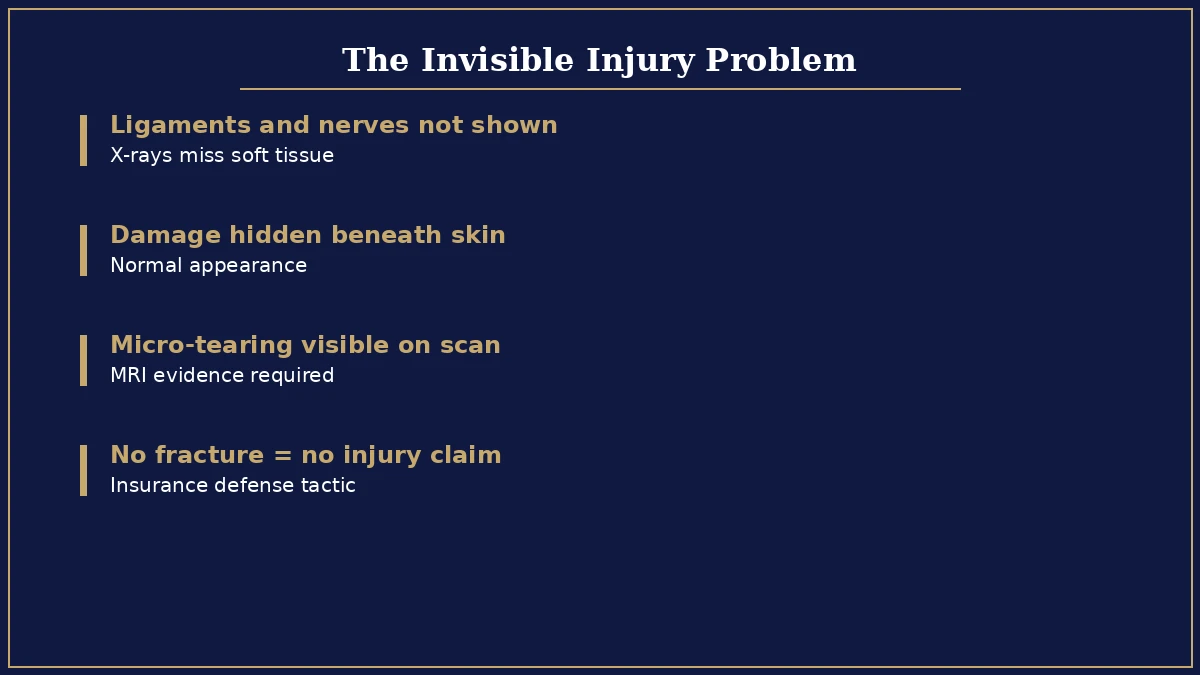
Soft tissue victims often look completely normal to friends and coworkers. The damage hides behind a normal outward appearance. Standard X-rays show no fractures or dislocations. Yet the victim cannot lift their arm, turn their head, or walk without severe pain. Insurance adjusters exploit this gap between appearance and reality. They argue the victim is exaggerating or malingering. Your attorney bridges this gap with MRI evidence, nerve testing, and specialist testimony.
Why Soft Tissue Damage Is Not Minor
Insurance companies label soft tissue injuries as minor because they cannot be seen on an X-ray. This label ignores the reality of ligament tearing, nerve damage, and chronic pain. A torn rotator cuff is a soft tissue injury that requires surgery and months of therapy. A brachial plexus avulsion is a soft tissue injury that causes permanent arm paralysis. The word “soft” does not mean minor. Your attorney presents medical evidence showing the true severity of the tissue damage.
Compartment Syndrome and Emergency Surgery
Compartment syndrome is a severe soft tissue injury that can destroy a limb within hours. An Atlanta soft tissue injury attorney documents the timeline from injury to emergency surgery. Without immediate treatment, the muscle tissue dies and the limb may require amputation.
Fasciotomy and Limb Salvage
Compartment syndrome occurs when deep tissue pressure builds inside a muscle compartment, cutting off blood flow. This condition develops after crush injuries, severe fractures, or trauma that causes swelling. Without emergency fasciotomy surgery, the muscle tissue dies within hours. The surgeon cuts open the fascia to relieve pressure and save the limb. Delayed treatment leads to permanent muscle death, nerve damage, and possible amputation. Your attorney documents the timeline from injury to surgery to prove the urgency was met.
Long-Term Effects of Compartment Syndrome
Even after successful fasciotomy, compartment syndrome leaves lasting damage. The surgical scars are large and permanent. Muscle weakness in the affected limb may persist for years. Some victims develop permanent nerve damage from the prolonged pressure. Chronic pain and reduced mobility affect employment and daily activities. Your attorney documents the long-term impact through follow-up medical records and functional capacity evaluations.
Nerve Damage and Brachial Plexus Injuries
Nerve damage is one of the most severe consequences of soft tissue trauma. An Atlanta soft tissue injury attorney documents nerve damage through conduction studies and specialist testimony. Nerve injuries can cause permanent disability even when no bones are broken.
Brachial Plexus and Nerve Root Avulsion
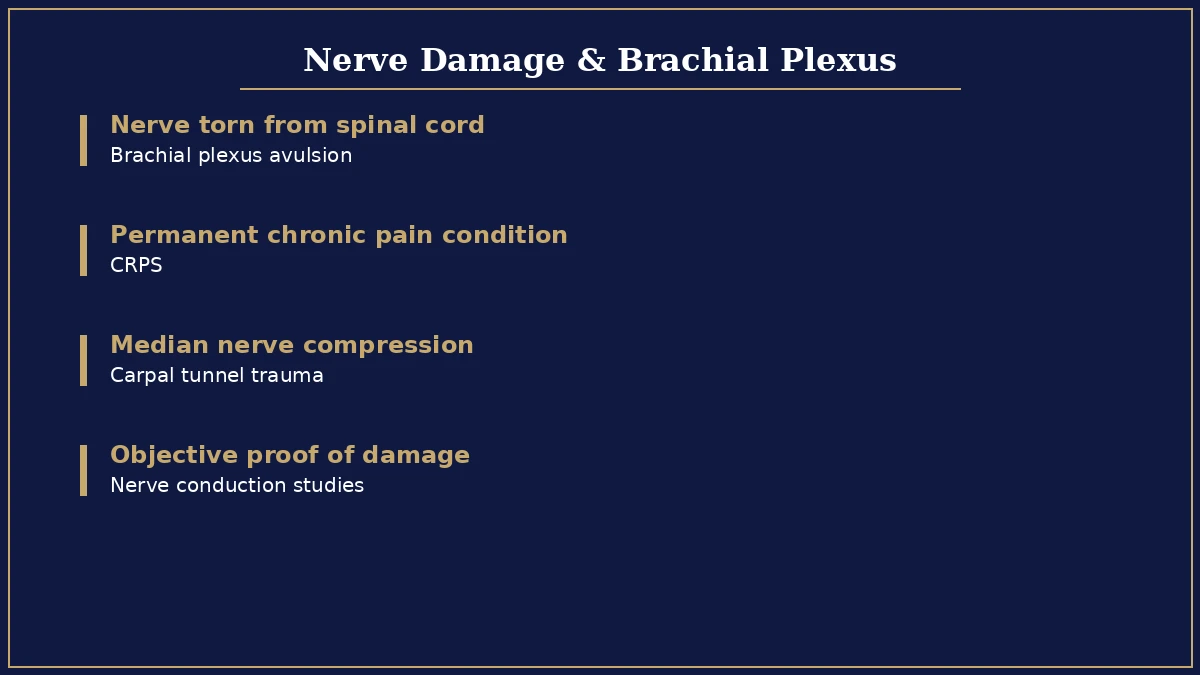
The brachial plexus is a network of nerves that controls the arm and hand. Violent impacts to the shoulder or neck can tear these nerves, causing permanent arm weakness. Brachial plexus injuries range from stretching to complete nerve root avulsion. Avulsion means the nerve is torn from the spinal cord and cannot repair itself. Some victims require nerve graft surgery or tendon transfers to restore partial function. Your attorney documents nerve conduction studies and surgical records to prove the extent of damage.
CRPS and Chronic Regional Pain Syndrome
CRPS, or chronic regional pain syndrome, is a permanent pain condition triggered by soft tissue trauma. The nervous system sends pain signals long after the original injury has healed. CRPS causes burning pain, swelling, skin color changes, and temperature sensitivity in the affected limb. The condition can spread to other parts of the body over time. There is no cure for CRPS, only management through medication and nerve blocks. Your Atlanta soft tissue injury attorney documents pain management records and the lifelong cost of treatment.
Carpal Tunnel from Trauma
Carpal tunnel syndrome can develop after a wrist fracture, crush injury, or repetitive trauma. The median nerve becomes compressed within the carpal tunnel, causing numbness and weakness. Traumatic carpal tunnel requires surgical release of the transverse carpal ligament. Recovery includes months of hand therapy and possible permanent grip weakness. Your attorney documents nerve conduction tests and the impact on daily activities and employment.
Attacking the “Soft Tissue” Defense Tactic
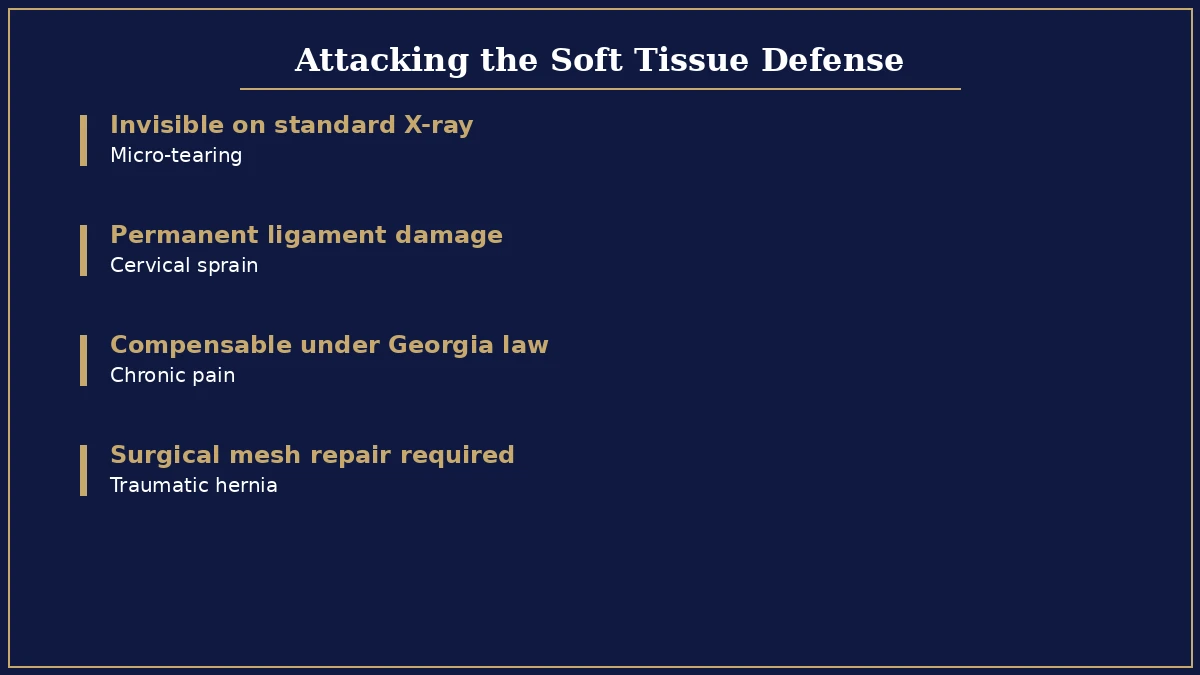
Insurance adjusters routinely classify whiplash, sprains, strains, and lacerations as minor injuries. They claim these injuries resolve in a few weeks with minimal medical care. This is an insurance defense tactic designed to force quick, lowball settlements. An Atlanta soft tissue injury attorney aggressively challenges this classification with medical evidence. Soft tissue damage does not mean minor damage.
Micro-Tearing of Ligaments and Tendons
Ligaments and tendons can sustain micro-tearing that does not appear on standard X-rays. These micro-tears cause inflammation, pain, and joint instability that persists for months. Scar tissue builds up around the torn fibers, reducing flexibility and causing chronic pain. Full recovery may require months of physical therapy or surgical repair. Your attorney documents MRI findings and therapy records that prove the injury is real and ongoing.
Cervical and Lumbar Sprains as Permanent Injuries
Cervical sprains and lumbar sprains are often dismissed as whiplash that heals in six weeks. In reality, severe sprains involve tearing of the ligaments that stabilize the spine. This tearing causes permanent instability, chronic pain, and increased risk of future disc herniation. Some victims never return to their pre-injury activity level after a severe spinal sprain. Your attorney documents the difference between a mild sprain and a ligament tear requiring surgical fusion.
Chronic Pain as a Compensable Damage
Chronic pain is a real medical condition, not a complaint or exaggeration. Pain that lasts beyond the expected healing period indicates ongoing nerve damage or tissue dysfunction. Chronic pain affects sleep, mood, employment, and relationships. Treatment includes pain management specialists, medication, and ongoing therapy. Under O.C.G.A. § 51-12-4, Georgia law allows compensation for ongoing pain and suffering. Your attorney documents pain management records and the daily impact of chronic pain.
Hernia Injuries from Trauma
Traumatic hernias occur when sudden force tears the abdominal wall muscles. The injury allows internal tissue or organs to push through the muscle wall. Traumatic hernias require surgical repair with mesh and weeks of restricted activity. Some victims develop chronic pain or recurrent hernias after the initial repair. Your attorney documents the surgical repair and the impact on lifting restrictions at work.
Lacerations and Deep Tissue Damage
Lacerations and deep tissue injuries involve tearing or crushing of skin, muscle, and underlying tissue. An Atlanta soft tissue injury attorney documents the full depth of tissue damage and any nerve involvement. These injuries often require surgical repair and leave permanent scarring.
Deep Tissue Injury and Crush Damage
Deep tissue injuries involve damage to muscle layers beneath the skin. Crush accidents can destroy muscle tissue without breaking the skin surface. The damage may not be visible immediately but develops over hours as swelling increases. Some deep tissue injuries require surgical removal of dead muscle tissue. Your attorney documents the depth of tissue damage through MRI imaging and surgical reports.
Scarring and Nerve Severing from Lacerations
Deep lacerations can sever nerves, blood vessels, and tendons beneath the skin. Nerve severing causes permanent numbness or loss of function in the affected area. Tendon lacerations require surgical repair and months of rehabilitation. Visible scarring from lacerations carries additional compensation, especially on the face, hands, and arms. Your attorney documents nerve conduction tests and plastic surgery evaluations for scar revision.
What Compensation Covers for Soft Tissue Injuries
Soft tissue compensation covers emergency care, surgery, physical therapy, and long-term pain management. Under O.C.G.A. § 51-12-4, Georgia recognizes both economic and non-economic damages. Economic damages include nerve repair surgery, fasciotomy, physical therapy, and pain management. Non-economic damages include pain, suffering, loss of range of motion, and loss of enjoyment of life. An Atlanta soft tissue injury attorney also pursues compensation for future medical needs and ongoing therapy. Catastrophic injury claims involving nerve damage require detailed Life Care Planning.
Filing Your Soft Tissue Injury Claim in Georgia
Georgia gives you two years from the accident date to file a lawsuit. This deadline is set by O.C.G.A. § 9-3-33. Soft tissue injuries may seem to heal initially but worsen over time. Filing before the deadline preserves your right to pursue full compensation. Under O.C.G.A. § 51-12-33, Georgia follows modified comparative negligence. If you are 50% or more at fault, you cannot recover damages. An Atlanta soft tissue injury attorney begins building your claim immediately. Insurance companies push to settle before the full extent of tissue damage is known.
Why Humphrey & Ballard Law Handles Soft Tissue Cases
Desmond Humphrey and David Ballard represent Atlantans suffering from nerve damage, ligament tears, and chronic pain. As a Black-owned firm rooted in South Fulton, they understand how soft tissue injuries affect working families. An Atlanta soft tissue injury attorney at Humphrey & Ballard works with neurologists, orthopedic specialists, and pain management doctors. They demand compensation for nerve repair surgery, physical therapy, and ongoing pain treatment. They operate on contingency, meaning clients pay nothing unless the firm wins. Burn injury and orthopedic injury cases share the same commitment to documenting invisible damage.
Frequently Asked Questions
| Question | Answer |
|---|---|
| What does an Atlanta soft tissue injury attorney do? | They investigate your accident and document ligament tearing, nerve damage, and chronic pain through MRI imaging and nerve conduction studies. They work with specialists to pursue full compensation for visible and invisible injuries. |
| How long do I have to file a soft tissue injury claim in Georgia? | Georgia law gives you two years from the accident date under O.C.G.A. § 9-3-33. An Atlanta soft tissue injury attorney can ensure this deadline is met. |
| How much does it cost to hire an Atlanta soft tissue injury attorney? | Humphrey & Ballard Law works on contingency. You pay nothing unless the firm secures compensation for your soft tissue injury claim. |
| Are soft tissue injuries really worth compensation? | Yes. Soft tissue damage includes nerve tearing, ligament damage, and chronic pain that can last for years. Insurance companies label these as minor to minimize payouts. Your attorney proves the real damage with medical evidence. |
Get Help From an Atlanta Soft Tissue Injury Attorney Today
If you suffered nerve damage, ligament tears, or chronic pain in Atlanta, Humphrey & Ballard Law can help. An Atlanta soft tissue injury attorney on their team will review your case at no cost. Call (404) 446-9854 or visit the contact page to schedule a free consultation. There are no fees unless they win your case.
About Humphrey & Ballard Law
Humphrey & Ballard Law is a Black-owned personal injury firm based in Atlanta, Georgia. Founders Desmond Humphrey and David Ballard serve clients across South Fulton, College Park, Riverdale, East Point, and Fairburn. They also serve the greater Atlanta area. The firm handles soft tissue injury claims, car accidents, personal injury, and catastrophic injury cases. Clients pay nothing unless the firm wins.
