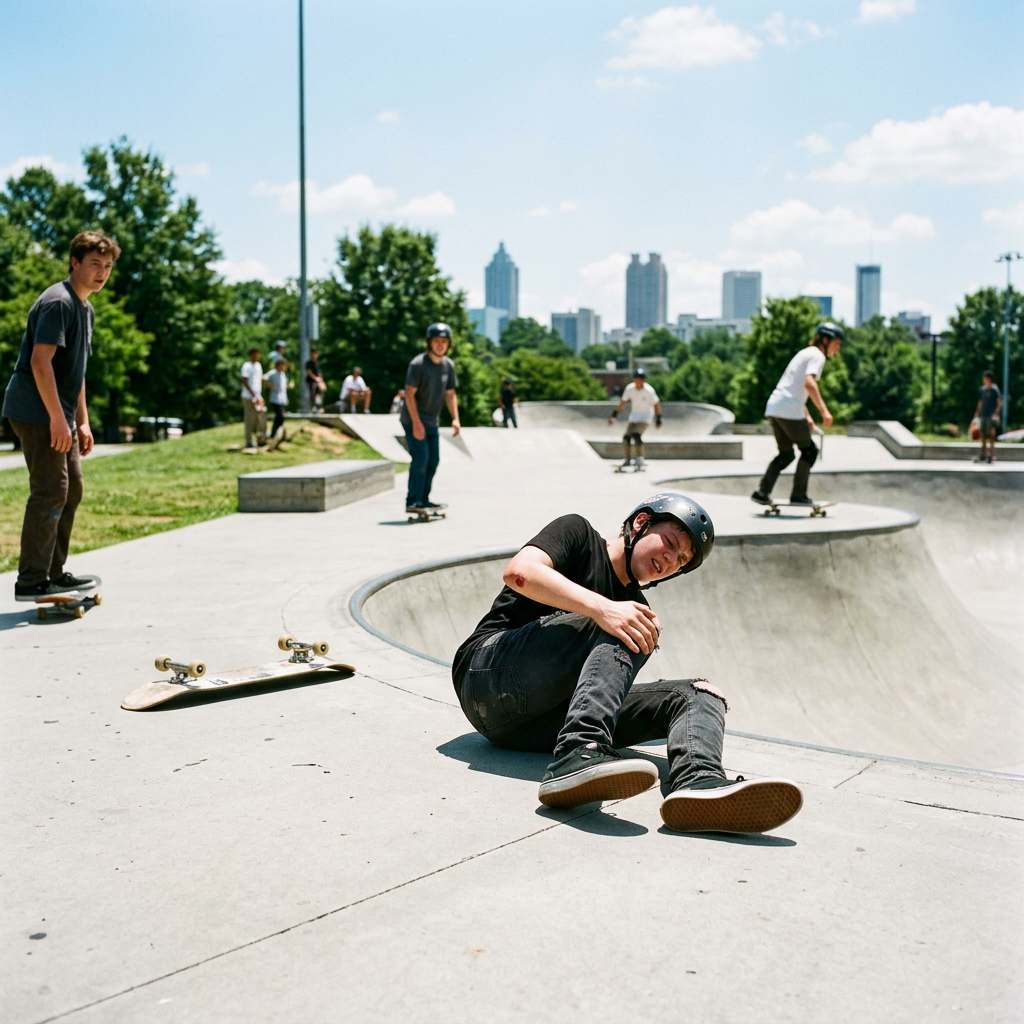
Who is responsible for injuries at public skate parks in Atlanta is a question with a real legal answer, and the answer depends on whether the park is publicly or privately owned, how the injury happened, and whether the hazardous condition was known and unaddressed. Skate park injuries in Georgia are governed by premises liability law under O.C.G.A. § 51-3-1: which requires owners who invite the public onto their property to keep it reasonably safe. When a skate park injury results from a defective ramp, broken concrete, inadequate lighting, or negligent supervision, the responsible party can be held liable, even in a sport where falls are common. HB Injury Lawyers represents Atlanta skate park injury victims and their families throughout the metro area.
Atlanta has a growing network of public and private skate parks, from city skate parks at Historic Fourth Ward Park, Harper Park and the Arthur Langford Jr. Recreation Center to private indoor facilities. Each carries different liability rules. City and county parks come with immunity defenses and strict notice deadlines. Private parks carry commercial premises liability exposure. In both cases, the key question is whether the dangerous condition was known or foreseeable, and whether the owner took reasonable steps to address it. Assumption of risk is the standard defense, but it doesn’t eliminate liability for negligent maintenance or defective equipment.
For the broader context of how HB Injury Lawyers handles premises liability cases, visit the firm’s Atlanta premises liability attorney page and slip and fall attorneys page.
Public vs. Private Skate Parks: How Liability Differs in Georgia
| Factor | Public Park (City/County) | Private Park (Business) |
|---|---|---|
| Governing law | City parks: municipal immunity, O.C.G.A. § 36-33-1. County parks: sovereign immunity. State parks: Georgia Tort Claims Act, O.C.G.A. § 50-21-20 and following | Standard premises liability, O.C.G.A. § 51-3-1 |
| Notice requirement | City: written notice within 6 months (O.C.G.A. § 36-33-5). County: claim within 12 months (O.C.G.A. § 36-11-1). State: notice within 12 months (O.C.G.A. § 50-21-26) | No notice requirement. 2-year statute of limitations (O.C.G.A. § 9-3-33) |
| Damage caps | State parks: $1 million per person, $3 million per occurrence (O.C.G.A. § 50-21-29). City and county claims are usually barred by immunity unless an exception applies | No statutory cap, full damages available |
| Free-entry parks | May apply. The Recreational Property Act limits liability for land opened to the public for recreation without charge, except for willful or malicious failure to guard or warn (O.C.G.A. § 51-3-23, § 51-3-25) | Applies only if entry is free. Charging admission removes this protection |
| Assumption of risk defense | Applies, but doesn’t excuse negligent maintenance | Applies, waivers may limit but not eliminate liability |
| Defendant | City of Atlanta, DeKalb County, Fulton County, etc. | Business owner, property manager, franchisor |
“Assumption of risk is a shield, not a blanket immunity. A skater accepts the inherent risks of the sport. They do not accept broken equipment, unmaintained ramps with hidden cracks, or inadequate lighting that makes hazards invisible. Those are the owner’s responsibility.”
Common Causes of Skate Park Injuries That Create Liability
- Cracked or uneven concrete: surface defects that cause wheel catches and falls are a direct maintenance failure. If inspections revealed the crack and nothing was done, that’s actionable.
- Defective or deteriorating ramps: warped wood, exposed screws, rotting plywood, or improperly anchored equipment all create foreseeable fall hazards
- Inadequate lighting: poorly lit parks during evening hours create conditions where hazards are invisible. Lighting failures in managed facilities are a maintenance negligence issue.
- Overcrowding without supervision: private parks that accept paid admissions and fail to manage capacity or enforce safety rules face liability for resulting collisions
- Defective skateboard equipment: if a wheel, truck, or deck defect caused the crash, the manufacturer or retailer faces separate products liability exposure
- Failure to warn of known hazards: a park that knew about a dangerous condition and failed to close the area or post warnings is directly liable
Emergency rooms treated an estimated 66,566 skateboarding injuries among children and teens in 2020, according to Consumer Product Safety Commission surveillance data compiled by Safe Kids Worldwide. Most are ordinary falls. A claim exists when a hazard the owner knew about, or should have found, caused the fall.
Does a Signed Waiver Kill My Skate Park Injury Claim?
Private skate parks routinely require signed liability waivers. In Georgia, these waivers are enforceable, but they have real limits:
- Waivers don’t cover gross negligence or willful conduct: Georgia courts hold that exculpatory clauses do not excuse gross negligence or willful or wanton conduct (McFann v. Sky Warriors, 2004)
- Waivers signed for a child are not settled law: Georgia’s appellate courts have not clearly decided whether a parent’s waiver binds a child. A federal court applying Georgia law enforced one for ordinary negligence in 2021, but not for gross negligence
- Vague or poorly worded waivers: courts interpret ambiguity against the drafter. If the waiver doesn’t specifically cover the type of negligence that caused the injury, it may not apply
“Parents are often told a signed waiver ends their child’s claim. That is not always true. A waiver does not reach gross negligence, and courts read waivers narrowly.”
What to Do Immediately After a Skate Park Injury in Atlanta
- Photograph the hazard immediately: the cracked surface, broken ramp, or defective equipment before it gets repaired or removed
- Report it to park staff or management: get a written incident report and keep a copy
- Get witness contact information: other skaters or bystanders who saw the fall or the hazard
- Seek immediate medical treatment: fractures, head injuries, and soft tissue damage need same-day documentation
- Preserve the equipment: the skateboard, helmet, and protective gear are physical evidence. Don’t discard anything.
- Call an attorney before speaking to the park’s insurer: recorded statements are used to assign comparative fault and reduce your recovery
Frequently Asked Questions: Atlanta Skate Park Injury Attorney
| Question | Answer |
|---|---|
| Can I sue the City of Atlanta for a skate park injury? | Possibly, but it is difficult. Georgia cities are generally immune from negligence claims tied to running public recreation facilities. You must also give written notice within 6 months under O.C.G.A. § 36-33-5, and missing that deadline bars the claim. Talk to a lawyer right away. |
| My child was hurt at a skate park. Does the waiver I signed matter? | It may. Georgia’s appellate courts have not settled whether a parent’s waiver binds a child, and a federal court applying Georgia law has enforced one for ordinary negligence. A waiver does not cover gross negligence, so how the injury happened matters. |
| What if the defective skateboard caused the fall, not the park? | Products liability against the manufacturer, distributor, or retailer applies. These claims run separately from and in addition to any premises liability claim against the park. |
| How long do I have to file in Georgia? | Generally two years under O.C.G.A. § 9-3-33. For a city park, written notice is due within 6 months. For a county or state park, notice is due within 12 months. Act immediately regardless of which type of park was involved. |
Atlanta Skate Park Injury Attorneys: Holding Negligent Parks Accountable
Whether it was a city park with crumbling concrete or a private facility that ignored a known hazard, HB Injury Lawyers fights for Atlanta skate park injury victims and their families. Call 404-446-9854 or reach us through our contact page. Free consultation, no fees unless we win.
If you were injured, our Atlanta premises liability attorneys can review your options. You may also want to read about apartment complex injury liability and how fault is determined.
About HB Injury Lawyers
HB Injury Lawyers is a top-rated Atlanta personal injury law firm founded by attorneys Desmond Humphrey and David Ballard. The firm handles premises liability, skate park injury, slip and fall, car accident, and wrongful death cases throughout Fulton, DeKalb, Gwinnett, Clayton, and Cobb counties. Free consultations, no fees unless they win.
