If you were injured in an accident in Georgia, one of the first questions you are probably asking is how long this is going to take. That is a fair question, and it deserves a real answer, not a vague response about how every case is different. How long a personal injury lawsuit takes in Georgia depends on several specific factors, and understanding those factors gives you a clear picture of what to expect at every stage. Most straightforward cases resolve within six to eighteen months. More serious or disputed cases can take two to three years from the date of the accident to the final resolution.

The Stage That Determines Everything Else: Your Medical Recovery
Before any settlement demand goes out, your attorney needs to know the full extent of your injuries. This is called reaching maximum medical improvement, or MMI. It is the point at which your treating physicians confirm you have healed as much as you are going to heal, or they have a clear picture of your long-term prognosis and ongoing care needs.
Settling before you reach MMI is one of the most common and costly mistakes injury victims make on their own. If you settle while you are still in treatment, you give up your right to any additional compensation, even if your condition worsens or requires surgery you did not anticipate. Your attorney will not send a demand until your medical picture is complete, because that is the only way to accurately calculate the full value of what you are owed.
Why Rushing the Process Costs You Money
Insurance companies know that injured people are under financial pressure. Medical bills pile up. You may be missing work. The adjuster assigned to your case is trained to move quickly, make an early offer that seems reasonable, and get you to sign a release before you understand what your claim is actually worth.
That early offer almost never accounts for future medical costs, long-term lost earning capacity, or the full value of your pain and suffering. Patience in the early stages of a Georgia personal injury claim is not just advisable, it is financially significant.
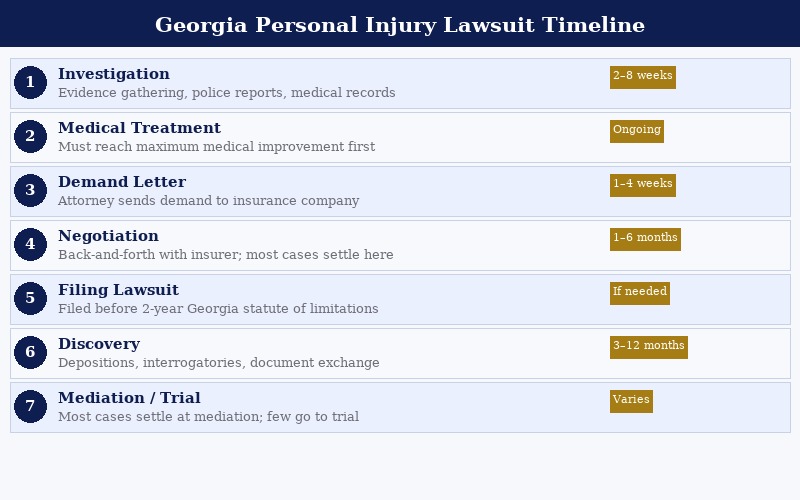
Stage One: Investigation and Evidence Gathering
Once you hire an attorney, the first work is building the factual foundation of your case. This means securing the police report, requesting surveillance footage before it gets overwritten, identifying witnesses, and sending preservation letters to any businesses or entities that may hold relevant evidence.
Your attorney will also begin gathering your medical records from every provider who has treated you since the accident. This documentation process takes time because hospitals and clinics have their own response timelines for records requests. Attempting to rush this stage leads to incomplete documentation, which weakens your eventual demand.
What a Strong Investigation Looks Like
In serious accident cases, the investigation may include hiring an accident reconstruction expert, subpoenaing trucking company maintenance logs, or pulling black box data from a commercial vehicle. These steps add time to the early stages, but they add significantly more value to your eventual recovery. An Atlanta personal injury attorney who shortcuts the investigation phase is leaving money on the table for their client.
Practical rule: The investigation stage is when your case is won or lost on liability. Every week your attorney spends building a clean, well-documented record in the early stages pays back multiple times over at the negotiation table.
Stage Two: The Demand Letter
Once you reach maximum medical improvement and all records are compiled, your attorney drafts a formal demand letter to the at-fault party’s insurance company. This document lays out the facts of the accident, the full scope of your injuries and treatment, your documented economic losses, and the total compensation amount being demanded.
A well-prepared demand letter does more than state a number. It tells the story of what happened to you, establishes liability clearly, and signals to the insurance company that your attorney has done the work and is prepared to take the case to trial if needed. Insurance adjusters respond very differently to a thorough, well-supported demand than to a bare-bones one.
What Insurance Companies Do With Your Demand
After receiving the demand, the insurance company has time to review and respond. Under Georgia law, insurers must acknowledge receipt of a claim promptly and act in good faith in evaluating it. In practice, response times vary from a few weeks to a couple of months, depending on the size of the claim and the insurer involved. Your attorney will follow up consistently to keep the process moving.

Stage Three: Negotiation
The negotiation stage is where the majority of Georgia personal injury cases are resolved. The insurance company responds to the demand with a counteroffer, your attorney responds with a revised position, and this back-and-forth continues until both sides reach a number that reflects a fair settlement or until negotiations break down.
Most cases with clear liability, solid documentation, and an experienced attorney settle at this stage. The range of time varies considerably. A case with a cooperative insurer and well-documented moderate injuries might settle in four to six weeks after the demand goes out. A case involving a larger insurer, a disputed liability question, or significant damages might take three to six months of negotiation before a resolution is reached.
When Negotiation Breaks Down
Not every case settles at the demand and negotiation stage. If the insurance company’s best offer does not reflect the actual value of your claim, your attorney will recommend filing a lawsuit. This is not a failure of the process. It is a strategic decision to pursue what you are actually owed through the court system, where a judge or jury decides the outcome.
Practical rule: Filing a lawsuit does not mean your case goes to trial. The vast majority of cases that are filed still settle before trial, often during or after the discovery process. Filing is what shifts the pressure onto the insurer.
Stage Four: Filing a Lawsuit and the Two-Year Georgia Deadline
Georgia’s statute of limitations for personal injury cases is two years from the date of the accident, under O.C.G.A. § 9-3-33. If your claim has not settled and a lawsuit has not been filed within that two-year window, you lose your right to sue entirely, regardless of how strong your case is.
There are limited exceptions to this rule. Cases involving minors, cases where the defendant fraudulently concealed their identity, and certain cases involving government entities have different rules that an attorney can explain based on your specific facts. But the general rule is firm: two years, no exceptions.
Special Deadlines to Know in Georgia
- General personal injury — Two years from the date of injury
- Wrongful death — Two years from the date of death
- Claims against a government entity — Ante litem notice required within six months to one year depending on the entity
- Product liability — Two years from injury, subject to a ten-year statute of repose from product manufacture date
- Minors — Two years from the minor’s 18th birthday in most circumstances
Missing any of these deadlines is permanent. It cannot be corrected after the fact. This is one of the primary reasons why consulting with an Atlanta personal injury lawyer as early as possible after an accident protects your legal rights.
Stage Five: Discovery
Once a lawsuit is filed, both sides enter the discovery phase. This is the formal legal process by which each party gathers evidence from the other. Discovery in a Georgia personal injury case typically includes written interrogatories, requests for production of documents, and depositions.
What Depositions Involve and Why They Matter
A deposition is sworn testimony given outside of court, recorded by a court reporter, and used by both sides to evaluate the strength of the case. You will likely be deposed. The at-fault driver or their representatives will be deposed. Expert witnesses may be deposed. Medical providers are sometimes deposed to address the nature and causation of your injuries.
Depositions are one of the most significant events in a personal injury lawsuit because they often determine whether a case settles or proceeds to trial. A strong deposition performance by the plaintiff, combined with damaging testimony from the defendant, frequently leads insurers to reevaluate their settlement position significantly upward. Your attorney will prepare you thoroughly for every deposition before it occurs.
Practical rule: Discovery takes time because both sides have legal deadlines to respond to requests, and disputes over document production sometimes require court intervention. Do not interpret a longer discovery phase as a sign your case is weak. It often means the other side is working harder to find ways to limit their exposure.

Stage Six: Mediation and Trial
Most Georgia courts require the parties to attempt mediation before a case goes to trial. Mediation is a structured negotiation session facilitated by a neutral third-party mediator. Both sides present their positions, the mediator works to bridge gaps, and the goal is to reach a settlement agreement that day.
The large majority of personal injury cases in Georgia settle at or before mediation. According to the Georgia Courts system, civil trials represent a small fraction of filed cases because settlement at the mediation stage is common when both sides have realistic expectations and experienced counsel.
When a Case Goes to Trial
If mediation does not produce an acceptable settlement, the case proceeds to trial. A Georgia personal injury trial involves jury selection, opening statements, presentation of evidence and witnesses, closing arguments, and jury deliberation. Trial preparation is intensive, and the scheduling of trial dates in Georgia courts can add additional months to the overall timeline depending on court docket availability in your county.
Trials do produce the highest verdicts in the right cases, and sometimes going to trial is the right decision for a client. At Humphrey & Ballard Law, we prepare every case as if it is going to trial from day one. That preparation is part of why our negotiated settlements consistently reflect the true value of our clients’ claims.
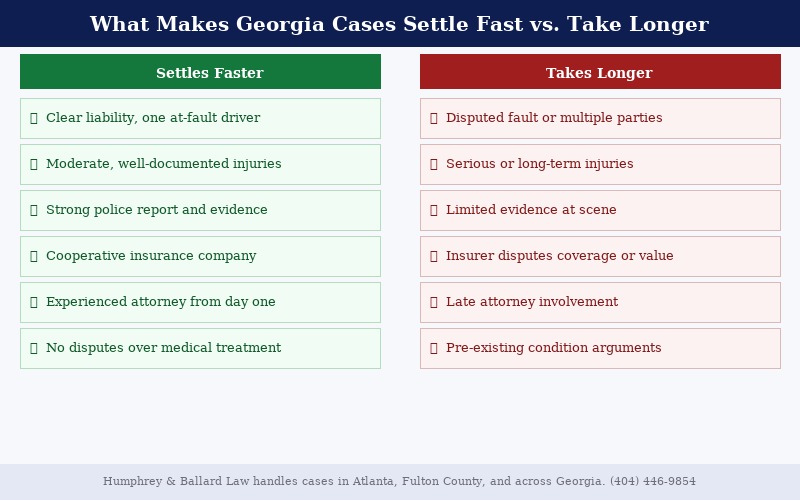
Factors That Make Your Georgia Case Resolve Faster or Slower
No two injury cases move at exactly the same pace. But certain factors consistently affect the timeline, and understanding them helps you set realistic expectations and make informed decisions throughout the process.
Factors That Speed Up Resolution
- Clear, undisputed liability — When fault is obvious and well-documented, insurers have less incentive to drag things out
- Moderate injuries with full recovery — Cases where you have fully healed and have complete medical records are easier to value and faster to resolve
- Strong evidence from the start — Police reports, photographs, witness statements, and surveillance footage all accelerate the process
- Early attorney involvement — Hiring a lawyer immediately after the accident prevents evidence loss and avoids early missteps that create delays later
Factors That Extend the Timeline
- Serious or permanent injuries — Cases involving long-term disability, ongoing treatment, or permanent impairment require more time to fully document the damages
- Multiple at-fault parties — When liability is shared among several defendants, coordination and litigation become more involved
- Pre-existing condition disputes — Insurers often argue that your injuries predated the accident. Addressing this requires additional medical documentation and expert testimony
- Uncooperative insurers — Some insurance companies are simply difficult, use delay tactics, and require litigation to reach reasonable positions
Practical rule: The single most reliable way to keep your case moving efficiently is to hire an experienced attorney early, follow your treatment plan consistently, and avoid giving recorded statements or signing anything without attorney review.
What Happens After a Settlement Is Reached
Once you and the insurance company agree on a settlement amount, there are a few additional steps before you receive payment. You sign a release of all claims, which is a binding legal document. The insurer then processes the payment, which typically takes two to six weeks. Your attorney’s office handles any medical liens, subrogation claims, and outstanding bills that must be paid from the settlement before your net proceeds are disbursed to you.
Understanding this final stage matters because the settlement check is not your take-home amount. Medical providers, health insurers, and Medicare or Medicaid sometimes have reimbursement rights from your settlement. Your attorney negotiates those lien amounts to reduce them where possible, maximizing what ends up in your pocket.
| Stage | Typical Duration | What Happens |
|---|---|---|
| Investigation | 2 to 8 weeks | Evidence gathered, records requested, case built |
| Medical Treatment | Ongoing until MMI | You complete treatment before demand is sent |
| Demand Letter | 1 to 4 weeks after MMI | Formal demand sent to insurance company |
| Negotiation | 1 to 6 months | Back-and-forth until settlement or impasse |
| Lawsuit Filed | Before 2-year deadline | Filed if negotiation fails; shifts pressure to insurer |
| Discovery | 3 to 12 months | Depositions, document exchange, expert witnesses |
| Mediation | 1 to 3 months post-discovery | Structured settlement negotiation, most cases resolve here |
| Trial | If mediation fails | Jury decides verdict; highest potential recovery |
| Post-Settlement | 2 to 6 weeks | Release signed, liens resolved, funds disbursed |
| Question | Answer |
|---|---|
| How long does a typical Georgia injury case take? | Six to eighteen months for straightforward cases. Two to three years for serious or disputed cases. |
| When should I hire an attorney after an accident? | As soon as possible. Early attorney involvement protects evidence and prevents costly early mistakes. |
| What is maximum medical improvement? | The point at which your treating physician determines you have healed as fully as you are going to heal. Settling before MMI risks undervaluing your claim. |
| What happens if I miss the two-year deadline? | Your right to sue is gone entirely. Georgia courts do not grant extensions for missing the statute of limitations except in very narrow circumstances. |
| Does filing a lawsuit mean going to trial? | No. Most filed cases still settle before trial, often during or after the discovery phase or at mediation. |
| How long after settlement do I get paid? | Typically two to six weeks after signing the release, once the insurer processes payment and liens are resolved. |
Your Personal Injury Lawsuit Timeline Starts With One Phone Call
Understanding how long a personal injury lawsuit takes in Georgia helps you make better decisions at every stage of the process. It helps you resist pressure to settle too early. It helps you understand why your attorney is taking the time to build a thorough case. And it helps you stay focused on the outcome that actually matters, which is receiving full and fair compensation for everything you have been through.
At Humphrey & Ballard Law, we walk every client through this timeline from the very first consultation so there are no surprises. If you have been injured in an accident in Atlanta or anywhere across Georgia, call us today at (404) 446-9854 or reach us through our contact page for a free case evaluation. We work on contingency. You pay nothing unless we win.
About the Author: Desmond Humphrey
Desmond Humphrey is a personal injury attorney and founding partner at Humphrey & Ballard Law in Atlanta, Georgia. A graduate of Atlanta’s John Marshall Law School and the University of Tennessee, Desmond has spent his career standing up for injury victims across Fulton County and the greater Atlanta metro area. He is a licensed minister of the Gospel, a recurring legal analyst on Court TV, and the co-founder of Lawyer Up, a nonprofit dedicated to educating Atlanta youth about their legal rights. Desmond believes every person deserves a fair shot at justice, no matter who they are or where they come from. To speak with Desmond directly, call (404) 446-9854.
