Tow Truck Driver vs Car Owner: Who Is Liable After an Atlanta Accident?
When a tow truck driver vs car owner collision happens in Atlanta, liability depends on who acted negligently, what duty of care each driver owed, and how Georgia’s comparative fault rules apply to the facts of your crash. A tow truck driver vs car owner dispute is not a simple question of who hit whom. A tow truck carrying a disabled vehicle is significantly heavier and harder to control than a standard passenger car, and Georgia law holds commercial drivers to a higher standard when they are operating in a professional capacity on public roads.
If you were injured in a collision involving a tow truck in Atlanta, HB Injury Lawyers can help you sort through the liability questions. Call (404) 446-9854 for a free consultation, or reach out through our contact page.
Tow Truck Driver vs Car Owner: The Core Liability Question
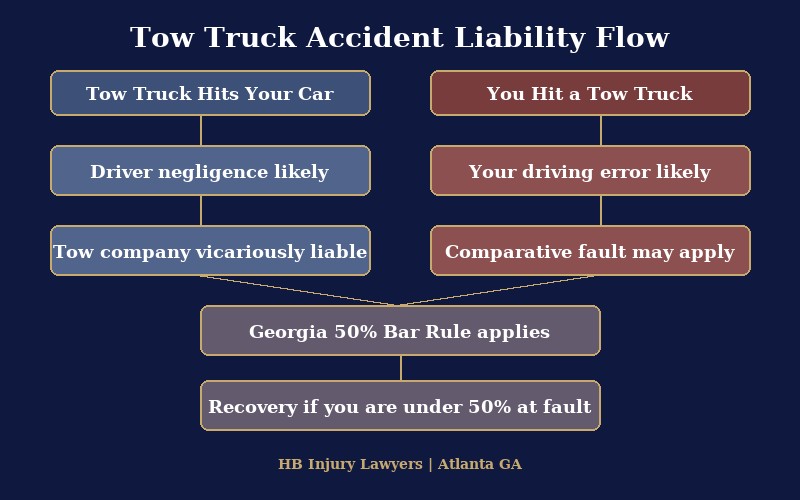
The fundamental question in any tow truck accident liability case is whether the tow truck driver, the car owner, or both parties contributed to the crash. Georgia follows a modified comparative negligence system under O.C.G.A. section 51-12-33, which means fault can be shared between multiple parties. The party who is less than 50 percent at fault can recover damages, reduced by their percentage of responsibility. In a tow truck driver vs car owner case, this rule directly determines how much you can recover.
Tow truck drivers are not treated the same as ordinary drivers. They are operating a commercial vehicle, often carrying another vehicle on their flatbed or hook, which changes the physics of stopping distance, turning radius, and blind spots. Georgia courts have long recognized that people operating commercial vehicles for business purposes owe a heightened duty of care to the public.
Practical rule: The driver who had the most control over preventing the crash is usually the one who bears the most liability. Tow truck drivers who operate equipment while driving, fail to secure loads, or speed to reach a dispatch call carry more blame than a car owner who was simply driving defensively.
What Makes a Tow Truck Case Different From a Regular Car Accident
Three things set a tow truck accident attorney Atlanta case apart from a standard rear-end collision. First, the tow truck may be carrying a second vehicle, which means the cargo itself can cause injuries if it breaks free. Second, the towing company’s commercial insurance policy comes into play, which typically has higher limits than a personal auto policy. Third, tow truck drivers often work as independent contractors, which complicates the question of who is legally responsible for their negligence.
Why the Comparison Matters for Your Recovery
People search for answers using all kinds of phrases. Some type “tow truck driver vs car owner” looking for a direct comparison. Others search “who is at fault when a tow truck hits my car.” The legal question is always the same: who breached their duty of care, and did that breach cause your injuries? Understanding the comparison helps you know what evidence to collect and what arguments to make.
The Duty of Care Owed by Each Party
Both the tow truck driver and the car owner owe each other a duty of reasonable care on the road. The difference is the standard. A tow truck driver operating a heavy commercial vehicle with a load owes a heightened duty because they have the potential to cause greater harm. A car owner owes the standard duty of any driver: follow traffic laws, maintain safe speeds, and pay attention to the road.
How Georgia Law Treats Tow Truck Drivers Differently
Georgia does not apply the same commercial vehicle liability Georgia standards to tow trucks that it applies to interstate semi-trucks. The Federal Motor Carrier Safety Administration (FMCSA) regulates interstate trucking, but most local tow truck operators work within Georgia state lines, meaning they fall under state commercial vehicle rules rather than federal hours-of-service regulations.
However, Georgia still holds tow truck drivers to a commercial standard. They are required to hold a commercial driver’s license if their vehicle exceeds certain weight thresholds. They must follow Georgia Department of Public Safety rules for tow truck operations, including proper warning light usage, securement protocols, and equipment maintenance standards.
Practical rule: A tow truck driver operating without proper licensing or failing to follow Georgia tow truck safety rules gives you a stronger negligence case. Violations of safety regulations can establish negligence per se under Georgia law.
Tow Truck Driver Licensing Requirements in Georgia
Tow truck drivers in Georgia must hold a valid commercial driver’s license (CDL) if their vehicle has a gross vehicle weight rating over 26,000 pounds. Many heavy-duty tow trucks and rotator trucks exceed this threshold. A driver operating without the required CDL is violating state law, and that violation can serve as the basis for negligence per se, which means the driver is automatically negligent for violating a safety statute designed to protect the public.
Georgia Tow Truck Warning Light Requirements
Georgia law requires tow trucks to display specific warning lights when operating on roadside calls. Failure to use proper amber warning lights or failure to activate them when performing roadside recoveries creates direct liability if another driver crashes into the tow truck or its work zone. The relevant statute is O.C.G.A. section 40-8-4, which governs emergency and service vehicle lighting requirements.
When the Tow Truck Driver Is at Fault
Tow truck drivers cause accidents through the same types of negligence as other drivers, plus several risks unique to their profession. The most common causes of tow truck accident cases where the driver is at fault include improper vehicle securement, distracted operation of lift equipment while in traffic, brake failures from carrying heavy loads, and failure to use proper warning lights at roadside scenes. In a tow truck driver vs car owner dispute, these factors tip the liability scale toward the tow truck.
Improper Vehicle Securement
When a towed vehicle breaks free from a flatbed or hook, it becomes a projectile on the highway. Securement failures are among the most dangerous tow truck accident causes because the unsecured vehicle can cross multiple lanes of traffic or strike vehicles behind the tow truck. Georgia law requires specific chain and strap securement methods, and failure to follow them creates direct liability for the tow truck driver and their employer.
Practical rule: If a towed vehicle came loose and hit your car, the tow truck driver and their employer are almost certainly liable. Securement is entirely within the driver’s control, and a failure there is not something the car owner contributed to.
Distracted Operation of Lift Equipment
Tow truck drivers often operate lift controls while stopped in traffic or on the shoulder of a busy Atlanta highway. When their attention is split between operating the equipment and watching the road, they can drift into adjacent lanes, fail to notice approaching vehicles, or roll forward unexpectedly. These distractions are a form of driver negligence that creates liability for any resulting collision.
Fatigue and Long Hours
Tow truck drivers frequently work 24-hour on-call shifts with no federally mandated rest periods. Unlike interstate truckers who must follow FMCSA hours-of-service rules, local tow operators can legally drive exhausted. A fatigued tow truck driver who causes a crash can still be held liable for negligence, but proving fatigue requires looking at dispatch records, time stamps, and work logs that the towing company may not want to share voluntarily.
When the Car Owner Bears Responsibility
Not every tow truck accident is the tow driver’s fault. Car owner liability in a tow truck collision usually comes down to whether the car owner was driving negligently. Common scenarios where the car owner shares or bears fault in a tow truck driver vs car owner case include rear-ending a tow truck that was properly stopped with warning lights active, failing to yield to a tow truck merging from a roadside recovery, and cutting off a tow truck that has a longer stopping distance due to its load.
Rear-Ending a Stopped Tow Truck
If a tow truck is stopped on the shoulder with its amber warning lights flashing and a car rear-ends it, the car owner is likely at fault. Georgia’s following-distance laws require drivers to maintain enough space to stop safely for any obstruction ahead. The tow truck’s warning lights make it even harder for the car owner to argue they did not see the truck in time.
Failure to Move Over for Tow Trucks
Georgia’s Move Over law, found in O.C.G.A. section 40-6-16, requires drivers to move over one lane or slow down when approaching any stationary vehicle displaying flashing warning lights, including tow trucks. A driver who fails to move over and hits a tow truck driver working at a roadside scene is in violation of state law and liable for the resulting injuries.
Practical rule: If you hit a tow truck that was stopped with its warning lights on, you will likely be found at fault. Georgia’s Move Over law makes this one of the hardest facts to overcome in a tow truck accident claim.
Georgia’s Comparative Negligence Rule in Tow Truck Cases
Georgia’s modified comparative negligence statute, O.C.G.A. section 51-12-33, allows you to recover damages as long as you are less than 50 percent at fault. Your recovery is reduced by your percentage of fault. In a tow truck driver vs car owner case, this means the allocation of fault directly controls your recovery:
| Scenario | Tow Truck Driver Fault | Car Owner Fault | Recovery Available |
|---|---|---|---|
| Tow truck rear-ends your car | 100% | 0% | Full recovery |
| Towed vehicle breaks free and hits your car | 100% | 0% | Full recovery |
| You rear-end stopped tow truck with lights on | 0% | 100% | No recovery |
| Both speeding, tow truck veers into your lane | 70% | 30% | 70% of damages |
| You failed to move over, tow truck also negligent | 40% | 60% | No recovery (over 50%) |
The 50 percent threshold is the most important number in your tow truck driver vs car owner case. If a jury finds you 51 percent or more at fault, you recover nothing. This is why having an Atlanta truck accident attorney who can frame the facts to keep your fault percentage under 50 percent is so valuable.
Practical rule: The insurance company will try to push your fault percentage above 50 percent to deny your claim entirely. Every piece of evidence that shifts blame to the tow truck driver protects your right to recover.
How Fault Percentages Get Calculated
There is no formula for calculating fault percentages in Georgia. A jury assigns them based on the evidence, and insurance adjusters estimate them during settlement negotiations. The stronger your evidence showing the tow truck driver’s negligence, the lower your assigned fault percentage will be in a tow truck driver vs car owner dispute.
The 50 Percent Bar Explained
If you are found to be exactly 50 percent at fault, you can still recover. If you are found to be 51 percent or more at fault, you get nothing. The insurance company knows this and will fight to push your percentage to 50 or above. Every piece of evidence that puts more blame on the tow truck driver keeps you below the bar.
Evidence That Decides Who Pays
In a tow truck accident attorney Atlanta case, the evidence you collect determines who pays and how much. The most valuable evidence includes:
| Evidence Type | What It Proves | How to Get It |
|---|---|---|
| Police accident report | Officer’s assessment of fault, citations issued, witness statements | Request from Atlanta PD or Georgia State Patrol |
| Tow truck dispatch records | Driver was on a call, distracted, or rushing | Subpoena from towing company |
| Vehicle securement inspection | Chains or straps were improperly attached | Expert witness or photo evidence from scene |
| Black box data | Speed, braking, and steering inputs before crash | Subpoena from tow truck manufacturer data |
| Dash camera footage | Exactly how the crash happened | Your dash cam, nearby business cameras, or witness footage |
| Tow truck maintenance records | Brake failures or equipment defects | Subpoena from towing company |
Acting Quickly Before Evidence Disappears
Tow truck dispatch records, black box data, and surveillance footage can be overwritten or destroyed within days. A car accident attorney can send preservation letters to the towing company immediately, requiring them to retain evidence before it disappears. The Georgia Department of Public Safety also maintains records of commercial vehicle violations that can support your claim.
Insurance Coverage Differences You Need to Know
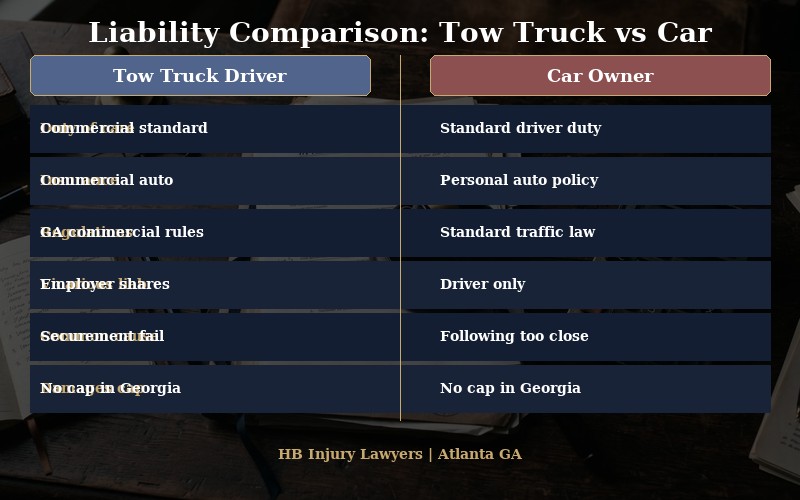
The insurance picture in a tow truck driver vs car owner case is very different from a standard car accident. Tow trucks carry commercial auto liability coverage, which typically has much higher policy limits than personal auto insurance. However, the structure of that coverage depends on whether the driver is an employee or an independent contractor.
When the Towing Company Is Liable
If the tow truck driver is an employee of a towing company, the company is vicariously liable for the driver’s negligence under Georgia’s respondeat superior doctrine. The company’s commercial auto policy covers your damages, and you can also pursue claims for negligent hiring or supervision if the company failed to properly screen or train the driver.
When the Driver Is an Independent Contractor
Many tow truck drivers are independent contractors who own their own trucks. In that case, the driver’s personal commercial auto policy is the primary coverage source, and the towing company or dispatch network may have separate coverage. An attorney can identify all available policies and pursue the full limits of each.
Practical rule: Never accept the first insurance offer in a tow truck accident case. Commercial policies have higher limits, which means the insurance company has more room to negotiate. Their first offer is almost never their best.
Uninsured and Underinsured Motorist Coverage
If the tow truck driver was uninsured or underinsured, your own uninsured motorist coverage Georgia policy may cover the gap. Georgia requires insurers to offer uninsured motorist coverage, and many drivers carry limits that exceed the at-fault driver’s policy. Check your policy declarations page to see your UM limits.
Frequently Asked Questions
| Question | Answer |
|---|---|
| Are tow trucks subject to FMCSA regulations? | Most local tow trucks operating within Georgia are not subject to federal FMCSA hours-of-service rules. They fall under Georgia state commercial vehicle regulations instead. However, tow trucks crossing state lines may face federal requirements depending on their operations. |
| Can I sue the towing company if the driver was an independent contractor? | It depends on the relationship. If the company controlled the driver’s work, provided the truck, or directed the dispatch, vicarious liability may still apply. An attorney can evaluate the specific arrangement and identify all liable parties. |
| What if the towed vehicle came loose and hit my car? | The tow truck driver is responsible for properly securing the towed vehicle. If it breaks free, the driver and their employer are liable for any resulting injuries. This is one of the strongest tow truck accident claims you can bring. |
| Does Georgia’s Move Over law apply to tow trucks? | Yes. Georgia’s Move Over law requires drivers to move over one lane or slow down for any stationary vehicle with flashing warning lights, including tow trucks. Violating this law creates negligence per se. |
| How long do I have to file a tow truck accident lawsuit in Georgia? | Georgia’s statute of limitations for personal injury claims is two years from the date of the accident under O.C.G.A. section 9-3-33. Missing this deadline bars you from recovery entirely. |
| How much is a tow truck accident settlement worth? | Settlement value depends on medical expenses, lost income, property damage, pain and suffering, and the degree of fault. Commercial vehicle cases often settle for more than standard car accidents due to higher insurance limits. |
| What if I was partially at fault for the tow truck accident? | Georgia follows modified comparative negligence. As long as you are less than 50 percent at fault, you can recover damages reduced by your fault percentage. At 50 percent or more, you recover nothing. |
Tow Truck Driver vs Car Owner: Getting the Right Legal Help
A tow truck accident attorney who understands the difference between commercial vehicle cases and standard car accident claims can make a significant difference in your recovery. Tow truck accidents involve commercial insurance policies, regulatory compliance questions, and evidence that disappears quickly. The sooner you have representation, the better your chances of preserving evidence and building a strong liability case for your tow truck driver vs car owner claim.
HB Injury Lawyers handles tow truck driver vs car owner accident cases throughout metro Atlanta, including car accidents, truck accidents, wrongful death claims, and the full range of personal injury claims. Call (404) 446-9854 or contact us through our contact page for a free consultation. No fees unless we win.
Practical rule: The towing company’s insurance adjuster is already working to minimize your claim. Having an attorney level the playing field and handle the negotiations is the single best thing you can do to protect your recovery.
About HB Injury Lawyers
HB Injury Lawyers is an Atlanta personal injury law firm founded by attorneys Desmond Humphrey and David Ballard, handling tow truck accidents, commercial vehicle crashes, car accidents, truck accidents, and wrongful death cases throughout metro Atlanta. Free consultations, no fees unless they win. Call (404) 446-9854 or visit hbinjurylawyers.com.
