Georgia O.C.G.A. § 40-6-391 is the statute that governs driving under the influence in this state. Most people think of it as a criminal law. What they do not realize is that it directly affects your ability to recover full compensation in a civil claim. When a drunk driver hits you in Georgia, you are dealing with more than physical injuries. You are dealing with a system that moves fast, favors the insured, and often leaves victims confused about what their rights actually are. Understanding what this law says, and how it applies to your case, is the first step toward getting what you deserve.
You Were Hurt. Here Is What That Statute Actually Means for You
Georgia Code § 40-6-391 makes it unlawful for any person to operate a vehicle while under the influence of alcohol, drugs, or any other intoxicating substance to the extent that they are less safe to drive. It also covers situations where a driver’s blood alcohol concentration reaches 0.08 grams or more per 100 milliliters of blood. That threshold drops to 0.04 for commercial drivers and 0.02 for drivers under 21.
When the driver who hit you was charged under this statute, something called negligence per se kicks in. This is a legal doctrine that works in your favor. It means the driver’s violation of § 40-6-391 is treated as automatic proof of negligence in your civil case. You do not have to argue that the driver was careless. The law already says so.
The Six Ways Georgia Charges a DUI Under § 40-6-391
Understanding the different subsections of § 40-6-391 helps clarify what the driver may have been charged with and why it matters to your injury claim.
- § 40-6-391(a)(1) — Under the influence of alcohol to the extent of being less safe to drive
- § 40-6-391(a)(2) — Under the influence of any drug to the extent of being less safe to drive
- § 40-6-391(a)(3) — Under the influence of any glue, aerosol, or toxic vapor
- § 40-6-391(a)(4) — Under the combined influence of alcohol and any drug
- § 40-6-391(a)(5) — Blood alcohol concentration of 0.08 or more (per se DUI)
- § 40-6-391(a)(6) — Any amount of marijuana or controlled substance present in blood or urine
Each of these subsections can support a negligence per se argument in your civil case. The specific charge matters when building your claim for damages.
The Criminal Case and Your Civil Case Are Two Different Things
A lot of people wait to see what happens in the criminal case before they act on their civil claim. That is one of the most costly mistakes an injury victim can make in Georgia.
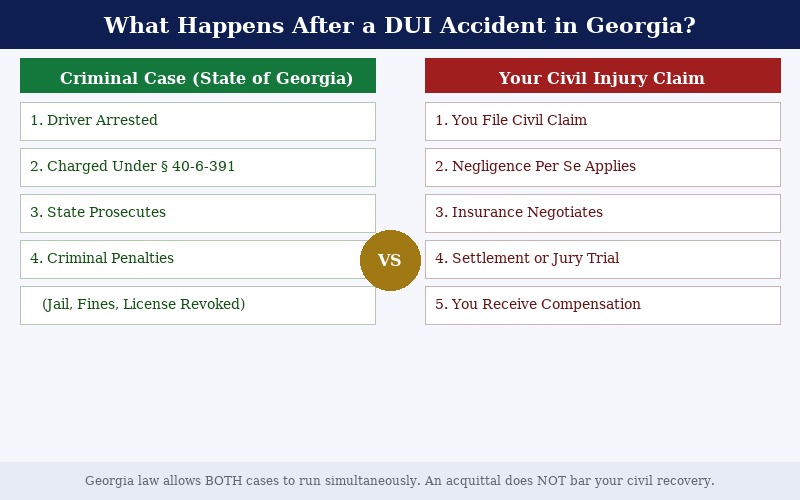
The criminal case against the drunk driver is handled by the State of Georgia. A prosecutor decides the charges. A judge or jury decides guilt. You are a witness in that process, not the decision-maker. The State’s goal is punishment, not compensation for you.
Your Civil Case Is Separate and Runs on Its Own Timeline
Your civil personal injury claim exists independently of whatever happens in criminal court. The driver can be acquitted of the DUI charge, and you can still win your civil case. The standards are different. Criminal cases require proof beyond a reasonable doubt. Civil cases require only a preponderance of the evidence, meaning it is more likely than not that the driver’s conduct caused your injuries.
Georgia’s statute of limitations for personal injury claims is two years from the date of the accident. That clock does not pause while the criminal case plays out. Waiting for a verdict can cost you your right to sue entirely.
What the Driver’s Criminal Conviction Means for Your Claim
If the drunk driver is convicted under § 40-6-391, that conviction becomes evidence in your civil case. It strengthens your negligence per se argument significantly. Insurance adjusters know this, and a conviction makes it much harder for them to dispute liability. That typically improves your settlement position considerably.
Even without a conviction, the arrest record, the officer’s field observations, field sobriety test results, and any blood alcohol test are all admissible in your civil claim. A skilled Atlanta DUI accident attorney knows exactly how to use that evidence to build the strongest possible case for you.
Punitive Damages and Why They Matter in DUI Accident Cases
Most personal injury cases in Georgia allow for compensatory damages, meaning money to cover your actual losses. Medical bills, lost wages, pain and suffering, and property damage all fall into this category. DUI accident cases open the door to something additional: punitive damages.
Georgia Law on Punitive Damages in DUI Cases
Under O.C.G.A. § 51-12-5.1, punitive damages are available when a defendant’s conduct shows willful misconduct, malice, fraud, wantonness, or an entire want of care that raises a presumption of conscious indifference to consequences. Choosing to drive drunk qualifies. Georgia courts have upheld punitive damage awards in DUI accident cases consistently.
There is a cap on punitive damages in most Georgia personal injury cases at $250,000. However, that cap does not apply in cases involving driving under the influence of alcohol or drugs. This is one of the most important distinctions in Georgia personal injury law, and it is one that victims who handle claims without an attorney almost always miss entirely.
What You Can Recover in a Georgia DUI Accident Claim
| Type of Damages | What It Covers |
|---|---|
| Medical Expenses | Emergency care, hospitalization, surgery, physical therapy, future treatment costs |
| Lost Wages | Income lost during recovery and reduced earning capacity if permanently injured |
| Pain and Suffering | Physical pain, emotional distress, and loss of enjoyment of life |
| Property Damage | Vehicle repair or replacement and personal property lost in the accident |
| Punitive Damages | Additional punishment for the drunk driver, no cap applies in Georgia DUI cases |
| Wrongful Death | Available to surviving family members if the victim did not survive the crash |
Practical rule: In a DUI accident case, punitive damages are not automatic. You have to ask for them, document the driver’s conduct, and argue them properly. This is where experienced legal representation makes a real difference in your final recovery amount.
Negligence Per Se and Why the Statute Works Directly in Your Favor
Let’s talk about negligence per se in plain terms, because this doctrine is one of the most powerful tools available to DUI accident victims in Georgia and most people have never heard of it.
In a typical personal injury case, you must prove four things: the defendant owed you a duty of care, they breached that duty, the breach caused your injuries, and you suffered damages as a result. Proving the breach, meaning proving the driver was negligent, often requires expert testimony and extensive litigation.
How § 40-6-391 Eliminates One of Your Biggest Hurdles
When a driver violates § 40-6-391, Georgia law treats that statutory violation as automatic proof of negligence. The argument shifts entirely. You no longer need to prove the driver was careless behind the wheel. The law already decided that a drunk driver is a negligent driver. Your focus moves to documenting your damages and maximizing your recovery.
This is why the police report, the arrest record, the blood alcohol test results, and the specific charge under § 40-6-391 are so important to preserve immediately after the accident. An Atlanta DUI accident attorney will secure that evidence before it becomes harder to access.
Practical rule: Never give a recorded statement to the at-fault driver’s insurance company before speaking with an attorney. In DUI cases especially, adjusters use those statements to build comparative fault arguments against you.
What Georgia’s Dram Shop Law Adds to Your Options
Georgia’s dram shop liability law, found at O.C.G.A. § 51-1-40, allows injury victims to hold bars, restaurants, and other alcohol-serving establishments liable in certain circumstances. If a business willfully and knowingly sold alcohol to someone who was noticeably intoxicated, and that person then drove and caused an accident, the business may share liability for your injuries.
When Dram Shop Claims Apply in Georgia
Dram shop liability is not automatic and the bar for proving it is intentionally high under Georgia law. The key word in the statute is “knowingly.” You must show the establishment knew or should have known the person was visibly intoxicated at the time of service. Surveillance footage, witness statements from other patrons, and bar receipts showing excessive orders all support this type of claim.
When a dram shop claim applies, it opens up an additional source of recovery. That matters significantly in cases where the drunk driver carries only minimum insurance coverage. Our attorneys at Humphrey & Ballard Law evaluate every DUI accident case for potential dram shop liability as part of our standard process.
Uninsured and Underinsured Motorist Coverage in DUI Cases
Many drunk drivers in Georgia carry only the state minimum auto insurance coverage, which is $25,000 per person for bodily injury. When your medical bills exceed that amount, and they often do in serious DUI crashes, your own uninsured and underinsured motorist coverage becomes your next line of recovery.
Georgia requires insurers to offer UM/UIM coverage to every policyholder. If you have it, your own policy can stack on top of the at-fault driver’s coverage and provide a fuller recovery. This is a coverage analysis every DUI accident victim needs done immediately after the accident.
Practical rule: Pull your own insurance policy the same day as the accident. Knowing whether you have UM/UIM coverage, and how much, directly affects your recovery strategy from day one.
Evidence You Need to Protect Right Now
The evidence in a DUI accident case starts degrading fast. Surveillance footage gets overwritten. Witnesses’ memories fade. Blood alcohol test results get challenged in court. The steps you take in the first 72 hours after a drunk driving crash can make or break your entire claim.
The Evidence That Matters Most
- Police report — Request it immediately and confirm it includes the DUI arrest and the specific § 40-6-391 charge
- Blood or breath test results — These are often the most direct evidence of intoxication and are admissible in your civil case
- Surveillance footage — From the accident scene, nearby businesses, or the establishment that served the driver
- Witness contact information — Anyone who saw the driver’s behavior before, during, or after the crash
- Medical records — Document every injury, every treatment, and every follow-up starting from the emergency room visit
- Photographs — Vehicle damage, road conditions, your visible injuries, and the full accident scene
An experienced Atlanta personal injury lawyer will send preservation letters to relevant businesses and request traffic camera footage through proper legal channels. Do not wait to begin this process.
How Georgia’s Modified Comparative Fault Rule Affects DUI Victims
Georgia follows a modified comparative fault rule under O.C.G.A. § 51-11-7. This means that if you are found to be 50% or more at fault for the accident, you recover nothing. If you are found less than 50% at fault, your recovery is reduced proportionally by your percentage of fault.
In DUI accident cases, insurance companies sometimes attempt to introduce comparative fault arguments against the victim. They may claim you were speeding, that you failed to take evasive action, or that you contributed to the collision. The negligence per se doctrine does not automatically shield you from these arguments. It strengthens your position on the driver’s fault, but the defense will still look for ways to reduce your recovery percentage.
Practical rule: Do not discuss accident details with anyone other than your attorney. Every statement you make to an adjuster, a family member of the driver, or on social media can be used to build a comparative fault argument against your claim.
| Question | Answer |
|---|---|
| Can I sue if the drunk driver was not convicted? | Yes. Civil and criminal cases use different standards of proof. An acquittal does not bar your civil injury claim. |
| How long do I have to file in Georgia? | Two years from the date of the accident under Georgia’s personal injury statute of limitations. |
| What if the drunk driver had no insurance? | Your own UM/UIM coverage may apply. Dram shop claims against the serving establishment may also be available. |
| Are punitive damages capped in DUI cases? | No. Georgia’s $250,000 punitive damages cap does not apply when impaired driving caused the injury. |
| What is negligence per se? | A doctrine that treats the driver’s violation of § 40-6-391 as automatic proof of negligence in your civil case. |
| Can I recover if I was partially at fault? | Yes, as long as you are less than 50% at fault. Your recovery is reduced by your percentage of responsibility. |
| What does a DUI accident attorney do for me? | Secures evidence, builds your damages case, pursues punitive damages, negotiates with insurers, and takes your case to trial if necessary. |
| How much does it cost to hire HB Injury? | Nothing upfront. Humphrey & Ballard Law works on contingency. You pay nothing unless we win your case. |
What a Georgia DUI Accident Attorney Does That Changes Your Outcome
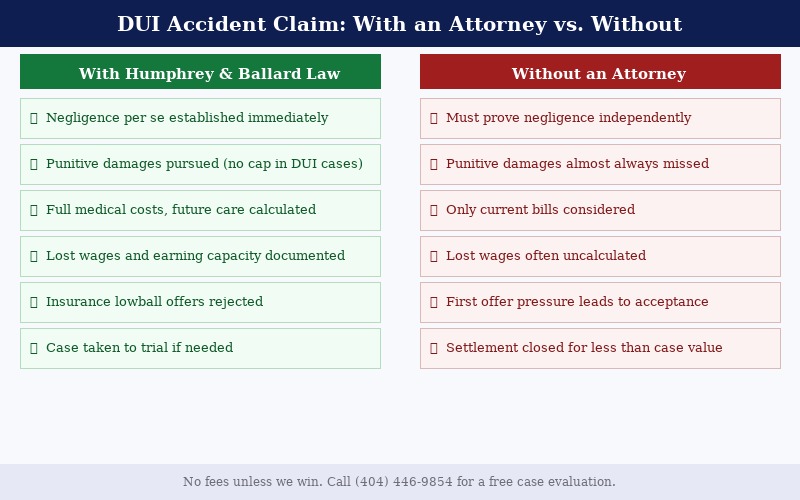
Insurance companies have lawyers working on your claim the moment you file it. Their job is to pay you as little as possible. Handling a DUI accident claim on your own, even when liability seems clear, consistently results in lower recoveries than cases handled by experienced legal counsel.
What We Do From Day One
At Humphrey & Ballard Law, our first step is evidence preservation. We send spoliation letters to businesses, request law enforcement records, and identify every potential source of recovery. We calculate your full damages, including future medical costs and lost earning capacity, so the insurance company cannot settle your case for a fraction of what it is worth by only addressing your current bills.
When punitive damages apply, and in DUI cases they often do, we make sure that argument is front and center. Many injury victims never pursue punitive damages simply because they did not know to ask. That money is available under Georgia law. Our job is to make sure you get every dollar you are owed.
Practical rule: The first settlement offer from an insurance company after a DUI crash is almost never the right number. It is a starting point designed to close your claim quickly and cheaply before you fully understand what your case is worth.
If a Drunk Driver Hit You in Georgia, You Have Real Legal Rights
Being hit by a drunk driver is one of the most preventable causes of serious injury. When someone chooses to get behind the wheel intoxicated and causes you harm, the law gives you real tools to hold them fully accountable. Georgia O.C.G.A. § 40-6-391 is not just a criminal statute. In the hands of an experienced attorney, it becomes the foundation of a powerful civil claim that includes compensatory damages, punitive damages with no cap, potential dram shop liability, and UM/UIM recovery.
At Humphrey & Ballard Law, we have been fighting for injury victims in Atlanta and across Georgia since 2015. If a drunk driver hurt you or someone you love, call us today at (404) 446-9854 or visit our contact page to schedule your free case evaluation. You deserve answers, and you deserve justice.
About the Author: Desmond Humphrey
Desmond Humphrey is a personal injury attorney and founding partner at Humphrey & Ballard Law in Atlanta, Georgia. A graduate of Atlanta’s John Marshall Law School and the University of Tennessee, Desmond has spent his career fighting for injury victims across Fulton County and the greater Atlanta metro area. He is a licensed minister of the Gospel, a recurring legal analyst on Court TV, and was also involved in Lawyer Up, a nonprofit dedicated to educating Atlanta youth about their legal rights. Desmond believes every person deserves a fair shot at justice, and that belief drives every case he takes. To speak with Desmond directly, call (404) 446-9854.
