You are probably dealing with pain, lost wages, and mounting medical bills after an 18-wheeler accident. The right 18-wheeler accident attorney makes the difference between struggling through recovery and securing the full compensation you are owed. Truck accidents are fundamentally different from standard car collisions. The size, weight, and federal regulations governing commercial trucks create unique liability questions that most general accident attorneys are not equipped to handle. Insurance companies deploy specialized adjusters trained to minimize payouts on truck claims — and they move fast. You need an experienced Atlanta truck accident attorney working your case from day one.
What Makes 18-Wheeler Accidents Different from Car Crashes
An 18-wheeler weighs up to 80,000 pounds when fully loaded. A standard sedan weighs around 3,500 pounds. When these vehicles collide, the physics are catastrophic. The forces involved in a truck accident are simply not comparable to a fender-bender or even a serious two-car crash. Victims of 18-wheeler accidents face injuries on a completely different scale:
- Spinal cord injuries and permanent paralysis from crushing compression forces
- Traumatic brain injuries from violent impact and cab intrusion
- Internal organ damage from blunt force and seatbelt compression
- Multiple fractures, herniated disc injuries, and internal bleeding that may not be immediately apparent
- Fatalities at dramatically higher rates than standard vehicle collisions
The Federal Motor Carrier Safety Administration (FMCSA) regulates commercial trucking nationwide — setting rules for driver hours of service, vehicle maintenance, cargo loading, drug testing, and commercial driver licensing. When a carrier or driver violates those regulations, that violation is direct evidence of negligence. Your 18-wheeler accident attorney must know how to obtain federal accident reports, identify FMCSA violations in driver and company records, access electronic logbook data, challenge maintenance histories, and build the multi-party liability case that truck crashes typically require.
Practical rule: General accident attorneys often lack the federal trucking knowledge to build a true truck liability case. An experienced 18-wheeler accident attorney knows how to use FMCSA records, ELD data, and federal safety regulations as the foundation of your claim.
Common Causes of 18-Wheeler Accidents in Georgia
Truck accidents happen for specific, identifiable reasons. Understanding what caused your crash is the first step toward establishing liability and securing the full compensation you are owed. Every cause below creates a distinct evidence trail your attorney will pursue.
Driver Fatigue and Hours-of-Service Violations
Federal law limits truck drivers to 11 hours of driving per 14-hour work window. Many drivers and carriers violate these rules under pressure from unrealistic delivery deadlines. A fatigued driver’s reaction time at highway speeds is equivalent to driving under the influence. Electronic logging device (ELD) data records every driving hour and can prove a driver exceeded legal limits before your crash — that record is preserved automatically and must be obtained quickly before it is overwritten.
Improper Cargo Loading
Overweight or improperly secured cargo shifts during transit and causes loss of directional control. Trailers with uneven weight distribution jackknife, roll, or swing into adjacent lanes without warning. The party responsible for loading the cargo — whether the carrier, a third-party shipper, or a warehouse facility — carries direct liability. According to the FMCSA cargo securement rules, improperly secured loads violate federal standards that exist precisely because of how often shifting cargo causes catastrophic collisions.
Inadequate Vehicle Maintenance
Commercial trucks require regular inspection and maintenance under both federal and state law. Failing brakes, bald tires, defective coupling systems, and broken steering components cause accidents that a well-maintained vehicle would have avoided. Trucking companies cut maintenance corners to reduce costs — then send vehicles back on the road. Maintenance records subpoenaed by your attorney prove whether the carrier knew about mechanical deficiencies before they sent that truck onto the highway.
Speeding and Failure to Adjust for Conditions
A fully loaded 18-wheeler traveling at 70 mph requires over 500 feet to stop — roughly the length of one and a half football fields. Speeding, unsafe lane changes, and failure to slow for weather, traffic, or road conditions turn controllable situations into fatal crashes. Speed data from the truck’s event data recorder (black box) provides objective evidence of how fast the driver was traveling at the moment of impact.
Impaired or Distracted Driving
Drug use is a documented problem in the commercial trucking industry. Stimulant abuse to push through fatigue regulations, alcohol, and mobile device use behind the wheel all create the same result — a driver who cannot react in time. Post-accident drug and alcohol testing is required by federal regulation, and cell phone records can prove distraction at the moment of the crash.
Practical rule: Every 18-wheeler accident requires immediate investigation of driver logs, vehicle maintenance records, and cargo documentation. Do not accept the carrier’s account of what happened — the evidence tells a different story.
Who Is Liable in an 18-Wheeler Accident in Georgia?
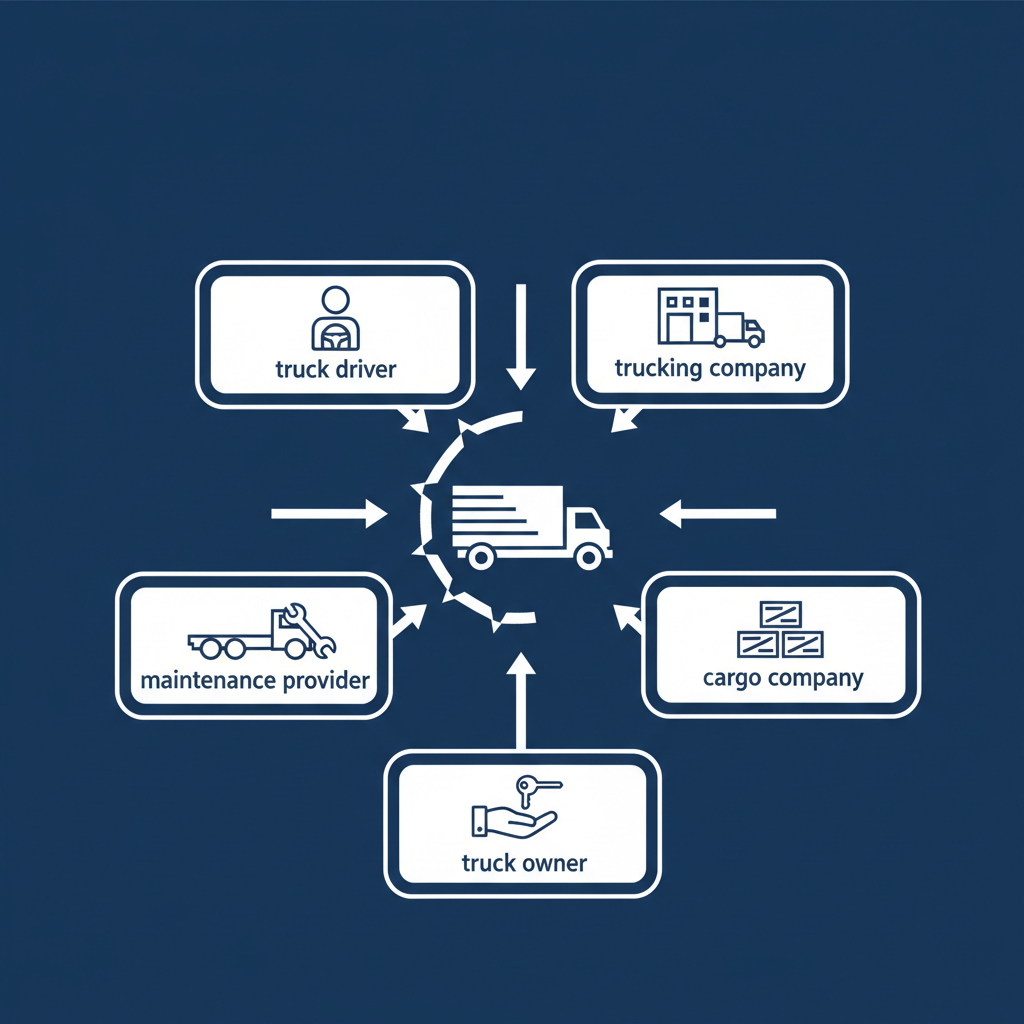
After an 18-wheeler accident, multiple parties may share liability. Identifying every responsible party is not optional — partial liability claims leave significant compensation on the table. Your Atlanta truck accident attorney must conduct a full investigation to ensure every negligent party is named and every available insurance policy is accessed.
The Truck Driver
The driver may be directly liable for speeding, fatigue, impairment, distraction, or failure to adjust for road conditions. Negligent drivers can be held personally accountable regardless of whether they are an employee or independent contractor. The driver’s CDL history, prior violations, and safety record all become relevant evidence.
The Trucking Company (Motor Carrier)
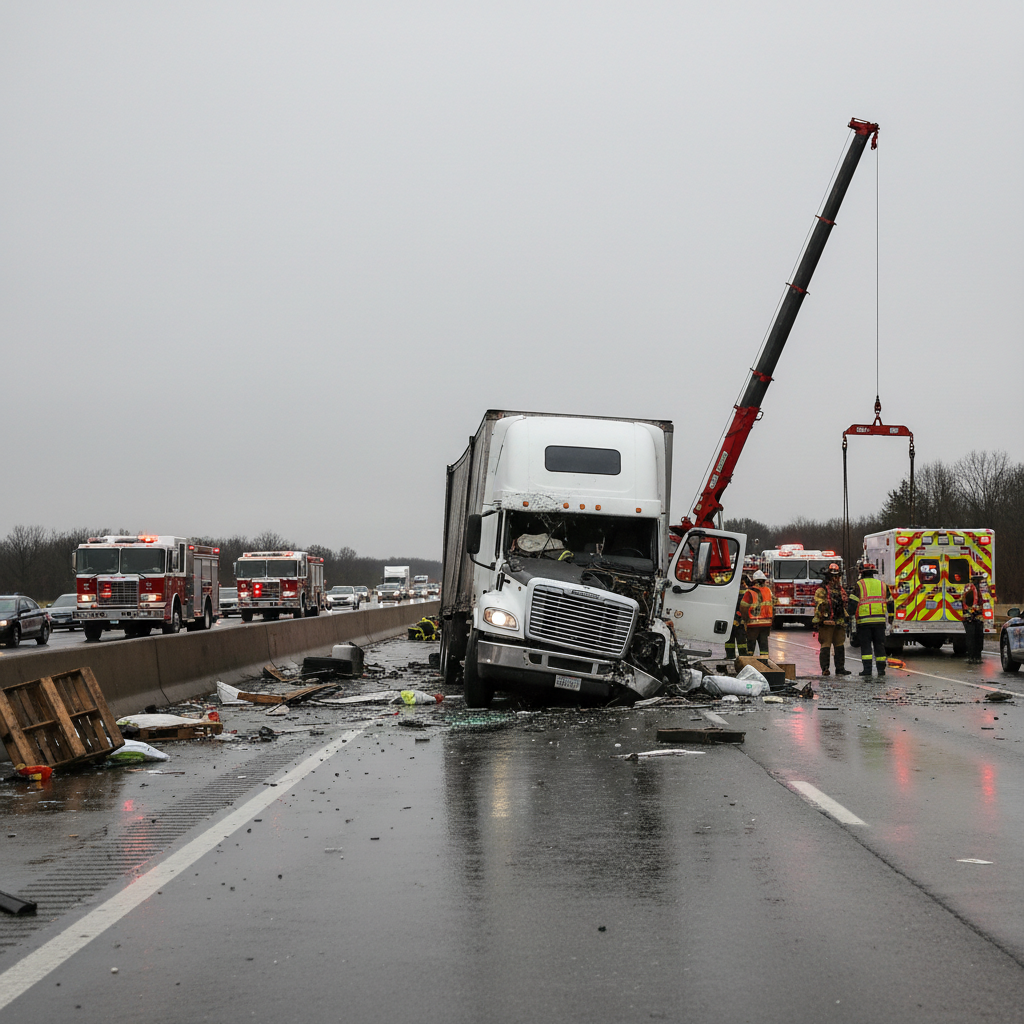
The carrier is almost always liable under vicarious liability — they are responsible for their employees’ negligent actions during the course of employment. Beyond vicarious liability, carriers face direct liability for negligent hiring of drivers with known safety violations, failing to maintain vehicles, requiring drivers to violate hours-of-service rules, and inadequate safety training. Carrier liability typically means access to commercial insurance policies worth millions of dollars.
Third-Party Cargo and Maintenance Companies
If a third-party cargo loading company improperly secured the freight, or a maintenance facility performed defective repairs, those parties share liability independently of the driver and carrier. This multi-party structure is what makes 18-wheeler accident claims fundamentally different from standard auto accident claims — and why thorough investigation matters so much to your final recovery.
Practical rule: Most 18-wheeler accidents involve multiple liable parties — the driver, the carrier, sometimes a cargo company or maintenance facility. Full recovery requires finding and naming every one of them.
Critical Evidence in an 18-Wheeler Accident Case
Building a strong truck accident case requires evidence that standard car accident claims never involve. Your 18-wheeler accident attorney must move fast — some of this evidence disappears or is overwritten within days of the crash.
Evidence to secure immediately at the scene
- Photos of the truck’s damage, cargo configuration, and any visible defects
- Photos of your vehicle, the crash scene, and road conditions
- Witness contact information — names, phone numbers, statements
- The truck’s DOT number, license plate, and carrier name on the cab door
- Any visible safety violations — overloaded trailer, improperly secured cargo, worn tires
Evidence your attorney will obtain through subpoena
- Driver’s commercial driver’s license (CDL) history and prior violation record
- Electronic logging device (ELD) data — the objective hours-of-service record
- DOT safety inspection history from the FMCSA Safety Measurement System
- Full truck maintenance and repair records
- Dispatch communications and delivery deadline records
- The truck’s event data recorder (black box) — speed, braking, and impact data
- Drug and alcohol post-accident test results
- Cargo loading documentation and weight manifests
- Driver and company insurance policy information
- Prior complaints, citations, or out-of-service orders against the driver or carrier
Practical rule: Black box data and ELD records are overwritten quickly. Your attorney must send a written preservation demand to the carrier within days of the crash — not weeks.
Georgia Law and 18-Wheeler Accident Claims
Georgia law creates specific rules for how truck accident liability and damages are calculated. Understanding these rules is the difference between a partial recovery and a full one.
Georgia’s modified comparative fault standard
Georgia follows a modified comparative negligence doctrine under OCGA § 51-12-33. If you were partially at fault, your recovery is reduced proportionally — but only if your fault is below 50%. Truck accident cases rarely involve meaningful plaintiff fault. A commercial carrier operating an 80,000-pound vehicle has a heightened duty of care, and courts recognize that. Still, defense attorneys will attempt to assign you partial fault to reduce the payout. Your attorney’s job is to document the carrier’s negligence comprehensively so that comparative fault arguments cannot gain traction.
Punitive damages in Georgia truck accident cases
Georgia allows punitive damages under OCGA § 51-12-5.1 when a defendant acts with willful misconduct, malice, fraud, or conscious indifference to consequences. Trucking companies that knowingly violated hours-of-service rules, employed drivers with disqualifying records, or ignored documented mechanical failures can face punitive exposure well beyond compensatory damages. Punitive damages in Georgia are capped at $250,000 in most cases — but in cases involving specific intent to harm, that cap does not apply.
The statute of limitations for truck accident claims in Georgia
Georgia’s statute of limitations for personal injury claims is two years from the date of the accident. For wrongful death claims arising from a fatal 18-wheeler accident, the two-year period runs from the date of death. Missing this deadline permanently bars your claim regardless of how strong the liability evidence is. If the at-fault truck was operated by a government contractor or municipal entity, ante litem notice requirements apply with even shorter windows — sometimes as few as six months from the crash date. According to the Georgia Department of Transportation, commercial truck crashes account for a disproportionate share of serious injury and fatality crashes on Georgia highways. The NHTSA large truck safety data makes clear that these crashes produce the most severe injury outcomes in personal injury law — the stakes of missing a deadline are enormous.
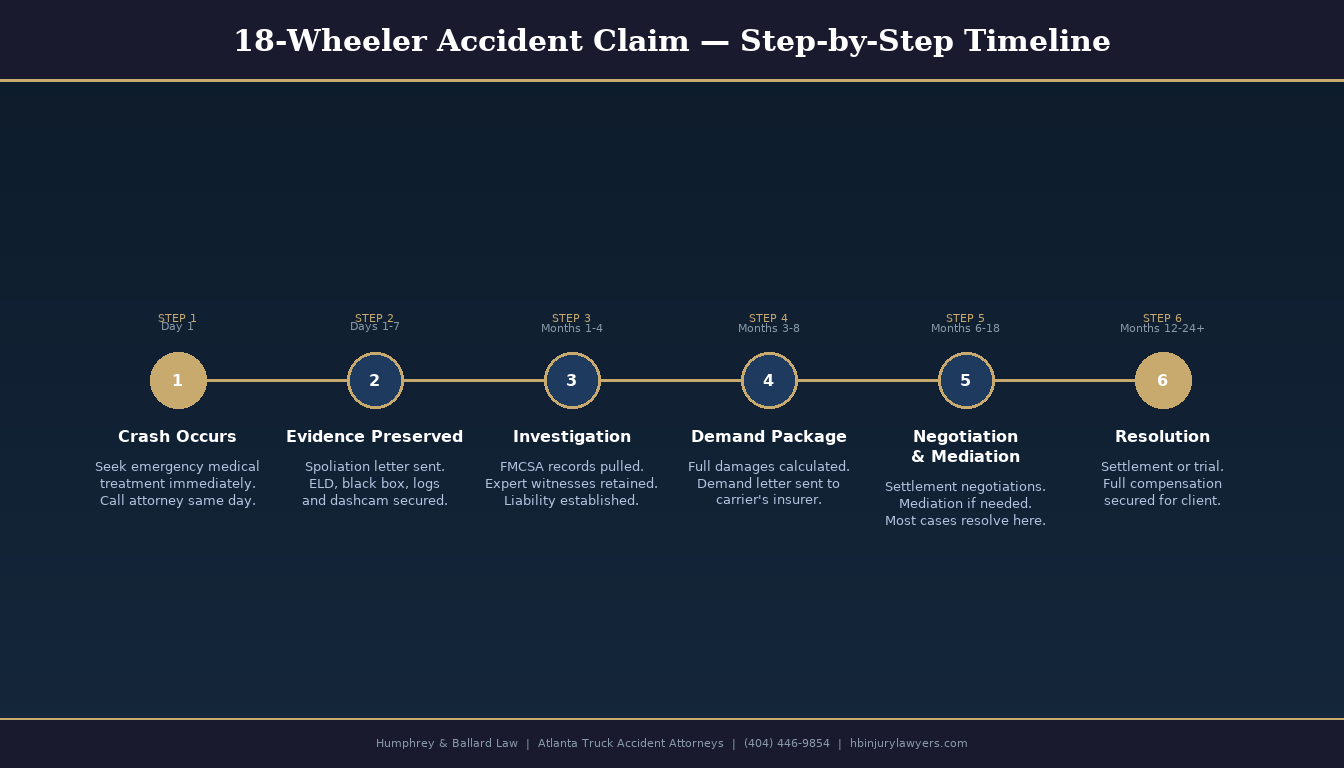
The typical timeline for an 18-wheeler accident claim
Understanding how long a truck accident case takes helps you plan financially during recovery. Most Georgia 18-wheeler accident claims follow this general timeline:
- Weeks 1–4: Emergency medical treatment, attorney engagement, spoliation letter sent, initial investigation begins, preservation demand filed.
- Months 1–4: Subpoenas issued for ELD records, black box data, maintenance records, CDL history. Accident reconstruction and medical experts retained.
- Months 3–8: Medical treatment continues. Attorney compiles complete damages picture including future care projection. Demand package prepared.
- Months 6–12: Demand letter sent to carrier’s insurer. Negotiation begins. Most straightforward cases settle in this window.
- Months 8–18: Mediation if negotiations stall. Depositions of driver, carrier representative, and expert witnesses.
- Months 12–24+: Trial if no settlement. Jury trials in Georgia truck accident cases often result in larger verdicts than what was offered in settlement — carriers know this and frequently return to negotiate before the verdict comes in.
Do not accept an early settlement offer without knowing your full injury picture. Early offers from trucking company adjusters are designed to close your claim before the true cost of your injuries becomes clear — often before you know whether you will ever fully recover. An experienced truck accident attorney will never advise you to settle before maximum medical improvement is established.
Practical rule: Georgia’s two-year statute of limitations sounds like a long time. It is not — gathering the evidence needed to prove a truck liability case takes months. Start the process immediately after your crash.
What Damages Can You Recover After an 18-Wheeler Accident?
The damages available in a Georgia 18-wheeler accident claim reflect the full scope of what the crash has cost you — financially, physically, and personally. Your attorney’s job is to document and quantify every category.
Economic damages
- Past and future medical expenses — emergency room, surgery, hospitalization, rehabilitation, physical therapy, assistive devices, and ongoing specialist care
- Lost wages — income missed during recovery, reduced earning capacity if injury prevents return to prior work, and lost business income for self-employed victims
- Property damage — vehicle replacement or repair, and personal property destroyed in the crash
- Out-of-pocket costs — transportation to medical appointments, home modification for disability, and caregiver expenses
Non-economic damages
- Pain and suffering — the ongoing physical experience of the injuries themselves
- Emotional distress — anxiety, PTSD, depression, and psychological trauma resulting from the crash and its aftermath
- Loss of enjoyment of life — activities, relationships, and quality of life permanently diminished by the injury
- Loss of consortium — impact on spousal and family relationships
In cases involving spinal cord injuries or traumatic brain injuries — the injuries most commonly seen in severe truck crashes — lifetime medical cost projections often run into the millions. A case that settles without accounting for future care leaves the victim permanently undercompensated. According to CDC data on traumatic brain injury, TBI survivors often require decades of ongoing care — costs that must be built into your demand before any settlement is accepted.
How Humphrey & Ballard Law Handles 18-Wheeler Accident Cases
At Humphrey & Ballard Law, we handle 18-wheeler accident cases throughout Atlanta and Georgia. Our approach is built around the reality that truck cases require more investigation, more expert resources, and more aggressive evidence preservation than standard vehicle claims. Here is exactly what we do when we take your case.
Immediate evidence preservation
The first thing we do is send a written spoliation letter to the trucking company demanding preservation of all evidence — ELD records, black box data, maintenance records, driver logs, dashcam footage, and dispatch communications. This letter creates legal liability if the carrier destroys evidence, and it happens within hours of our engagement, not weeks.
Full FMCSA compliance investigation
We pull the carrier’s full safety record from the FMCSA Safety Measurement System, check the driver’s CDL history and prior violations, and obtain every inspection and out-of-service record available. This investigation frequently reveals a pattern of safety violations that supports a punitive damages claim — and that changes the economics of the entire case for the carrier’s insurance company.
Medical and economic damages documentation
We work with your treating physicians and independent medical experts to build a complete picture of your injuries, current treatment needs, and projected future care costs. For 18-wheeler accident victims with severe injuries, this often means engaging a life care planner and economic expert to project lifetime costs. The demand we send the insurance company reflects the full value of your claim — not a number designed to facilitate a quick settlement.
Wrongful death representation
When a truck accident results in a fatality, the family has the right to pursue a wrongful death claim for the full value of the life lost — past and future income, the deceased’s pain and suffering before death, and the family’s own loss of companionship. These cases require experienced counsel from the very first step. We handle them on contingency — families pay nothing unless we recover.
Practical rule: Trucking companies have legal teams and specialized insurance adjusters on your crash within hours. You need an experienced 18-wheeler accident attorney on your side just as fast — not after you have already spoken to their adjuster.
Frequently Asked Questions About 18-Wheeler Accident Claims in Georgia
| Question | Answer |
|---|---|
| How is a truck accident different from a car accident claim? | Truck accidents involve federal regulations, multiple liable parties, specialized evidence (ELD data, black box, FMCSA records), and commercial insurance policies with much higher limits. |
| How long do I have to file a truck accident claim in Georgia? | Two years from the date of the accident for personal injury. Two years from the date of death for wrongful death. Government entity involvement may shorten this window significantly. |
| Can I sue both the driver and the trucking company? | Yes. Georgia law allows claims against the driver, the carrier, and any third parties whose negligence contributed to the crash. |
| What if I was partially at fault in the truck accident? | Georgia’s modified comparative fault rule allows recovery as long as you were less than 50% at fault. Your damages are reduced by your percentage of fault. |
| What is a spoliation letter and why does it matter? | A formal demand for evidence preservation sent to the carrier immediately after the crash. If the carrier destroys evidence after receiving it, that destruction can be used against them at trial. |
| Do I need an attorney who specializes in truck accidents? | Yes. Federal trucking regulations, FMCSA compliance investigations, ELD data interpretation, and multi-party liability cases require specific expertise that general attorneys often lack. |
| What does Humphrey and Ballard Law charge for truck accident cases? | Nothing upfront. We handle all cases on a contingency fee — you pay only if we recover compensation for you. |
| What if the truck driver was an independent contractor, not an employee? | The carrier can still be liable under leasing regulations and FMCSA rules. Independent contractor status does not automatically shield the company from liability. |
Get the 18-Wheeler Accident Attorney Atlanta Families Trust
An 18-wheeler accident changes everything — your health, your income, and your family’s stability. Humphrey & Ballard Law represents Atlanta injury victims in truck accident cases throughout Georgia. Call us at (404) 446-9854 or reach us through our contact page for a free, no-obligation consultation. You pay nothing unless we win. We are available 24 hours a day, 7 days a week — because accidents do not happen on a schedule.
About Humphrey & Ballard Law
Humphrey & Ballard Law is an Atlanta personal injury firm representing victims of car accidents, 18-wheeler and commercial truck crashes, traumatic brain injuries, wrongful death, slip and fall, and catastrophic injury across Georgia. Founded by attorneys Desmond Humphrey and David Ballard, the firm has built a reputation for thorough investigation, aggressive negotiation, and trial readiness in serious injury cases. Every case is handled on a contingency fee basis — clients pay nothing unless the firm recovers compensation. The firm serves Atlanta and surrounding communities including Buckhead, Decatur, Marietta, College Park, Sandy Springs, and throughout Fulton, DeKalb, Cobb, and Clayton counties. Call (404) 446-9854 or visit hbinjurylawyers.com to speak with an attorney today.
