Atlanta Construction Site Deaths | Legal Options

Atlanta Construction Site Deaths With Humphrey and Ballard Law

Atlanta’s skyline is booming. From the sweeping redevelopment at Centennial Yards near Mercedes-Benz Stadium to ongoing expansions around Hartsfield-Jackson Atlanta International Airport, cranes now dot every major corridor in the city. Billions in investment are pouring into Midtown, Buckhead, the Beltline, and beyond — transforming Atlanta into one of the fastest-growing metro areas in the country.

But behind every crane and concrete pour is a human being. A father. A spouse. A son or daughter showing up to do honest, dangerous work.

When that work becomes fatal — and in Atlanta, it does at an alarming rate — surviving families are left not only with grief, but with urgent, unanswered questions: Who is responsible? What are my rights under Georgia law? How do I make sure this never happens to another family?

If you lost a loved one in a construction site accident in or around Atlanta, this guide is written for you. At HB Injury Lawyers, our Atlanta construction accident attorneys are committed to fighting for families who deserve answers — and justice.


The Scope of the Problem: Construction Deaths in Atlanta and Georgia

Construction is consistently one of the most deadly industries in Georgia and across the United States. The numbers are stark and sobering:

These are not random, unavoidable tragedies. Safety researchers, OSHA officials, and experienced construction accident attorneys agree: the majority of construction site deaths are preventable. They happen because safety is deprioritized in favor of speed and cost efficiency — and because enforcement of existing safety standards remains dangerously inconsistent.

The Center for Construction Research and Training (CPWR) reports that there is approximately one OSHA inspector for every 70,000 workers nationwide — leaving the vast majority of job sites unmonitored until an accident occurs.


Common Causes of Fatal Construction Accidents in Atlanta

OSHA identifies four primary causes of construction fatalities, commonly called the “Fatal Four.” Together, these account for the majority of construction worker deaths in the U.S. each year:

1. Falls from Heights

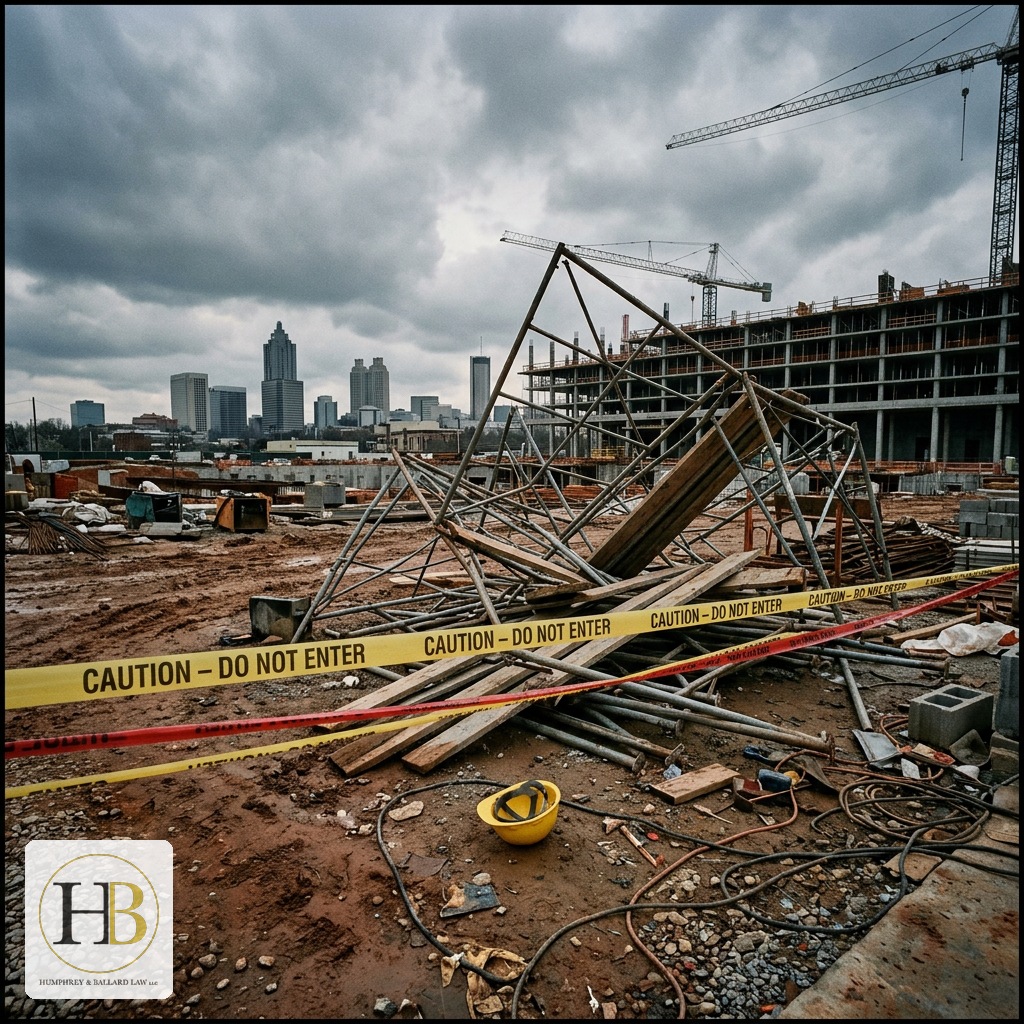
Falls are the leading cause of construction worker deaths nationwide. Unprotected edges, missing or inadequate guardrails, improperly secured scaffolding, and harness failures all contribute. Atlanta’s boom in high-rise construction — with structures routinely exceeding 20 and 30 stories — makes fall risk especially acute. As the Centennial Yards tragedy in March 2025 demonstrated, even one moment of inadequate fall protection can cost a young worker their life.

2. Struck-By Accidents

Workers on Atlanta job sites are regularly endangered by falling tools, swinging crane loads, forklifts, dump trucks, and other heavy equipment. According to OSHA, struck-by accidents are the second most common cause of construction fatalities — and one of the most preventable with proper site management protocols.

3. Electrocution

Construction sites are densely wired environments. Contact with overhead power lines, exposed wiring, and live circuits kills hundreds of workers across the country every year. Failure to de-energize lines, inadequate lockout/tagout procedures, and lack of proper insulated tools are common contributing factors.

4. Caught-In/Between Accidents

These accidents occur when a worker is caught, compressed, or crushed between equipment, materials, or a structure. Trench collapses are a particularly deadly subset: more than 250 workers nationally have died since 2013 from trench cave-ins, most of them in cases where employers failed to follow basic government regulations for making trenches safe.

Additional Causes of Atlanta Construction Fatalities

Beyond the Fatal Four, Atlanta construction workers also die from:

  • Heat illness and heat stroke — Atlanta’s summer temperatures regularly exceed 95°F. OSHA has specifically targeted the Southeast in its regional emphasis program for heat-related worker injuries and deaths.
  • Crane collapses and equipment failures — A partial crane collapse in Midtown Atlanta displaced hundreds of residents from surrounding apartment buildings, illustrating how dangerous crane operations can become when safety protocols fail.
  • Scaffold collapses
  • Defective tools and equipment
  • Inadequate personal protective equipment (PPE)
  • Subcontractor negligence — OSHA data shows that over 60% of fatal construction accidents occur on projects with fewer than 10 workers on-site, often smaller subcontractor crews who lack safety training or adequate oversight.

Who Is Legally Responsible After a Construction Site Death in Atlanta?

One of the most complex aspects of a fatal construction accident case is determining who bears legal responsibility. Atlanta’s massive construction projects routinely involve multiple layers of contractors and subcontractors, making accountability difficult to trace — and allowing negligent parties to deflect blame.

Potentially liable parties in a Georgia construction death case can include:

  • General contractors — who have broad responsibility for safety on the overall job site
  • Subcontractors — who may have created the specific unsafe condition that led to the death
  • Property owners — who may be liable for dangerous conditions they knew or should have known about
  • Equipment manufacturers — if a defective product (crane, forklift, harness, scaffold component) contributed to the accident
  • Engineers and architects — if design defects or failures created foreseeable hazards
  • Site safety managers — who had a direct duty to enforce OSHA standards and worker safety protocols

Identifying all liable parties is one of the most important early steps in any construction fatality case. An experienced Atlanta construction accident attorney will conduct a thorough investigation — including reviewing OSHA inspection records, accident reports, site safety logs, equipment maintenance history, and witness testimony — to build a complete picture of what happened and who is responsible.


Legal Options for Families After an Atlanta Construction Site Death

Georgia law provides multiple legal avenues for families who lose a loved one in a construction accident. Understanding which claims apply to your situation — and how they interact with one another — is critical to securing the full compensation your family deserves.

Option 1: Georgia Workers’ Compensation Death Benefits

If the deceased worker was an employee (not an independent contractor) of a Georgia-based employer, the family is likely entitled to workers’ compensation death benefits under O.C.G.A. § 34-9-265.

Georgia workers’ compensation death benefits can include:

  • Weekly income benefits paid to surviving dependents (typically a percentage of the worker’s average weekly wage)
  • Burial and funeral expense reimbursement (up to the statutory cap)
  • Medical expenses related to the fatal injury

Workers’ compensation is a no-fault system — benefits are available regardless of whether the employer was negligent. However, there is an important trade-off: by accepting workers’ compensation benefits, the family generally gives up the right to sue their employer directly for negligence.

Important limitation: Workers’ compensation benefits, while helpful, rarely account for the true and total economic and emotional loss a family suffers after a fatal workplace accident. This makes pursuing additional legal claims — especially when third parties were involved — absolutely essential.

Option 2: Georgia Wrongful Death Lawsuit

If a party other than the direct employer — such as a subcontractor, property owner, equipment manufacturer, or site safety supervisor — contributed to the fatal accident through negligence, Georgia law allows the family to pursue a wrongful death lawsuit separate from and in addition to any workers’ compensation claim.

Under O.C.G.A. § 51-4-2, surviving family members are entitled to recover the “full value of the life” of the deceased worker. Georgia courts have interpreted this to include both economic and non-economic damages evaluated from the perspective of the deceased — making it one of the broadest wrongful death damage measures in the country.

Damages recoverable in a Georgia wrongful death claim can include:

  • The full economic value of the deceased’s future earning capacity
  • The intangible, non-economic value of the deceased’s life — companionship, guidance, love, and presence
  • Funeral and burial expenses (through a companion estate claim under O.C.G.A. § 51-4-5)
  • Medical expenses incurred between the accident and the time of death
  • Pain and suffering experienced by the deceased prior to death (through the estate claim)

Who Can File a Wrongful Death Claim in Georgia?

Georgia law establishes a specific hierarchy for who has standing to bring a wrongful death claim:

  1. Surviving spouse — has the primary right; if there are also surviving children, the spouse represents their interests and must share the recovery, but can never receive less than one-third of the total award regardless of the number of children
  2. Children of the deceased — if there is no surviving spouse
  3. Parents of the deceased — if there is no surviving spouse or children
  4. Administrator or executor of the estate — if none of the above survive the deceased

A 2022 amendment to O.C.G.A. § 51-4-2 expanded protections so that descendants of a predeceased child can now share in a wrongful death recovery — an important update for complex family situations.

The Statute of Limitations: Act Quickly

Georgia’s wrongful death statute of limitations is two years from the date of death (O.C.G.A. § 51-4-2). Missing this deadline typically results in permanently losing the right to file a civil lawsuit. Do not wait. Contact an Atlanta wrongful death attorney as soon as possible to protect your family’s legal rights.

Option 3: Third-Party Personal Injury or Product Liability Claim

In some cases, a fatal construction accident involves a defective product — a malfunctioning harness, a crane with a defective safety mechanism, a scaffold built with substandard materials. In these situations, the family may have a product liability claim against the manufacturer, distributor, or retailer of the defective equipment, separate from any wrongful death or workers’ compensation claim.

Product liability claims in construction fatality cases require expert investigation, engineering analysis, and often extensive discovery. They can result in significant additional compensation — particularly in cases involving large equipment manufacturers whose negligence may have contributed to multiple deaths.

Option 4: OSHA Violation as Evidence of Negligence

When OSHA investigates a fatal construction accident, any citations issued for safety violations can serve as powerful evidence in a civil wrongful death lawsuit. An OSHA citation is not a finding of civil liability — but it establishes that a safety standard was violated, which significantly strengthens a negligence argument in court.

Families of construction fatality victims should promptly request a copy of all OSHA investigation reports and citations through the OSHA Freedom of Information Act (FOIA) process. Your attorney can assist with this.


Workers’ Compensation vs. Wrongful Death: Can You Pursue Both?

Yes — in many cases, Georgia families can and should pursue both workers’ compensation death benefits and a civil wrongful death lawsuit, provided the wrongful death claim targets a third party (not the direct employer).

Here’s how it typically works:

  • Workers’ compensation death benefits are paid by the deceased’s direct employer (through their insurance carrier) — regardless of fault
  • A wrongful death lawsuit or third-party negligence claim can be brought simultaneously against other responsible parties — general contractors, subcontractors, property owners, equipment manufacturers
  • The two claims are legally separate and do not preclude each other

This dual approach is often the most effective strategy for maximizing the total compensation a family can recover after a construction site death. An experienced Atlanta wrongful death attorney will evaluate both avenues and build a coordinated legal strategy.


Special Considerations: When the Employer Was Grossly Negligent

Georgia generally prohibits direct lawsuits against employers who are covered by workers’ compensation insurance — a legal concept known as the “exclusive remedy” doctrine. However, there are narrow but important exceptions where a direct lawsuit against the employer may be possible:

  • When the employer intentionally created the dangerous condition that caused the death
  • When the employer engaged in fraud or misrepresentation to conceal a known hazard
  • When a corporate officer or manager personally and directly caused the injury
  • When the employer is not properly covered by workers’ compensation insurance

These situations require careful legal analysis. If you suspect your loved one’s employer acted with gross disregard for worker safety — cutting corners on fall protection, ignoring known equipment failures, falsifying safety logs — tell your attorney immediately. The facts may support claims well beyond standard workers’ compensation benefits.


What Damages Can Families Recover?

The total compensation recoverable after an Atlanta construction site death depends on the specific legal claims available, the parties involved, and the strength of the evidence. In general, Georgia families can seek compensation for:

Economic Damages

  • Lost future wages, salary, and earning capacity
  • Lost benefits (health insurance, pension, retirement contributions)
  • Medical and emergency treatment expenses incurred before death
  • Funeral and burial expenses
  • Loss of household services and financial support the deceased would have provided

Non-Economic Damages

  • Loss of the deceased’s care, guidance, and companionship
  • Grief and emotional suffering (compensable through the estate claim)
  • Loss of parental guidance for surviving minor children
  • Loss of consortium for a surviving spouse

Punitive Damages

In cases involving especially egregious conduct — such as a contractor who knowingly ignored OSHA citations, falsified safety inspections, or deliberately suppressed evidence of a known hazard — punitive damages may be available under O.C.G.A. § 51-12-5.1. These damages are designed not to compensate the family, but to punish the wrongdoer and deter similar conduct in the future.


Steps to Take After a Construction Site Death in Atlanta

The actions taken in the hours, days, and weeks immediately following a construction fatality can significantly affect the outcome of a family’s legal case. If you have lost a loved one, here is what you should do:

  1. Request a copy of all incident reports — from the employer, the general contractor, and any government agencies that responded to the scene.
  2. Do not sign anything from the employer’s insurance carrier or the general contractor’s legal team without consulting an attorney first. Insurance companies routinely contact families quickly in an attempt to limit their liability exposure.
  3. Preserve evidence — If possible, photograph the accident scene, the equipment involved, and any visible safety deficiencies. Gather names and contact information for coworkers who witnessed the accident.
  4. Request the OSHA investigation record — OSHA is required to investigate fatal workplace accidents. Their reports, citations, and findings are public records and can be invaluable evidence.
  5. Obtain a copy of the death certificate and any autopsy report — these documents are essential for both legal claims and insurance proceedings.
  6. Contact an experienced Atlanta construction death attorney immediately — The two-year statute of limitations on wrongful death claims sounds like ample time, but critical evidence — construction logs, surveillance footage, equipment maintenance records — can disappear quickly. Early legal intervention protects the evidence your case depends on.

Learn more about the full process by visiting our page on Atlanta construction accident claims.


Why Atlanta Construction Sites Are Especially Dangerous Right Now

Atlanta’s construction boom is creating a perfect storm of elevated risk for workers:

Tight deadlines and cost pressure. Major projects like The Stitch, Centennial Yards, and airport expansion contracts are valued in the billions and subject to hard completion deadlines tied to events like the 2026 FIFA World Cup. When timelines get compressed, safety shortcuts follow.

Complex subcontracting chains. Mega-projects routinely involve a developer, a general contractor, and dozens of subcontractors — each with different safety standards, training protocols, and equipment. This fragmentation creates confusion over who is responsible for worker safety at any given moment, and OSHA data confirms that smaller subcontractor crews operating within large projects are disproportionately represented in fatalities.

Heat exposure. Atlanta’s summers are punishing. OSHA has identified Georgia as a regional hotspot for heat-related worker injuries and deaths, launching a targeted enforcement program across the Southeast. Employers who fail to provide adequate water, shade, and rest breaks during heat events face not just OSHA citations — they face potential wrongful death liability.

Skilled labor shortages. With demand for construction workers outpacing supply, companies are increasingly using workers with limited experience and training — increasing the risk of accidents from improper equipment use, failure to recognize hazards, and non-compliance with safety protocols.


Frequently Asked Questions About Atlanta Construction Site Death Claims

Can I file a lawsuit if my loved one was an undocumented worker?

Yes. Georgia workers’ compensation benefits apply to all workers, regardless of immigration status. Wrongful death and third-party claims are similarly available. Immigration status does not affect a family’s right to pursue justice and compensation under Georgia law.

What if my loved one was partially at fault for the accident?

Georgia follows a modified comparative fault rule. As long as the deceased worker was less than 50% at fault for the accident, the family can still recover damages — though the recovery may be reduced in proportion to the worker’s share of fault. In most construction fatality cases, site conditions, equipment failures, and supervisor decisions are primary contributing factors, making significant worker fault unlikely.

How long does a construction death lawsuit take in Georgia?

Every case is different. Some claims resolve through settlement negotiations within months; others involving large contractors or disputed liability may take a year or more to litigate through the Georgia court system. Our attorneys work to resolve cases as efficiently as possible while always prioritizing maximum recovery for your family.

What if the employer had no workers’ compensation insurance?

Georgia law requires most employers with three or more employees to carry workers’ compensation insurance. An employer who fails to carry this coverage is subject to penalties — and may be directly sued by the worker’s family without the protection of the “exclusive remedy” workers’ compensation shield.

Does it cost anything to consult with an Atlanta construction death attorney?

No. At HB Injury Lawyers, we offer free consultations for construction fatality cases, and we work on a contingency fee basis — meaning you pay nothing unless we win your case.


HB Injury Lawyers: Fighting for Atlanta Construction Fatality Families

Losing a family member to a preventable construction accident is one of the most devastating experiences a family can endure. The financial pressure of lost income, funeral costs, and an uncertain future compounds the grief. You should not have to navigate Georgia’s complex legal landscape alone — especially while you are grieving.

At HB Injury Lawyers, our team has extensive experience handling construction site fatality cases throughout Atlanta and Georgia. We know how to investigate multi-party construction accident claims, work with OSHA records and expert witnesses, and pursue every available legal avenue — from workers’ compensation death benefits to full wrongful death litigation — to recover the maximum compensation for your family.

We believe that every construction worker who goes to work and doesn’t come home deserves justice. And every family left behind deserves a legal team that will fight as hard for them as they fought for their family.

Contact HB Injury Lawyers today for a free, confidential consultation. There is no obligation, no upfront cost, and no fee unless we win. Reach out to our team now — because the sooner we begin, the better positioned your family will be to secure the justice your loved one deserves.


This blog post is provided for general informational purposes only and does not constitute legal advice. Reading this article does not create an attorney-client relationship. Laws and statutes are subject to change. If you have a specific legal matter, please contact a licensed Georgia attorney for advice tailored to your situation.

Related Articles

Understanding Truck Accidents

Understanding Truck Accidents and the Role of a Truck Accident Attorney in Atlanta Truck accidents can be life-altering events that cause serious injuries and significant

Read More »