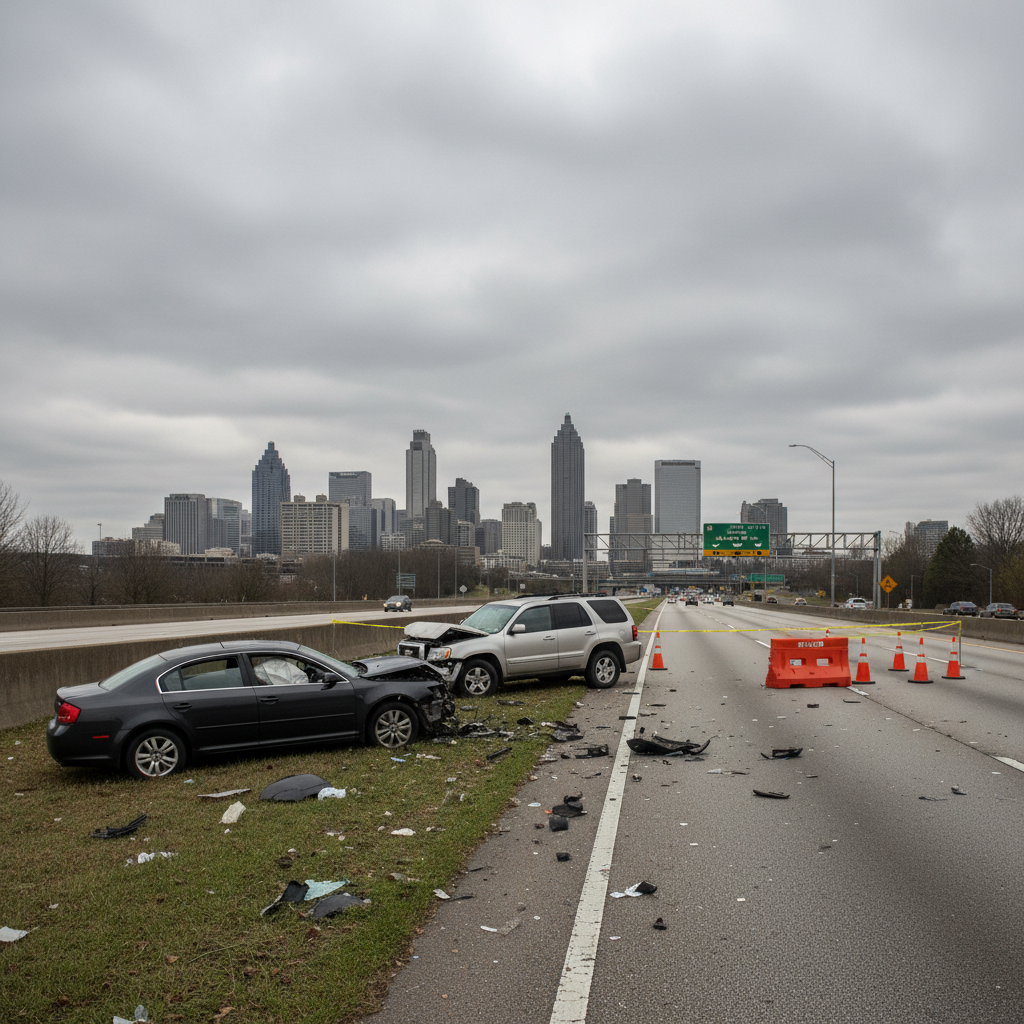
Knowing what to do after a car accident in Atlanta can protect your health, your rights, and the value of your claim. The first moments after a crash are chaotic — but the steps you take in those minutes determine everything that follows. Insurance companies start building their defense immediately. Evidence disappears fast. Georgia law has specific requirements that most drivers don’t know until it’s too late. This guide walks you through exactly what to do after a car accident in Atlanta — step by step, in plain language, from an attorney’s perspective.
Atlanta roads are among the most dangerous in the Southeast. The National Highway Traffic Safety Administration (NHTSA) consistently ranks Georgia in the top tier nationally for traffic fatalities. Interstates 285, 75, and 85 see thousands of collisions every year. Whether you were rear-ended on I-285 or hit at a Buckhead intersection, the same rules apply — and the same mistakes get made. What to do after a car accident in Atlanta isn’t just good advice. It’s the foundation of a winning injury claim.
At HB Injury Lawyers, Atlanta car accident attorneys Humphrey and Ballard have seen firsthand how a single mistake after a crash — one wrong statement, one missed photo — can cost victims thousands of dollars. This guide exists so that doesn’t happen to you.
Step 1: Move to Safety and Check for Injuries
Your immediate priority after any collision is safety first. If the vehicles are drivable, move them to the shoulder or a nearby parking lot to prevent secondary crashes — Georgia law requires clearing the roadway for minor collisions when possible.
- Check yourself and all passengers for injuries before moving anyone
- Call 911 immediately if anyone is hurt, even if injuries seem minor
- Turn on hazard lights and place road flares if available
- Never admit fault at the scene — even an apology can be used against you
“Some injuries — like whiplash, concussions, and internal bleeding — don’t show symptoms until hours or days after the crash. Always get checked by a doctor, even if you feel fine at the scene.”
Step 2: Call the Police and Get an Official Report
A police report is one of the most important pieces of evidence in any Atlanta car accident claim. Never skip calling law enforcement — even if the other driver asks you to handle it privately. The officer’s report documents fault, road conditions, and witness statements in real time.
- Call 911 and request an officer to the scene
- Stick to facts when speaking with police — don’t speculate about speed or fault
- Ask for the incident report number before the officer leaves
- Georgia crash reports can be obtained through the Georgia Department of Public Safety
Step 3: Document the Scene Like an Investigator
Evidence at the crash scene disappears fast — skid marks fade, debris gets swept, and witnesses leave. The more you document in the first 30 minutes, the stronger your Atlanta car accident claim will be.
- Photograph everything — vehicle positions, damage, skid marks, road conditions, traffic signals, and visible injuries
- Get the other driver’s name, license plate, insurance company, and policy number
- Collect contact information from all witnesses
- Note road and weather conditions, time of day, and direction of travel
- If there are nearby businesses, ask about security camera footage — request it immediately before it’s overwritten
Step 4: Get Medical Care Immediately
This is the step most victims skip — and it’s the one that hurts their case the most. Insurance adjusters will use any gap in medical treatment as evidence that your injuries weren’t serious. Going to the ER or urgent care within 24 hours creates a documented record that links your injuries directly to the crash.
| Common Delayed-Onset Injuries | Why They’re Missed at the Scene | When Symptoms Typically Appear |
|---|---|---|
| Whiplash | Adrenaline masks pain immediately after impact | 12–24 hours post-crash |
| Concussion / TBI | No visible wound; confusion dismissed as stress | Hours to days |
| Internal bleeding | No external signs visible | Can be life-threatening within hours |
| Spinal injuries | Numbness or tingling dismissed as soreness | 24–72 hours |
Step 5: Do Not Talk to the Other Driver’s Insurance Company
This is where most Atlanta car accident victims make their biggest mistake. The other driver’s insurance company is not your friend. Their adjuster’s job is to settle your claim for as little as possible — and anything you say will be used against you.
- Do not give a recorded statement to the other driver’s insurer without an attorney
- Do not accept any quick settlement offer before you know the full extent of your injuries
- Do not sign any releases or documents from the insurance company
- You are only required to notify your own insurance company of the accident
Georgia is an at-fault state — the driver who caused the accident is responsible for all resulting damages. That means the other driver’s insurer has strong financial motivation to minimize your claim. A car accident attorney in Atlanta handles all communications on your behalf and levels the playing field.
Step 6: Preserve All Evidence and Keep a Recovery Journal
After the crash, your job is to document your recovery as thoroughly as you documented the scene. Insurance companies use gaps in your records to argue your injuries weren’t serious or that they were caused by something else.
- Keep all medical bills, treatment records, and prescription receipts
- Start a daily journal — note your pain levels, limitations, missed activities, and emotional state
- Save all communications with insurance companies in writing
- Track all missed workdays and lost income with pay stubs and employer letters
- Preserve damaged property — don’t repair your vehicle until it has been photographed and appraised
Step 7: Contact an Atlanta Car Accident Attorney Before You Do Anything Else
The single most important step after an Atlanta car accident is calling an attorney — before you talk to any insurance company, sign any documents, or accept any payment. Georgia’s statute of limitations gives you two years from the date of the crash to file a personal injury claim under O.C.G.A. § 9-3-33. But critical evidence needs to be preserved long before that deadline.
HB Injury Lawyers works on a contingency fee basis — you pay nothing unless we win. Our Atlanta personal injury team investigates your accident, deals with the insurance companies, and fights for the maximum compensation you deserve. External resources like the Governors Highway Safety Association Georgia page outline state-specific traffic laws that often apply to your claim.
Frequently Asked Questions: What to Do After a Car Accident in Atlanta
| Question | Answer |
|---|---|
| Do I have to call police after a minor accident in Atlanta? | Georgia law requires reporting crashes with injury, death, or property damage over $500. When in doubt, call. |
| What if the other driver has no insurance? | Your own uninsured motorist (UM) coverage may apply. Georgia requires UM coverage unless you opt out in writing. |
| How long do I have to file a car accident lawsuit in Georgia? | Two years from the date of the accident under O.C.G.A. § 9-3-33. Don’t wait — evidence disappears quickly. |
| Should I accept the insurance company’s first offer? | Almost never. First offers are almost always below the full value of your claim. Talk to an attorney first. |
| What if I was partly at fault? | Georgia uses modified comparative negligence. You can still recover as long as you were less than 50% at fault — but your award is reduced by your percentage of fault. |
HB Injury Lawyers: Atlanta’s Car Accident Team
Knowing what to do after a car accident in Atlanta is the first step — having the right team behind you is the next. HB Injury Lawyers represents Atlanta car accident victims across Fulton, DeKalb, Gwinnett, and Cobb counties. Call us at (404) 446-9854 or visit our contact page for a free consultation. No fees unless we win.
About HB Injury Lawyers
HB Injury Lawyers is a top-rated Atlanta personal injury law firm founded by attorneys Humphrey and Ballard. The firm handles car accidents, truck accidents, slip and falls, dog bites, wrongful death, and more. They serve clients throughout the Atlanta metro area including Fulton, DeKalb, Gwinnett, Clayton, and Cobb counties. Free consultations, contingency fee basis — you pay nothing unless they win.
