Slip and fall accidents in Atlanta leave you facing medical bills, lost wages, and pain. A slip and fall lawyer can make the difference between struggling through recovery and securing the full compensation you deserve. Slip and fall claims are far more complex than most injury victims realize. Property owners, managers, and insurers rely on technical defenses and loopholes — but experienced legal representation levels the playing field. This guide covers everything you need to know about slip and fall liability in Georgia, how to build a winning case, and what your claim is worth.
Why Slip and Fall Cases Require Specialized Legal Help
You might think a slip and fall accident is straightforward: someone falls, gets injured, and the property owner pays. The reality is completely different. Property owners and their insurers fight hard to deny liability. They’ll argue you were careless, that they posted warnings, or that the hazard wasn’t their responsibility. Without an experienced slip and fall lawyer, you’ll likely accept far less than your case is worth — or lose entirely.
Georgia law imposes specific duties on property owners. They must maintain their premises in a reasonably safe condition, warn visitors of known dangers, and fix hazards within a reasonable timeframe. But proving the owner knew or should have known about the hazard — that’s where most injury victims struggle. You need evidence of prior complaints, maintenance records, security footage, witness testimony, and expert analysis. A slip and fall attorney knows exactly which evidence matters and how to compel property owners to produce it.
A slip and fall lawyer in Atlanta also understands Georgia’s modified comparative negligence rule. If the property owner’s insurance company claims you were partially at fault, that reduces your recovery dollar-for-dollar. Your attorney’s job is to minimize or eliminate any finding of comparative negligence — proving the hazard was open and obvious, the owner had a duty to warn or repair, and their failure directly caused your injury.
Practical rule: Most slip and fall victims accept the first settlement offer without realizing how much more their case is worth. Insurance companies count on this. An experienced slip and fall attorney knows your injury’s true value and fights to reach it.
Common Slip and Fall Hazards in Atlanta Businesses
Slip and fall accidents happen in predictable patterns. Understanding what causes them helps your attorney prove the property owner knew or should have known about the danger.
Wet Floors and Poor Drainage
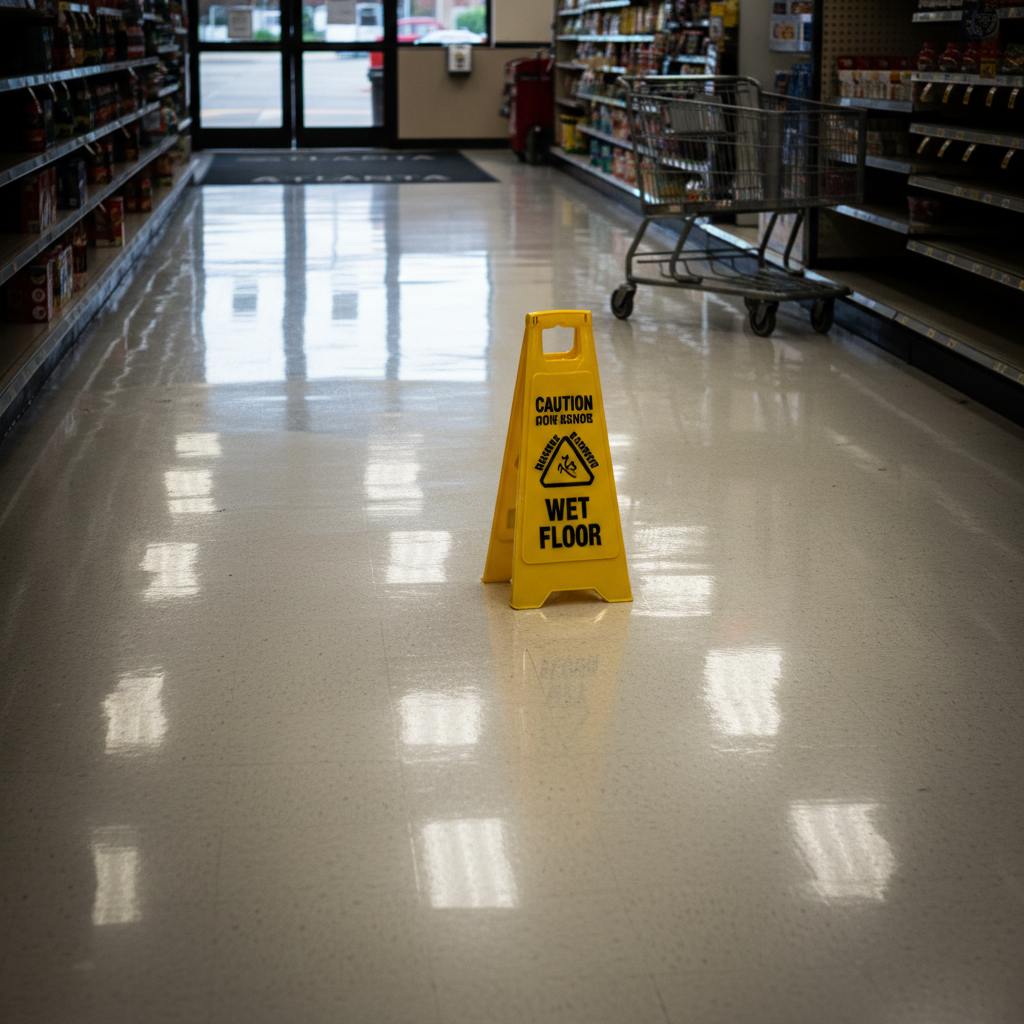
Spilled liquids, rain tracked indoors, broken plumbing, and clogged gutters create slipping hazards. Retail stores, restaurants, grocery stores, and office buildings have a duty to mop up spills quickly, post wet-floor signs, or redirect traffic. Security footage often shows whether the hazard existed for hours before someone fell. Electronic door logs and maintenance records reveal whether management was notified of drainage problems in advance. A slip and fall lawyer subpoenas this evidence.
Broken or Damaged Flooring
Cracked tile, broken concrete, missing stair treads, loose carpet, or uneven floor surfaces catch feet and cause falls. These defects usually exist for weeks or months before an injury occurs. Prior incident reports, maintenance requests, and construction records prove the owner knew. A slip and fall attorney in Atlanta uses this documented history to establish liability.
Poor Lighting
Inadequately lit hallways, stairwells, parking lots, and entryways hide tripping and falling hazards. Georgia law requires property owners to maintain sufficient lighting in areas where visitors are reasonably expected to be present. Building code violations and prior complaints establish that the owner knew lighting was inadequate.
Debris, Clutter, and Obstacles
Boxes, tools, snow, ice, leaves, and other obstacles create falling hazards — especially in outdoor areas and storage spaces. The question is whether the property owner should have removed the debris. If the hazard was visible for extended periods, or if prior complaints exist, liability becomes clear.
Icy Conditions and Weather-Related Hazards
Georgia doesn’t see heavy snow or ice often, but when weather strikes, property owners still have a duty to salt walkways, sand steps, or warn customers of slipping hazards. Failure to do so, especially at commercial establishments, is direct negligence.
Practical rule: Document the exact hazard — photograph it, measure it if possible, and get witness contact information immediately. The longer the hazard existed, the more obvious the owner’s negligence becomes.
How a Slip and Fall Lawyer Builds Your Case
Building a winning slip and fall claim requires a systematic approach. Here’s exactly how an experienced attorney proves liability and damages.
Investigation and Evidence Collection
Within days of your injury, your attorney sends a preservation letter to the property owner demanding they preserve security footage, maintenance records, incident reports, and any prior complaints about the hazard. Video footage that shows how long the hazard existed — and whether management ignored it — is often the case-winning evidence.
Your attorney also:
- Interviews witnesses who saw the hazard or the fall
- Photographs the scene from multiple angles
- Obtains building plans and code compliance records
- Subpoenas maintenance logs to show when repairs were last made
- Accesses prior slip-and-fall incident reports at that location
- Reviews the property owner’s insurance policies
A single prior incident report showing the same hazard caused another fall can establish that the owner knew exactly what they were dealing with and failed to fix it. That’s negligence.
Expert Analysis
For complex hazards — wet floors, lighting deficiency, or structural defects — your attorney may hire industry experts. A floor safety expert can testify about slip resistance and whether the hazard was reasonably foreseeable. An engineer can analyze structural failures. A safety consultant can explain building code violations.

Comparative Negligence Defense
Insurance companies will argue you were careless — you weren’t watching where you were going, you were wearing inappropriate footwear, you were in an area that was clearly off-limits. Your attorney anticipates these arguments and builds a defense:
- Security footage showing the hazard wasn’t obvious
- Witness testimony that you were being careful
- Expert testimony about how quickly the hazard would be discovered
- Prior incident reports showing others fell at the same spot
Practical rule: Never admit fault at the scene or in early conversations with property managers. Anything you say can and will be used against you in settlement negotiations.
Slip and Fall Liability in Georgia: What the Law Says
Georgia’s legal standard for slip and fall liability is set by Georgia’s premises liability statute and case law. Understanding these rules helps you evaluate your case’s strength.
The Duty of Care
Under Georgia law (OCGA § 51-6-1) — Georgia Courts documentation, property owners owe a duty of care to visitors on their premises. The level of duty depends on the visitor’s status:
- Invitees (customers, patients, guests invited for the owner’s benefit): The owner must maintain the premises in reasonably safe condition and warn of known dangers.
- Licensees (social guests, people with permission to be present): The owner must warn of known dangers they have reason to believe the licensee won’t discover.
- Trespassers: The owner owes minimal duty, except to refrain from willful or wanton injury.
Most injury victims are invitees. That means the property owner has the highest duty of care.
Knowledge of the Hazard
The owner’s liability depends on whether they had actual or constructive knowledge of the hazard. Actual knowledge means they knew directly — someone reported it, they saw it, or they caused it. Constructive knowledge means they should have known through reasonable inspection. If the hazard had existed long enough that a reasonably attentive owner would have discovered it, constructive knowledge applies.
A slip and fall lawyer in Atlanta builds constructive knowledge arguments by proving:
- The hazard existed for hours or days
- Regular maintenance should have revealed it
- Prior complaints or incident reports show the same issue
- Industry standards require more frequent inspections
Comparative Negligence
Georgia follows modified comparative negligence (OCGA § 51-12-33) — governed by state labor standards. If you were partially at fault, your recovery is reduced proportionally — but only if your fault is under 50%. If you’re 50% or more at fault, you recover nothing.
For slip and fall cases, comparative negligence arguments are often weak. You can’t be expected to see a hazard that’s been hidden by clutter or created by the owner’s negligence. An experienced slip and fall attorney argues that the hazard was foreseeable to the owner — not to you.
Practical rule: Georgia’s comparative negligence rule protects injury victims. As long as the property owner was more than 50% at fault, you can still recover. Most slip and fall cases fall clearly on the owner’s side of that line.
Evidence That Wins Slip and Fall Cases
The strongest slip and fall cases rest on specific, documented evidence. Here’s what matters most.
Security Footage
Video showing how long the hazard existed before your fall is case-winning evidence. If footage shows an employee walked past the hazard multiple times without addressing it, or a manager saw the problem and did nothing, liability becomes undeniable. Time-stamped footage also establishes the hazard wasn’t your fault.
Prior Incident Reports
If another person fell at the same spot, or reported the same hazard, the property owner can’t claim they didn’t know. Prior incident reports are devastating to the defendant’s case — they prove knowledge and failure to remedy.
Maintenance Records
When was the floor last inspected? When were repairs made? Maintenance logs that show neglect or infrequent upkeep support your case. If the owner inspects monthly but the hazard went unaddressed for months, that’s evidence of inadequate procedures.
Building Code Violations
Structural defects, inadequate lighting, and safety standard violations can be proven through expert testimony and building inspection records. Code violations establish that the owner didn’t meet their legal duty.

Witness Testimony
People who saw the hazard, saw you fall, or heard other customers complain about the same spot provide powerful testimony. Your attorney identifies and interviews witnesses within days — memories fade quickly.
Medical Records
Your injury documentation proves damages. Emergency room notes, imaging, surgery records, therapy, and ongoing treatment establish the severity of your injury and the cost of recovery.
Practical rule: Preserve all evidence immediately. The sooner your attorney sends a preservation letter, the less likely the property owner is to delete video footage or discard maintenance records.
What a Slip and Fall Settlement Is Worth in Georgia
Slip and fall settlements vary widely based on injury severity, liability strength, and insurance policy limits. Here’s how Georgia courts and juries evaluate damages.
Economic Damages
These are specific, documented costs:
- Medical expenses: emergency care, surgery, imaging, physical therapy, ongoing treatment
- Lost wages: time away from work during recovery
- Future medical costs: ongoing therapy, treatment, or care related to the injury
- Loss of earning capacity: if the injury reduces your ability to earn in the future
Economic damages are the easiest to prove and the first amount negotiated.
Non-Economic Damages
These cover pain, suffering, and life impact:
- Pain and suffering: physical pain from the injury
- Emotional distress: anxiety, depression, PTSD from the accident
- Loss of enjoyment of life: inability to participate in hobbies, exercise, or social activities
- Disfigurement: permanent scarring or visible injury effects
- Loss of consortium: impact on relationships and family life
Non-economic damages are typicall our officey 1–5 times the amount of economic damages, depending on injury severity and liability clarity.
Settlement Ranges in Atlanta
For typical slip and fall cases:
- Minor injuries (sprains, minor fractures): $5,000–$25,000
- Moderate injuries (significant fractures, surgery, extended recovery): $25,000–$100,000
- Serious injuries (permanent disability, multiple surgeries, ongoing pain): $100,000–$500,000+
These are generalized ranges. Your specific case depends on medical severity, liability clarity, and the defendant’s insurance coverage. A slip and fall lawyer in Atlanta negotiates aggressively within these parameters.
Practical rule: Insurance companies’ initial settlement offers are almost always too low. An experienced attorney typically increases the final settlement by 2–5 times the initial offer.
How Humphrey & Ballard Law Helps Slip and Fall Victims in Atlanta
Humphrey & Ballard Law specializes in slip and fall cases. We’ve recovered millions for Atlanta injury victims. Here’s what makes our approach different:
- Immediate investigation and evidence preservation
- Aggressive evidence collection — security footage, prior incidents, maintenance records
- Expert testimony from safety and medical professionals
- Negotiation and litigation experience
- No upfront costs — we work on contingency (you pay only if we win)
- Transparent communication — you know the strategy and your case’s value
We’ve handled slip and fall cases in retail stores, restaurants, grocery stores, apartment complexes, office buildings, and parking lots. We understand Georgia law and know how to overcome insurance company defenses. Contact us today for a free consultation.
Practical rule: Most slip and fall victims who hire an attorney within days of their injury settle for significantly more than those who wait or try to handle their case alone. Time is critical.
Frequently Asked Questions About Slip and Fall Claims
| Question | Answer |
|---|---|
| How long do I have to file a slip and fall lawsuit in Georgia? | Georgia’s statute of limitations is 2 years from the date of injury. After 2 years, you lose the right to sue. Don’t wait — contact a slip and fall attorney immediately. |
| Do I have to prove the owner was careless, or just that I fell? | You must prove the owner had a duty, breached that duty, and caused your injury. Simply falling doesn’t establish liability. Your attorney proves the owner knew or should have known about the hazard and failed to address it. |
| What if the property had a “wet floor” sign? | Signs alone don’t eliminate liability if the hazard was unreasonably dangerous. If you couldn’t reasonably see or avoid the hazard despite a warning, the owner may still be liable. Your attorney argues whether the sign was adequate. |
| Can I still sue if I was partially at fault? | Yes, under Georgia’s modified comparative negligence rule. As long as you’re less than 50% at fault, you can recover — your settlement is just reduced by your percentage of fault. |
| What’s the difference between a settlement and a lawsuit? | Most cases settle before trial through negotiation. Settlements are faster and more predictable. Lawsuits go to trial if the insurance company refuses a fair settlement. Your attorney decides the best approach based on the case’s strength. |
| How much does a slip and fall attorney cost? | Most work on contingency — no upfront fees, you pay a percentage (typically 25–33%) only if you win. This aligns the attorney’s interests with yours. |
Additional Safety Considerations for Premises Owners
Beyond the common hazards listed above, property owners must also consider seasonal challenges, weather-related risks, and industry-specific duties. Retailers, restaurants, and hospitality venues face distinct premises liability obligations under OSHA premises liability standards and Georgia state regulations. A slip and fall lawyer in Atlanta understands these industry-specific requirements and builds arguments based on whether the property owner met or violated industry standards.
Practical rule: Industry standards often establish a higher duty of care than general Georgia law. Your attorney uses these standards to prove the owner’s negligence.
Steps to Take After Your Slip and Fall Injury
If you’ve been injured in a slip and fall accident, immediate action preserves evidence and protects your legal rights. Here’s what to do:
- Report the hazard and your injury to the property manager or owner — get written confirmation
- Take photographs of the hazard, the scene, and your injuries from multiple angles
- Get contact information from all witnesses — names, phone numbers, addresses
- Seek medical attention immediately, even if your injury seems minor — document everything
- Keep all medical records, bills, and receipts related to your injury
- Do not post about the incident on social media — insurance companies monitor social platforms
- Contact a slip and fall attorney within days — don’t wait weeks or months
Your attorney will send a preservation letter to the property owner within 24–48 hours. This legally binds them to preserve all evidence — security footage, maintenance records, incident reports, and communications about the hazard. Failure to preserve evidence can result in sanctions and even liability for destruction of evidence.
Practical rule: Act fast. The property owner has no incentive to preserve evidence that proves their negligence. Your attorney must send a preservation demand immediately.
Long-Term Recovery and Support Resources
Beyond compensation, slip and fall injuries often require ongoing support and rehabilitation. Your settlement should account for future medical care, therapy, and potential complications. Legal reference resources like Justia provide additional information about premises liability law across Georgia and the nation.
Practical rule: Future medical costs and ongoing therapy are part of your damages calculation. Don’t settle without accounting for long-term recovery needs.
Why Professional Legal Representation Matters in Slip and Fall Claims
The stakes are high in slip and fall cases. Insurance companies employ specialized defense attorneys whose job is to minimize payouts. They use tactics like questioning your account of what happened, digging into your medical history to find pre-existing conditions, suggesting you were partially at fault, or claiming the hazard was obvious and you should have avoided it.
An experienced slip and fall lawyer levels this playing field. We understand insurance company strategies and counter them with solid evidence, expert testimony, and aggressive negotiation. We also understand when to walk away from low settlement offers and proceed to trial — a credible threat of litigation forces insurers to negotiate seriously.
Practical rule: Insurance companies fear trials. An attorney with a track record of courtroom success can extract higher settlements through the credible threat of litigation.
Why Insurance Companies Fight Hard on Slip and Fall Liability
Property owners and managers carry liability insurance specifically to cover slip and fall incidents. However, insurers make money by denying or minimizing claims. They employ strategies documented by legal resource databases and Georgia legal professionals. They request medical records looking for pre-existing conditions. They hire private investigators to photograph and document the scene weeks after your injury (by which time the hazard may have been fixed). They file discovery requests seeking every email, text, or casual comment you made that could suggest comparative negligence.
Your attorney anticipates these tactics and prepares defensively. We secure evidence before the insurance company can. We obtain expert reports establishing industry standards and whether the hazard violated them. We interview witnesses while memories are fresh. We build your case on a foundation the insurance company can’t shake — and they know it.
Practical rule: The stronger your attorney’s evidence and reputation, the more seriously the insurance company negotiates. This translates directly to higher settlement offers.
Unique Challenges in Slip and Fall Claims vs. Other Injury Cases
Unlike car accidents where liability is often clear — one driver hit another — slip and fall cases involve more nuanced questions about hazard visibility, duration, and foreseeability. Was the wet floor obvious? Should the victim have seen it? Could the property owner have reasonably prevented it?
Additionally, many injury victims are reluctant to pursue slip and fall claims because they worry about seeming frivolous or blame-shifting. This hesitation works against them — they delay seeking legal help, evidence disappears, and their case weakens. The insurance company counts on this psychological reluctance and uses it to their advantage.
An experienced slip and fall attorney reframes the narrative: the property owner had a legal duty to maintain safe premises, they failed to meet that duty, and they must answer for the consequences. This isn’t frivolous — it’s enforcing property owners’ basic legal obligations under Georgia law.
Practical rule: Premises liability law exists precisely because property owners must maintain reasonably safe environments. Your slip and fall claim enforces fundamental legal duties.
Documentation Standards and Evidence Preservation Under Georgia Law
Georgia courts recognize the importance of preserving evidence in slip and fall cases. Within hours of an injury, property owners may repair hazards, delete security footage, or discard maintenance records. Your attorney sends a preservation letter within 24 hours — a legally binding demand that the property owner preserve all evidence related to the incident.
This letter serves multiple purposes: it creates a documented timeline showing when your attorney first contacted the property owner, it establishes a record that the owner was on notice to preserve evidence, and it protects your case if evidence is later destroyed. Georgia courts take evidence destruction seriously — Georgia court precedent allows judges to impose sanctions and even find the property owner liable for destruction of evidence.
Additionally, Georgia Department of Labor standards often require property owners to maintain incident reports and safety documentation. If those records are missing or destroyed, courts interpret that absence against the property owner — it suggests they had something to hide.
Practical rule: Destroying evidence is worse than having weak evidence. Courts punish evidence destruction, often resulting in higher judgments against the property owner.
Take Action Today — Secure Your Compensation for Slip and Fall Injuries
If you’ve been injured in a slip and fall accident in Atlanta, don’t accept less than you deserve. Humphrey & Ballard Law fights for injury victims. We handle everything — investigation, negotiation, expert witnesses, and trial if necessary. You focus on recovery; we focus on your case.
Contact us today for a free consultation. Call (404) 446-9854 or visit our contact page to schedule your appointment. We serve all of Atlanta and Georgia — and we’re ready to help.
About Humphrey & Ballard Law
We’re a personal injury law firm based in Atlanta, Georgia. Our attorneys specialize in slip and fall cases, car accidents, truck accidents, wrongful death, and all types of personal injury claims. We’ve recovered millions for our clients and are committed to fighting for full compensation and justice.
