Slip and fall accidents happen fast — a wet floor with no warning sign, a broken step that should have been fixed weeks ago, a dark parking lot where the lights have been out for months. One second you’re going about your day; the next you’re on the ground with injuries that can take months to heal. If this happened to you, a slip and fall lawyer in Atlanta can help you hold the negligent property owner accountable. These cases are harder to win than most people expect — the insurance company will fight hard — but with the right attorney and the right evidence, victims recover full compensation every day.
Why Slip and Fall Cases Are Harder Than They Look
The burden of proof is on you
Here’s the reality that surprises a lot of people: just because you fell on someone else’s property doesn’t automatically mean they owe you money. Georgia’s premises liability law requires you to prove that the property owner knew about the dangerous condition — or should have known about it through reasonable inspection — and failed to fix it or warn you. That’s a meaningful burden. A fresh spill that happened thirty seconds before you slipped is a very different case from a spill that sat on the floor for two hours with no cleanup and no warning sign. Your Atlanta slip and fall lawyer builds the evidence of that knowledge gap.
Insurance companies fight these claims aggressively
Premises liability insurers are experienced at defending slip and fall claims. They’ll argue the hazard was “open and obvious” — meaning you should have seen it and avoided it. They’ll argue you were distracted, wearing improper footwear, or not paying attention. They’ll pull surveillance footage selectively. They’ll get to the scene before you do and document it in a way that supports their defense. The moment a fall happens, a property owner’s insurer is building the case against you. The sooner you have a slip and fall lawyer in Atlanta doing the same in your favor, the better your position.
Evidence disappears extremely quickly
Wet floors get mopped. Broken steps get repaired. Surveillance footage gets overwritten — often within 24 to 72 hours. Incident reports get filed and locked away. The physical conditions that caused your fall can look completely different by the time someone thinks to document them. This is why one of the most important things an attorney does is move immediately on evidence preservation. A legal hold letter to the property owner and their insurer, sent the same day you retain counsel, can be the difference between a winnable case and one where the key evidence is gone.
Practical rule: Photograph the hazard, the surrounding area, and your injuries immediately — before anything is cleaned up or repaired. That documentation, taken in the minutes after the fall, is often the most valuable evidence in the entire case.
What Georgia Law Actually Requires Property Owners to Do
The duty depends on why you were there
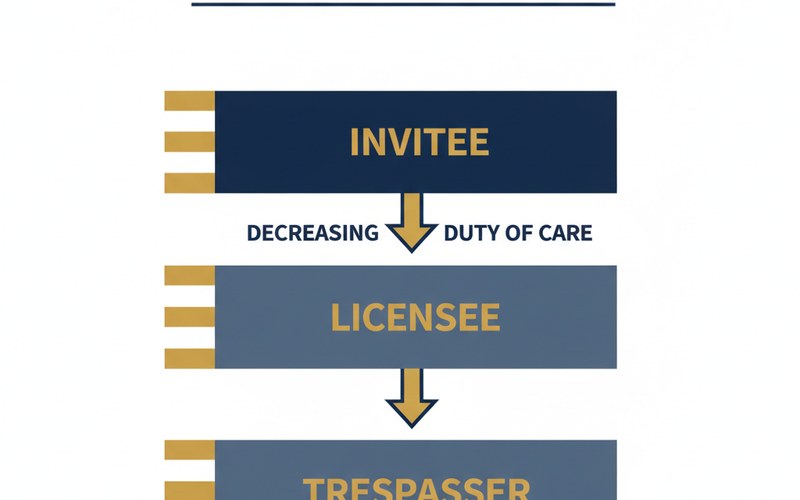
Georgia premises liability law under O.C.G.A. § 51-3-1 doesn’t treat all visitors the same. The duty a property owner owes you depends on your legal status on the property. As an invitee — a customer in a store, a patient in a medical office, a guest in a hotel — you receive the highest level of protection. The property owner must inspect their premises, discover hazardous conditions, and either fix them or provide adequate warning. As a licensee (a social guest), the owner must warn you of known hazards but doesn’t have the same active inspection duty. As a trespasser, protection is minimal. Most slip and fall cases involve invitees, which means the property owner’s duty is significant.
The “superior knowledge” standard
To win a slip and fall case in Georgia, your Atlanta slip and fall lawyer must prove the property owner had “superior knowledge” of the hazard — meaning they knew or should have known about the dangerous condition before you were hurt, and you did not know about it yourself. This is where cases get won or lost. If a store employee mopped the floor an hour before you slipped but removed the wet floor sign fifteen minutes later, that’s superior knowledge. If a landlord received three complaints about a broken handrail in the past month and did nothing, that’s superior knowledge. The paper trail — maintenance requests, complaint logs, inspection records, prior incident reports — is everything.
The “open and obvious” defense
The most common defense in slip and fall cases is that the hazard was “open and obvious” — something you should have seen and avoided through ordinary care. A large, clearly visible puddle in the center of a brightly lit walkway is a harder case than an unmarked wet spot on polished tile in dim lighting. Georgia courts balance the property owner’s duty to maintain safe conditions against the visitor’s duty to exercise reasonable care for their own safety. An experienced slip and fall lawyer anticipates this defense and builds evidence that the condition was not reasonably obvious under the actual circumstances — the lighting, the floor surface, the lack of warning, and the context in which the fall happened.
Where Slip and Fall Accidents Happen Most in Atlanta
Retail stores and grocery chains
Grocery stores, big-box retailers, and shopping centers generate more slip and fall claims than almost any other property type. Spills in food aisles, water tracked in from entrances, freshly mopped floors without adequate signage, and merchandise left in walkways are constant hazards. Large chains have dedicated claims departments and experienced insurance adjusters who handle these cases daily. They know exactly what evidence matters and how to build a defense. Matching that institutional experience is exactly what a seasoned Atlanta slip and fall lawyer at Humphrey & Ballard Law does for you.
Apartment complexes and rental properties
Landlords in Georgia have a duty to maintain common areas — hallways, stairwells, parking lots, laundry rooms, and building entrances — in reasonably safe condition. Broken stairs, deteriorated parking lot surfaces, inadequate exterior lighting, and loose handrails are among the most frequent hazards. When a tenant or visitor is injured in a common area because of a known maintenance failure, the landlord faces liability. Maintenance request records, management emails, and prior incident reports are the key evidence in these cases — and they’re often obtainable through discovery if you have an attorney.
Restaurants and bars
The combination of food, drinks, polished tile floors, and a constant stream of customers makes restaurants and bars high-risk environments for slip and fall injuries. Spilled drinks near bar areas, wet floors near kitchen entrances, freshly mopped surfaces without adequate warning, and outdoor areas with wet decking all generate claims. Many of these establishments carry commercial general liability policies with significant coverage limits — but their insurers fight just as hard. Establishing how long the hazard existed before your fall is usually the central issue.
Parking lots and outdoor areas
Deteriorated asphalt, unmarked speed bumps, standing water in potholes, uneven pavement, and inadequate lighting make parking lots a major source of fall injuries in Atlanta. The property owner’s responsibility extends to these outdoor areas. OSHA’s walking and working surfaces standards provide guidance on what constitutes a recognized hazard in commercial environments, and Georgia courts frequently look to industry standards in determining whether a property owner met their duty.
Hotels, hospitals, and office buildings
High-traffic commercial properties — hotels, medical facilities, office towers — carry significant liability exposure for slip and fall injuries. Polished marble lobbies that become slick when wet, hospital corridor floors with inadequate slip-resistance, and office building entrances that collect water in rainy weather all create hazards. These properties typically carry large commercial insurance policies, which means the resources to pursue a full claim are there — but so are the resources to fight it.

Injuries From Slip and Falls — More Serious Than People Expect
Hip fractures
Hip fractures are among the most serious and most common injuries in slip and fall accidents, particularly for adults over 50. A broken hip almost always requires surgery — typically a partial or total hip replacement — followed by weeks of inpatient rehabilitation and months of recovery. For older adults, hip fractures carry a significantly elevated risk of life-threatening complications. The medical costs alone can exceed $100,000, and the long-term impact on quality of life and independence is substantial. These cases deserve aggressive, experienced legal representation.
Traumatic brain injuries
When you fall and strike your head on a hard floor or surface, the result can be a traumatic brain injury — even without a visible wound. Concussions, subdural hematomas, and diffuse axonal injuries can cause symptoms that range from persistent headaches and memory problems to permanent cognitive impairment. TBI from slip and falls is frequently underestimated in the immediate aftermath because symptoms can take days to fully emerge. An ER evaluation followed by neurological follow-up is essential — both for your health and for establishing the medical record that supports your claim. The CDC’s traumatic brain injury resources outline the long-term burden these injuries carry.
Spinal injuries and herniated discs
The impact of a hard fall — particularly on stairs or from a height — can cause spinal fractures, herniated discs, and nerve compression that produce chronic back and neck pain, radiating pain into the arms or legs, and in severe cases, partial paralysis. These injuries are often invisible on initial X-rays and only fully revealed through MRI. Insurers frequently argue that spinal injuries are pre-existing — which is why consistent, documented treatment from the day of the fall is so important to your case.
Broken wrists, ankles, and shoulders
When people fall, their instinct is to catch themselves — which frequently results in broken wrists and fractured shoulders from the impact. Ankle fractures from stumbling on uneven surfaces are also extremely common. These orthopedic injuries require imaging, casting or surgery, and physical therapy, generating documented medical costs that form the economic foundation of your claim.
Practical rule: Even a fall that seems minor deserves a medical evaluation the same day — internal injuries, concussions, and stress fractures don’t always produce obvious pain immediately, and the gap between the fall and your first medical visit is the first thing an insurer will use against you.
What Your Slip and Fall Case Is Worth
Building the economic damages foundation
Every slip and fall claim starts with the documented financial losses. Medical bills from the emergency room, imaging, surgery, physical therapy, and follow-up care. Lost wages from the time you couldn’t work. Future medical costs projected by treating physicians for ongoing care and anticipated procedures. Out-of-pocket expenses for medication, medical equipment, and transportation to appointments. These concrete losses form the base of your claim — and your slip and fall lawyer in Atlanta documents every dollar from day one.
Non-economic damages — the full human cost
Beyond the bills, Georgia law allows recovery for pain and suffering, loss of enjoyment of life, emotional distress, and permanent disability or disfigurement. A hip fracture that leaves you unable to walk your neighborhood. A back injury that ends your ability to play with your grandchildren. Chronic pain that disrupts your sleep and your relationship. These are real losses, and Georgia does not cap non-economic damages in standard premises liability cases. Daily journals documenting your pain levels, limitations, and emotional impact significantly strengthen this part of your claim.
| Injury Type | Typical Medical Costs | Estimated Settlement Range |
|---|---|---|
| Minor soft tissue injuries | $5,000 – $20,000 | $15,000 – $60,000 |
| Fractures requiring surgery | $30,000 – $100,000 | $100,000 – $400,000 |
| Hip fracture / replacement | $50,000 – $150,000 | $150,000 – $600,000 |
| Traumatic brain injury | $100,000 – $500,000+ | $300,000 – $3M+ |
| Spinal cord injury | $500,000+ lifetime | $1M – $10M+ |

Practical rule: Georgia’s modified comparative fault rule means the insurance company will try to assign you a portion of the blame to reduce your award — your attorney builds evidence that minimizes your fault percentage from the very beginning.
Georgia’s Comparative Fault Rule and Your Slip and Fall Claim
How fault gets divided in premises cases
Georgia follows modified comparative fault under O.C.G.A. § 51-12-33. In a slip and fall case, the jury (or insurance adjuster in settlement) assigns a percentage of fault to each party. If the store is 80% at fault and you’re 20% at fault — maybe because you were looking at your phone — your $100,000 damages award becomes $80,000. The math works in your favor as long as your fault stays below 50%. Above that threshold, you collect nothing.
Insurance adjusters know this rule intimately. Their goal in almost every slip and fall negotiation is to find anything — your footwear, your speed, your awareness — that pushes your fault percentage as high as possible. An experienced Atlanta slip and fall lawyer anticipates every argument they’ll make and builds counter-evidence from the beginning.
The “distracted walker” argument
One of the most common defenses in modern slip and fall cases is that the injured person was looking at their phone and failed to notice an “open and obvious” hazard. If you were on your phone when you fell, be honest with your attorney about it — they need to know. This doesn’t automatically kill your case. If the hazard was genuinely not obvious — poor lighting, a floor surface that disguised a wet spot, inadequate signage — your attorney can argue the phone use doesn’t rise to 50% fault. Transparency with your legal team from day one is essential to building the strongest possible case.
Prior incidents on the same property
One of the most powerful pieces of evidence in a slip and fall case is proof that the same hazard injured someone else before. Prior incident reports, OSHA complaints, prior lawsuits, and online reviews mentioning the same condition can all be obtained through discovery. If a grocery store’s broken entrance mat injured three customers in the previous year and they never fixed it, that history directly establishes both knowledge and indifference — and it dramatically strengthens your case. The Georgia Courts system maintains public records of prior civil litigation that your attorney can search.
Practical rule: Prior accidents or complaints involving the same hazard on the same property are among the most powerful evidence in a slip and fall case — your attorney requests all incident reports and complaint logs in discovery.
Practical rule: If you were on your phone when you fell, tell your attorney immediately — transparency allows them to build around it rather than get blindsided by it during depositions or trial.
Steps to Take Immediately After a Slip and Fall in Atlanta
Document the scene before it changes
If you’re physically able, take photographs immediately — the hazard that caused your fall, the surrounding area, any warning signs (or the absence of them), and your injuries. The spill gets mopped, the broken step gets taped off, the surveillance footage gets overwritten. What you capture in the first minutes is often the only objective evidence of the conditions at the time of the fall.
Report it and get a written incident report
Report the accident to the property manager, store manager, or building supervisor immediately and ask for a written incident report. Get a copy. This creates an official record that the fall happened, on their property, on that date. Don’t accept verbal acknowledgment — get something in writing before you leave.
Get medical care the same day
Go to the emergency room or urgent care the same day, even if you feel okay. The medical record created at that visit is the clinical link between the fall and your injuries. Without it, the insurance company argues your injuries came from something else. If symptoms worsen over the following days — which is common with concussions and spinal injuries — return immediately and document the progression.
Call a slip and fall lawyer before you talk to the insurance company
The property owner’s insurer will contact you. They’ll sound reasonable and want to “take your statement.” Don’t do it without an attorney. Refer them to your Humphrey & Ballard Law attorney and let us handle all communication from that point forward. Call (404) 446-9854 — we’ll start working on your case immediately.
FAQ: Slip and Fall Claims in Atlanta
| Question | Answer |
|---|---|
| Can I sue if I slipped on a wet floor in a store? | Yes, if the store knew or should have known about the hazard and failed to fix it or warn you. Proof of their knowledge — through the duration the hazard existed or prior complaints — is the key issue. |
| What if there was a wet floor sign but I still fell? | A sign doesn’t automatically eliminate liability. If the sign was inadequate, poorly positioned, or the hazard existed beyond the warned area, the property owner may still be liable. |
| How long do I have to file? | Two years from the date of the fall under O.C.G.A. § 9-3-33. Government property claims can be as short as six months — contact an attorney immediately. |
| What if I was partly at fault for the fall? | You can still recover as long as your fault is below 50% under Georgia’s modified comparative fault rule. Your recovery is reduced by your percentage of fault. |
| What evidence do I need? | Photos of the hazard, incident report, medical records, witness contact information, and surveillance footage (your attorney can request preservation). Maintenance logs and prior complaints are obtained through discovery. |
| What if the fall happened in a private home? | Homeowner’s liability insurance typically covers these claims. The same legal framework applies — the homeowner’s knowledge of the hazard and failure to warn is the central issue. |
| How much does it cost to hire a slip and fall lawyer? | Humphrey & Ballard Law works on contingency — no upfront fees, no hourly charges. You pay nothing unless we recover compensation for you. |
| What if the property owner denies the hazard existed? | Surveillance footage, maintenance records, prior incident reports, and witness testimony can all establish the hazard’s existence independent of the property owner’s account. |
Get a Slip and Fall Lawyer in Atlanta Who Will Fight for You
Property owners and their insurers don’t make slip and fall cases easy. They fight hard, and they have experienced teams working against you from the moment you’re hurt. A slip and fall lawyer in Atlanta from Humphrey & Ballard Law levels that playing field — building the evidence, managing the insurance company, and pursuing every dollar of compensation you’re owed. Call (404) 446-9854 or visit our contact page for a free consultation. No fee unless we win.
About Humphrey & Ballard Law
Humphrey & Ballard Law is an Atlanta personal injury firm representing clients throughout Georgia including Fulton, DeKalb, Cobb, and Gwinnett counties. Attorneys Desmond Humphrey and David Ballard handle slip and fall cases, car accidents, truck accidents, wrongful death, and a full range of serious personal injury claims. Free consultations, contingency fee representation — no recovery, no fee.
