A workers’ compensation claim is your legal right to receive benefits after a work-related injury. Like other personal injury claims, workers’ compensation has specific rules. In Georgia, if you’re hurt on the job, you don’t have to sue your employer — instead, you file a workers’ comp claim to get medical coverage, lost wages, and disability benefits. Think of it as a trade-off: you give up the right to sue your employer for negligence, but in return, you get benefits that don’t depend on anyone being at fault. This system exists to protect both workers and employers, but it only works if you know how to navigate it. If you’re injured at work and unsure about your rights, this guide walks you through every step of the process, from the initial injury report through receiving your benefits.
According to the Georgia Department of Labor, over 400,000 workers file workers’ compensation claims annually in Georgia. Each claim follows a specific process set by state law, designed to protect workers’ rights while maintaining the solvency of the insurance system.
What Happens When You Get Injured at Work
The moment you’re injured at work in Georgia, you’re eligible for workers’ compensation. You don’t have to prove your employer was negligent or careless — it doesn’t matter who caused the accident. All that matters is that your injury happened during the course of your employment. Whether you experienced a slip and fall injury, were struck by equipment, or suffered a repetitive stress injury over months, you’re entitled to file a claim.
Your first responsibility is to report the injury to your employer immediately, or as soon as reasonably possible. Georgia law requires you to notify your employer within 30 days of the injury. Missing this deadline can cost you your benefits, so don’t delay. Even if the injury seems minor at first, report it. Some injuries get worse over days or weeks, and having a documented report protects you.
Report the Injury Right Away
Tell your supervisor or the person responsible for safety. Put it in writing if possible — an email to your supervisor, a text message with a timestamp, or a note filed with HR. This creates a record. Your employer is required to file a workers’ compensation claim with their insurance company within seven days of learning about your injury. They’re responsible for initiating the process, not you.
Practical rule: Report your injury within 24 hours if you can. Written notice is always better than verbal. You want a documented timestamp.
Seek Medical Treatment
In Georgia, your employer or their insurance company will direct you to an approved medical provider — usually one on their panel of doctors. See the doctor promptly. You have the right to request a change of physician after 30 days of treatment, but for the first month, you’ll likely see their doctor. The medical evaluation documents the extent of your injury and becomes the foundation for your benefits.
The Insurance Company Contacts You
Within a few days, the workers’ compensation insurance carrier will reach out. They’ll ask for details about how the injury occurred, your job duties, and whether you received medical treatment. Answer honestly and stick to the facts. Don’t speculate about causes or exaggerate the severity. They’ll open a claim file and assign a claims adjuster to your case.
Understanding Workers’ Compensation Benefits in Georgia
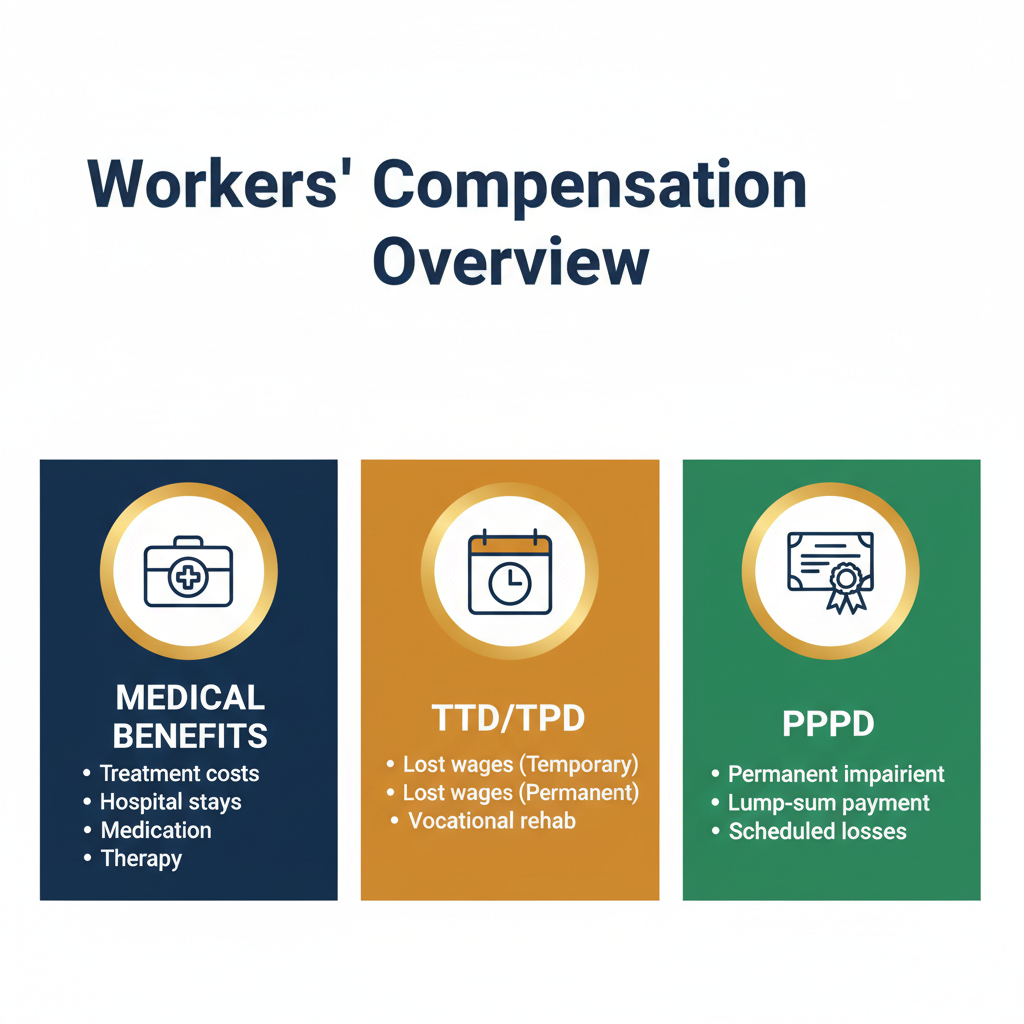
Georgia’s workers’ compensation system provides four types of benefits. Understanding each one helps you know what you’re entitled to and what to expect financially.
Watch this video to learn more about personal injury claims in Georgia. While this covers accident claims broadly, many of the legal principles apply to workers’ compensation disputes as well.
Medical Benefits
Medical benefits cover all reasonable and necessary treatment related to your work injury. This includes doctor visits, hospital care, surgery, prescription medications, physical therapy, diagnostic tests, and even medical equipment like braces or crutches. You don’t pay out of pocket — the insurance company pays the medical provider directly. If your claim is approved, you have no co-pays or deductibles.
The catch: you’re limited to providers on the insurance company’s approved panel. If they deny a treatment as “not reasonably necessary,” you have the right to appeal. If the treatment is clearly related to your work injury and medically justified, you can usually win the appeal.
Temporary Total Disability (TTD)
If your injury prevents you from working temporarily, you receive two-thirds of your average weekly wage while you’re unable to work. This is capped at a state maximum (currently around $350/week in Georgia, but the limit changes annually). Let’s say you earn $1,500/week. Your TTD benefit would be about $1,000/week (two-thirds) up to the state maximum.
Practical rule: TTD is NOT your full salary. It’s two-thirds of your average wage. If you were earning $2,000/week, you’ll receive roughly $1,333/week, not $2,000.
TTD benefits start after a seven-day waiting period from the date of injury. If you’re hospitalized overnight, that seven-day wait is waived. TTD continues as long as your doctor says you cannot work. Once your doctor releases you to return to work — even part-time or light duty — TTD stops.
Temporary Partial Disability (TPD)
If you’re able to return to work but at reduced capacity or lower wages, you may qualify for temporary partial disability. TPD is two-thirds of the difference between your pre-injury wage and your current wage. If you were earning $1,500/week before your injury and now can only work light duty for $1,000/week, your TPD would be about $333/week (two-thirds of the $500 difference).
TPD applies to the period between when you return to work and when you reach maximum medical improvement (MMI) — the point at which your condition has stabilized and is unlikely to improve further.
Permanent Partial Disability (PPD) and Permanent Total Disability (PTD)
Permanent partial disability benefits are awarded if your injury causes lasting impairment after you reach maximum medical improvement. If your doctor certifies that you have lost use of a body part, suffered scarring, or have chronic pain that will never fully resolve, you qualify for PPD. The amount depends on which body part is affected and how severe the impairment is.
For example, total loss of an arm might be worth 208 weeks of benefits. Total loss of a finger might be worth 35 weeks. The state has a schedule that outlines the number of weeks for each type of injury.
Permanent total disability is awarded if your injury is so severe that you can never work again. This is the highest level of benefit but also the hardest to prove. You must show that you’ve made a genuine effort to return to work and that no employer will hire you because of your disability. PTD benefits continue for life or until age 65, whichever comes first.
The Workers’ Compensation Claims Process Step-by-Step
Step 1: Injury Report (Days 1–2)
You report the injury to your employer. They have seven days to file a workers’ compensation notice with their insurance carrier. Your role is to provide clear, factual details: what you were doing, how the injury occurred, what part of your body was injured, and when it happened.

Step 2: Medical Evaluation (Week 1)
Your employer directs you to an approved medical provider. The doctor examines you, orders tests if needed, and documents your injury. The medical report becomes the official record of your condition. If the injury is serious (hospitalization, surgery, etc.), this happens quickly. For minor injuries, you might schedule an appointment within a few days.
Step 3: Claim Filing (Week 1–2)
The insurance company opens a formal claim file. They send you a notice of compensation (often called a Form 102) that explains your benefits and rights. Read this carefully. It tells you which doctor to see, how much you’ll receive in disability benefits, and how to file an appeal if you disagree with any decision.
Step 4: Benefits Begin (Week 2–3)
If your claim is approved, your benefits start. Medical treatment is authorized, and if you’re not working due to your injury, disability payments begin (after a seven-day waiting period). The insurance company pays your doctor directly. Disability checks arrive weekly or biweekly, depending on the insurance company’s process.
Step 5: Ongoing Medical Treatment (Weeks 3–Months 6)
You attend medical appointments, follow your doctor’s treatment plan, and provide updates to your employer or the insurance company as requested. Keep records of all appointments, medications, and treatment. If your condition improves and you can return to work, your doctor issues a release. If you stay unable to work, your doctor can extend your treatment.
Step 6: Maximum Medical Improvement (Months 3–12)
Eventually, your condition reaches a point where further treatment is unlikely to improve it. Your doctor certifies “maximum medical improvement” (MMI). At this point, temporary disability benefits usually stop. If you have lasting impairment, your doctor issues an impairment rating, which determines your permanent partial disability benefits.
Practical rule: Maximum medical improvement doesn’t mean you’re fully healed. It means your condition is stable and future treatment is unlikely to change the outcome. You might still have pain or reduced function, but it’s not expected to improve further.
Step 7: Return to Work or Appeal (Month 4+)
If you can return to your old job, you do so. If your injury prevents you from doing the same work, your employer must offer “transitional work” at your current wage or notify you that they cannot accommodate you. If there’s a dispute — for example, if the insurance company denies your claim or disputes the extent of your disability — you have the right to request a hearing before the Georgia State Board of Workers’ Compensation.
Common Workers’ Compensation Issues and Disputes
Claim Denied or Delayed
Sometimes the insurance company denies your claim entirely, arguing that your injury wasn’t work-related or that you failed to report it in time. If this happens, you have 30 days to request a hearing. Gather documentation: emails reporting the injury, medical records linking the injury to your work, witness statements, photos of the accident scene, and any other evidence. An attorney can help you present this evidence and argue your case.
Medical Treatment Disputed
The insurance company might approve some treatments but deny others. If your doctor recommends an MRI, physical therapy, or surgery, and the insurance company refuses to authorize it, you can file a dispute. The burden is on them to prove the treatment isn’t “reasonably necessary” for your condition. With medical documentation from your doctor, you can usually overturn these denials.
Inadequate Disability Calculations
The insurance company calculates your temporary disability benefits based on your average weekly wage. If they underestimated your wage or miscalculated the benefits, you can challenge it. Bring recent pay stubs, tax returns, or employment contracts to prove your actual earnings.
Practical rule: If the insurance company’s disability calculation seems too low, request a wage review. Bring all documents proving your pre-injury earnings. You deserve two-thirds of your actual average wage, not their guess.
Retaliation
Your employer cannot legally retaliate against you for filing a workers’ compensation claim. If you were fired, demoted, or had your hours cut immediately after reporting your injury, that’s illegal retaliation. Document the timing and any statements your employer made. An attorney can help you pursue a retaliation claim, which is separate from your workers’ compensation claim.
When You Need a Workers’ Compensation Attorney
Many workers handle straightforward claims on their own. But in certain situations, an attorney becomes invaluable. If your claim is denied, if your benefits are calculated incorrectly, if medical treatment is being withheld, or if your employer retaliates against you, an attorney protects your rights. In Georgia, you pay nothing upfront — attorneys work on contingency, meaning they only get paid if you win. Their fee is set by Georgia law at 25% of your benefits, capped at a reasonable amount. For more information on Georgia workers’ compensation law, visit the Georgia State Board of Workers’ Compensation website.
An attorney will:
- File appeals on your behalf if your claim is denied
- Challenge denials of medical treatment
- Ensure your disability benefits are calculated correctly
- Represent you at hearings before the State Board of Workers’ Compensation
- Pursue retaliation claims if you were fired for filing
- Negotiate settlements if appropriate
The key question: Is the value of your claim high enough to justify an attorney’s involvement? If you’re receiving benefits without dispute, probably not. If your claim has been denied, your benefits are inadequate, or serious permanent disability is involved, an attorney can make the difference between financial hardship and fair compensation.
Practical rule: If the insurance company denies your claim, hire an attorney immediately. You have only 30 days to request a hearing, and missing that deadline can cost you everything.
Real-World Example: How Workers’ Compensation Works
Let’s walk through a concrete scenario to show how the system works in practice.
Meet Marcus: Marcus is a warehouse supervisor in Atlanta earning $2,000 per week. One afternoon, a forklift operator fails to see him while backing up, and Marcus is struck. He’s transported to Grady Memorial Hospital with a broken leg and a back injury.

Week 1: Marcus reports the injury immediately. His employer files a workers’ compensation claim. The insurance company opens a claim file and authorizes emergency medical care. Marcus has surgery to repair his broken leg. Medical benefits cover the entire cost — $45,000 — at no charge to Marcus.
Week 2: Marcus is still hospitalized. The seven-day waiting period for disability benefits is waived because he’s hospitalized overnight. He receives temporary total disability: two-thirds of $2,000 = $1,333/week. He’ll continue receiving this while unable to work.
Week 3–4: Marcus is released from the hospital and begins outpatient physical therapy. Medical benefits continue. He receives $1,333/week in TTD. His wife begins driving him to therapy appointments.
Month 2: Marcus’s condition improves. His doctor clears him to do light-duty work and releases him to return to his warehouse job, but without lifting or climbing. His employer doesn’t have light-duty work available, so Marcus continues receiving TTD benefits: $1,333/week.
Month 3–4: Marcus’s doctor says his condition has reached maximum medical improvement. His leg has healed, but he has permanent stiffness in his knee and chronic back pain. The doctor rates his impairment at 15% permanent partial disability for his back injury. Under Georgia’s schedule, a 15% back impairment = about 75 weeks of PPD benefits at his weekly rate. That’s roughly $5,332 in lump-sum PPD benefits (not monthly — it’s paid once).
Month 5: Marcus returns to work in a different role that doesn’t require heavy lifting. His new wage is $1,600/week — lower than his pre-injury rate. He receives temporary partial disability while transitioning: two-thirds of the difference between his old wage ($2,000) and new wage ($1,600) = two-thirds of $400 = $267/week, until his doctor releases him fully.
Total benefits Marcus received:
- Medical: $45,000+ (all treatment covered)
- Temporary total disability: $1,333/week for 8 weeks = $10,664
- Permanent partial disability: $5,332
- Temporary partial disability: $267/week for 4 weeks = $1,068
- Total: ~$62,064
This covers Marcus’s medical care, his lost wages while recovering, and compensation for his permanent injury. He didn’t have to sue his employer. He didn’t have to prove negligence. The system gave him financial protection while he healed.
Special Situations in Georgia Workers’ Compensation
Pre-Existing Conditions
If you had a back injury or knee problem before your work injury, the insurance company might argue that your current condition is due to your pre-existing problem, not the work injury. This is wrong. If your work injury aggravates or accelerates a pre-existing condition, you’re still entitled to benefits for the aggravation. You only need to show that the work injury made your condition worse than it would have been otherwise. You can verify your employer’s workers’ compensation coverage through the State Board of Workers’ Compensation.
Occupational Diseases
Some injuries develop over time due to your job. Repetitive stress injuries (carpal tunnel), hearing loss from workplace noise, lung disease from chemical exposure — these are occupational diseases. You can file a workers’ compensation claim for an occupational disease just as you would for an acute injury. The key is showing a causal link between your job and the disease. The CDC’s National Institute for Occupational Safety and Health (NIOSH) provides resources on workplace safety and occupational disease prevention.
Traveling Employees
If you’re injured while traveling for work, you’re covered. Whether you’re driving to a client meeting, staying in a hotel for a business conference, or working a temporary assignment out of state, you’re eligible for workers’ compensation. The injury must occur in the scope of your employment.
Practical rule: If you’re injured during a work trip, notify your employer and seek medical attention immediately. Document where you were, what you were doing, and why you were there. These details matter if your employer later disputes coverage.
Independent Contractors
Independent contractors generally are NOT covered by workers’ compensation. Georgia law protects employees, not contract workers. However, the distinction matters. If your employer misclassifies you as a contractor when you’re really an employee, you might still have coverage. Consult an attorney if you’re in this situation.
For more details on Georgia regulations, see the Georgia Department of Labor Employer Coverage Guide.
Your Rights and Responsibilities
Your Rights
- Report an injury without fear of retaliation
- Receive medical treatment at no cost
- Receive disability benefits if you cannot work
- Choose a different physician after 30 days of treatment
- Request a hearing if your claim is denied or you dispute a decision
- Hire an attorney to represent you at no upfront cost
Your Responsibilities
- Report your injury within 30 days
- Follow your doctor’s treatment plan
- Attend scheduled medical appointments
- Cooperate with the insurance company’s investigation
- Inform your employer if your condition changes or improves
- Return to work when your doctor releases you, or request an appeal if you believe you’re not ready
FAQ: Common Workers’ Compensation Questions
| Question | Answer |
|---|---|
| How long do I have to report my injury? | 30 days in Georgia. Report it as soon as possible (ideally within 24 hours) for best documentation. Missing the 30-day deadline can disqualify your claim. |
| Will I get my full salary while injured? | No. Temporary total disability is two-thirds of your average weekly wage, capped at the state maximum (around $350/week). You’ll receive roughly 67% of your pre-injury pay. |
| Can my employer fire me for filing a workers’ comp claim? | No. Retaliation is illegal. If you’re fired immediately after reporting your injury, document it and contact an attorney. |
| Do I pay for medical treatment? | No. All reasonable and necessary medical care is covered 100% by the insurance company. No co-pays, no deductibles, no out-of-pocket costs. |
| What if the insurance company denies my claim? | You have 30 days to request a hearing before the Georgia State Board of Workers’ Compensation. An attorney can help you file and represent you at the hearing. |
| Can I change doctors? | Yes, after 30 days of treatment with the initial provider. You can request a different physician if you’re unhappy with your current doctor. |
| What happens if I reach maximum medical improvement but still can’t work? | You may qualify for permanent total disability, which pays benefits for life (until age 65). You must prove you’ve made genuine efforts to return to work and no employer will hire you due to your disability. |
| Do I need a lawyer? | Only if your claim is denied, disputed, or you have a serious permanent injury. Many straightforward claims are handled without an attorney. But if there’s a dispute, an attorney costs nothing upfront — they work on contingency. |
Getting Help With Your Workers’ Compensation Claim
A workers’ compensation claim is your safety net when you’re injured at work. Georgia law requires employers to carry workers’ compensation insurance, and you have the right to file a claim without fear. The system is designed to get you medical care and financial support while you recover — and it works well if you understand your rights.
If your claim is approved and benefits flow without problems, you’re fortunate. But if the insurance company denies your claim, disputes your medical treatment, or calculates your benefits incorrectly, you need an advocate. HB Injury Lawyers has handled hundreds of workers’ compensation cases in Atlanta and across Georgia. We know how insurance companies operate, and we know how to win appeals.
Call us today for a free consultation: (404) 446-9854. Or visit our contact page to schedule an appointment. We represent clients on contingency — you pay nothing unless we win. Let us fight for the benefits you deserve.
About HB Injury Lawyers
HB Injury Lawyers is a personal injury law firm based in Atlanta, Georgia, serving clients throughout the state. We specialize in workers’ compensation claims, car accidents, slip and falls, dog bites, and other personal injury cases. Our attorneys have recovered millions in compensation for injured workers. We work on contingency — you pay no fees unless we win your case. Desmond Humphrey and David Ballard have devoted their careers to helping injured people get fair compensation.
