Losing a family member to someone else’s negligence is devastating. The grief, anger, and financial burden happen all at once. A wrongful death attorney in Atlanta can help your family recover damages and hold the responsible party accountable. Wrongful death claims are different from standard personal injury cases — they protect your family’s right to compensation when someone’s negligence, recklessness, or intentional act causes a death. Georgia law creates specific rules about who can file, what damages you can recover, and how much time you have to act. Without an experienced wrongful death attorney, families often accept far less than they deserve or miss the filing deadline entirely.
Understanding Wrongful Death Claims in Georgia
A wrongful death claim is a civil lawsuit filed by the surviving family members of someone who died due to another person’s negligence or misconduct. This is not about criminal prosecution — it is about compensating your family for the financial and emotional loss caused by someone else’s negligence or recklessness.
Wrongful death cases cover a wide range of circumstances. A person can file a wrongful death claim when:
- A doctor’s medical error causes a patient’s death
- A drunk driver causes a fatal car accident
- A property owner fails to maintain safe conditions and someone dies in a fall
- A manufacturer’s defective product causes a fatal injury
- A nursing home’s neglect contributes to a resident’s death
- A truck driver’s recklessness causes a fatal collision
- A violent crime injures someone fatally and the injury is connected to negligent security
The key requirement is proving (as outlined in Georgia Wrongful Death Law) that the death was caused by someone else’s negligent, reckless, or intentional action — not by accident, not by the victim’s own choices, but by someone else’s breach of duty.
Practical rule: Wrongful death claims must be filed within two years of the death in Georgia. Missing this deadline means losing your right to recover damages. Time matters from day one.
Who Can File a Wrongful Death Claim in Georgia?
Georgia law limits who can file a wrongful death claim. Not every family member has legal standing to sue. Understanding who qualifies is critical because it determines who can recover damages and how those damages are divided.
Under O.C.G.A. § 34-12-2, the following family members can file a wrongful death claim in this order of priority:
- The surviving spouse — If the deceased was married, the surviving spouse has first priority to file and receive compensation. This includes current spouses only, not divorced or separated spouses.
- The surviving children — If the deceased had no spouse, adult children can file. The right to file extends to biological children, adopted children, and stepchildren if a parent-child relationship existed. Grandchildren can file only if their parent (the deceased’s child) is also deceased.
- The surviving parents — If the deceased had no spouse or children, parents can file. This applies even if the parent is elderly or retired.
- The personal representative of the estate — The executor or administrator of the deceased person’s estate can file on behalf of the estate if no spouse, children, or parents are able or willing to do so. Damages recovered go to the estate and are distributed according to the will or Georgia’s intestacy laws.
Adult siblings, grandparents, and other relatives cannot file a wrongful death claim with a wrongful death attorney in Georgia, even though they may be grieving the loss.
Practical rule: Only the people listed above have legal standing to file. If you are not in one of these categories, you cannot be the plaintiff in a wrongful death case, though you may testify as a witness or support the claim emotionally.
What Damages Can You Recover in a Wrongful Death Case?
Damages in a wrongful death case fall into two categories: economic damages and non-economic damages. Understanding what you can recover helps you recognize whether an insurance company settlement offer is fair.
Economic Damages:
Economic damages that a wrongful death attorney will pursue reimburse your family for financial losses directly caused by the death:
- Lost wages and earnings — The amount the deceased would have earned over their remaining work-life expectancy. A 35-year-old who would have worked 30 more years at $60,000 annually represents $1.8 million in lost wages.
- Medical and funeral expenses — Hospital bills, doctor visits, and end-of-life care leading up to the death. Funeral expenses typically range from $5,000 to $15,000 but can be much higher.
- Loss of benefits — The value of health insurance, retirement benefits, life insurance proceeds the deceased would have provided, and other benefits the family lost.
- Household services — The value of work the deceased performed at home — cooking, cleaning, childcare, home maintenance, lawn care — that the family must now pay others to perform.
- Loss of inheritance — If the deceased was expected to inherit money or assets, that loss can be claimed by the estate.
Non-Economic Damages:
Non-economic damages compensate for emotional suffering and loss:
- Pain and suffering of the deceased — If the deceased suffered injuries for a period before dying, their pain and suffering are recoverable. This applies if death was not instantaneous.
- Loss of companionship — The emotional loss, comfort, guidance, and support the family lost. This is the most substantial non-economic damage in wrongful death claims.
- Loss of parental guidance — Especially significant when a parent dies, leaving minor or adult children without guidance, mentoring, and emotional support.
- Mental anguish and grief — The emotional trauma of losing a loved one. Georgia courts recognize this as a legitimate damage category.
- Loss of consortium — If the deceased was a spouse, the surviving spouse can claim loss of sexual relations, companionship, and intimate support.
Georgia does not cap non-economic damages in wrongful death cases, which means juries can award substantial amounts (per Georgia Courts rules) based on the strength of evidence about the family’s loss.
Practical rule: Non-economic damages are often larger than economic damages because they represent the true human cost of losing a family member. Insurance companies know this and may offer aggressive early settlements hoping families will accept less than they deserve.

Common Causes of Wrongful Death in Atlanta
A wrongful death attorney knows wrongful death happens for specific, identifiable reasons. Understanding the legal standards for each type of claim helps you recognize whether you have a strong case.
Medical Malpractice Deaths
A doctor, surgeon, nurse, or hospital fails to follow the standard of care, and the patient dies as a result. Medical malpractice wrongful death cases require expert testimony proving the healthcare provider breached the standard of care and that breach directly caused the death.
Common medical errors that result in death include:
- Surgical mistakes — wrong site surgery, leaving instruments inside patients, damaging vital organs
- Medication errors — wrong drug, wrong dose, missed drug interactions
- Misdiagnosis — failing to diagnose cancer, heart disease, or other life-threatening conditions
- Anesthesia complications — over-medication or inadequate monitoring during surgery
- Failure to monitor — post-operative or post-procedural negligence that misses warning signs
- Infection control failures — hospital-acquired infections from poor sterilization or hygiene
Traffic Fatalities — Car, Truck, and Motorcycle Accidents
Drunk driving, reckless speeding, distracted driving, and failure to obey traffic laws cause fatal car accidents daily. Wrongful death cases from traffic accidents are among the most common and often involve clear negligence that juries understand immediately.
- Car accidents from impaired driving, excessive speed, or red-light running
- 18-wheeler accidents involving fatigued drivers, mechanical failure, or improper cargo
- Motorcycle accidents where a driver strikes a rider in a blind spot or fails to yield
Premises Liability Deaths
A property owner or manager fails to maintain safe conditions, and someone dies in a fall, fire, or other accident. Premises liability wrongful deaths involve negligent security, inadequate maintenance, or failure to warn of dangerous conditions.
- Falls from unsecured balconies, defective stairs, or wet floors without warning signs
- Deaths in fires caused by blocked exits, faulty smoke detectors, or inadequate fire suppression
- Drowning deaths at pools, beaches, or water features with negligent or absent lifeguard supervision
- Deaths from criminal assault on property where security was inadequate or negligent
Product Liability Deaths
A manufacturer, distributor, or seller places a defective or dangerous product in commerce, and someone dies from using it. Product liability claims do not require proving intentional wrongdoing — only that the product was defective and unreasonably dangerous.
- Defective automotive parts — brake failure, steering failure, airbag non-deployment
- Defective medical devices — faulty pacemakers, surgical implants, or diagnostic equipment
- Pharmaceutical deaths — drugs with undisclosed side effects, contaminated medications, or inadequate warnings
- Defective consumer products — furniture that collapses, appliances that catch fire, tools that fail catastrophically
Nursing Home and Elder Care Deaths
Nursing home facilities and assisted living communities have a duty to provide safe care. Negligent care, abuse, or neglect that results in death creates a wrongful death claim.
- Medication errors or failures
- Abuse or assault by staff or other residents
- Neglect resulting in falls, malnutrition, or dehydration
- Infection control failures leading to sepsis or other fatal infections
- Inadequate supervision of residents with dementia or other conditions
Practical rule: Every wrongful death has a specific cause. Identifying that cause and proving negligence requires investigation, expert testimony, and detailed evidence — not assumptions or the defendant’s account of what happened.
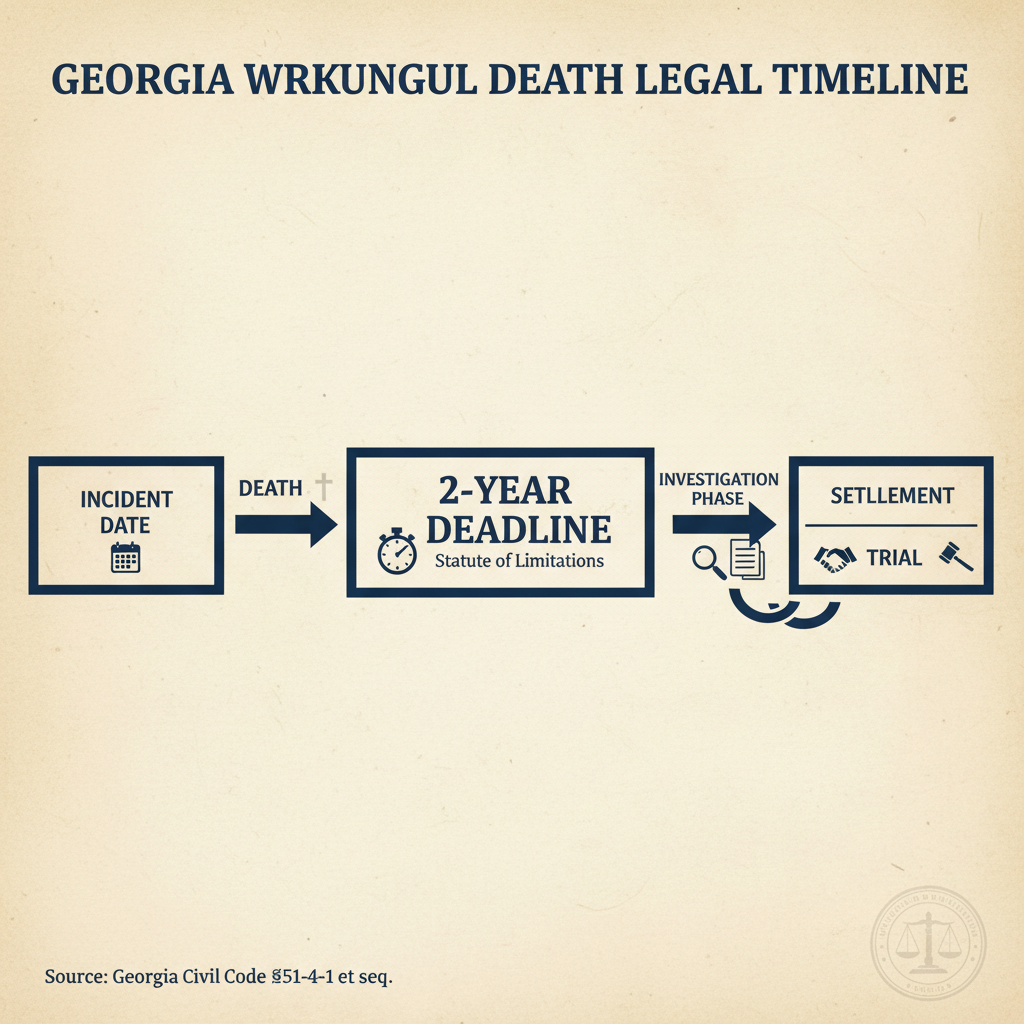
Georgia Law and Wrongful Death Claims: Timeline and Process
Georgia law creates strict rules about who can sue, when they can sue, and what they can recover. Understanding these rules prevents costly mistakes and ensures you meet all legal deadlines.
The Two-Year Filing Deadline (Statute of Limitations)
O.C.G.A. § 34-12-2 gives you two years from the date of death to file a wrongful death lawsuit. This deadline is absolute. Missing it means losing your right to recover compensation permanently, regardless of how strong your case is.
The two-year clock starts on the date of death, not the date you discover the negligence. For example:
- If someone dies on June 15, 2026, the deadline to file is June 15, 2028.
- If a doctor’s medical error is not discovered until two years after the death, you are already past the deadline.
- If the responsible party is out of state, Georgia’s tolling rules may extend the deadline slightly, but you should not rely on this.
Practical rule: File a wrongful death claim within 12 months of death whenever possible. This gives you time to investigate, gather evidence, and file before any statute of limitations complications arise.
Comparative Fault in Wrongful Death Cases
Georgia follows modified comparative negligence under O.C.G.A. § 51-12-33. If the deceased was partially at fault for the accident or incident that caused their death, your damages are reduced proportionally.
For example, if the jury determines the deceased was 10% at fault in a car accident (not wearing a seatbelt, slightly speeding) and the other driver was 90% at fault, your wrongful death damages are reduced by 10%. A $500,000 damages award becomes $450,000.
However, if the deceased is found to be 50% or more at fault, you recover nothing. This threshold makes comparative fault a major battleground in wrongful death litigation — the defense will argue the deceased was partially responsible to reduce or eliminate your recovery.
Practical rule: In wrongful death cases, the deceased cannot testify in their own defense. Your attorney must anticipate and counter the defense’s comparative fault arguments before trial.

How a Wrongful Death Attorney Helps Your Family
Managing a wrongful death claim while grieving is overwhelming. An experienced wrongful death attorney handles the investigation, legal strategy, and negotiations so your family can focus on healing.
Immediate Investigation and Evidence Preservation
Your attorney sends preservation demands to the responsible party and relevant third parties within days of the death. These demands require them to preserve evidence — maintenance records, surveillance footage, communication records, drug test results — before it can be destroyed or lost.
For medical malpractice deaths, this means obtaining the complete medical record and securing expert review immediately. For traffic fatalities, this means preserving crash data recorders, dispatch recordings, and cell phone records. For premises liability deaths, this means preserving surveillance footage and maintenance logs.
Waiting weeks or months to hire an attorney can result in lost evidence that would prove negligence.
Expert Witness Coordination
Wrongful death cases require expert testimony to establish standard of care, causation, and damages. Your attorney has relationships with medical experts, accident reconstruction specialists, economists, and life care planners who can testify about what happened and what your family lost.
Expert testimony is often the difference between a strong case and a weak one. Insurance companies know which experts are credible and which are not — your attorney’s choice of expert directly affects settlement value and jury credibility.
Calculating Fair Damages
Your attorney works with economists and life care planners to calculate the true financial value of your losses. This goes far beyond funeral expenses. It includes lost wages over the deceased’s work-life expectancy, the cost of household services, medical expenses, and non-economic losses like loss of companionship.
Insurance companies often propose settlements that cover only obvious costs while ignoring long-term losses. Your attorney’s damage analysis prevents you from accepting far less than you deserve.
Negotiation and Settlement
Most wrongful death attorney settlements in cases settle before trial. Your attorney negotiates with the responsible party’s insurance company from a position of strength — backed by investigation, expert opinions, and a credible threat of trial if fair compensation is not offered.
Insurance adjusters are trained to minimize payouts. They count on families being emotionally devastated and willing to accept quick settlements. Your attorney counters this by demonstrating the true value of your case and your willingness to take it to trial.
Trial Representation
If settlement negotiations fail, your attorney represents your family at trial. This includes opening statements, witness examination, expert testimony coordination, and closing arguments designed to help the jury understand the human and financial cost of your loss.
Trial is rare — most cases settle — but the credible threat of trial backed by thorough preparation is what drives fair settlements.
Practical rule: Hiring an experienced wrongful death attorney immediately after a death significantly increases your family’s recovery. Evidence preservation, expert coordination, and strategic negotiations all depend on quick action.
Wrongful Death Settlement and Verdict Amounts in Georgia
Wrongful death settlements and verdicts vary widely based on the type of claim, the age and earning potential of the deceased, the severity of negligence, and the impact on the family.
Typical wrongful death settlement ranges include:
- Medical malpractice deaths of working-age people: $300,000 to $2,000,000+ depending on lost earning potential, pain and suffering, and family impact
- Traffic fatality settlements (drunk or reckless driving): $250,000 to $1,500,000+ based on negligence severity and policy limits
- Premises liability deaths: $200,000 to $1,000,000+ depending on property owner negligence and liability insurance
- Nursing home neglect deaths: $150,000 to $800,000+ based on facility liability and care quality
- Product liability deaths: $500,000 to $5,000,000+ depending on product defect, manufacturer knowledge, and punitive damages potential
These ranges are estimates only. Your actual settlement depends on the specific facts, strength of evidence, and the insurance company’s assessment of trial risk.
Practical rule: Do not accept the first settlement offer from an insurance company. They always offer less than fair value initially, expecting you to counter-negotiate. Your attorney’s experience with similar cases is what drives a fair offer.

Frequently Asked Questions About Wrongful Death Claims
| Question | Answer |
|---|---|
| Can I file a wrongful death claim if I’m not married to the deceased? | Only if you are a biological child, adopted child, or stepchild of the deceased (if a parent-child relationship existed), or if you are a surviving parent. Adult siblings and other relatives cannot file. |
| How long do wrongful death cases take? | Most cases take 18 to 36 months from filing to settlement or trial. Simple cases settle faster; complex medical malpractice or product liability cases take longer. |
| Do I have to go to trial? | No. Most wrongful death cases involving a wrongful death attorney settle before trial. Your attorney will advise you if trial is necessary to achieve fair compensation. |
| Can I recover punitive damages in a wrongful death case? | Yes, if the defendant’s conduct was willful, wanton, or reckless. Punitive damages are rare but can be substantial in cases involving drunk driving, intentional misconduct, or gross negligence. |
| What if the defendant has no insurance? | You can sue the defendant personally and seek a judgment against their assets. Your attorney may also pursue uninsured motorist coverage if the death involved a vehicle accident. |
| Does settling a wrongful death claim mean giving up criminal justice? | No. A civil wrongful death settlement and a criminal prosecution are separate processes. Settling your civil case does not prevent criminal prosecution, and criminal conviction does not prevent a civil wrongful death lawsuit. |
| How much does it cost to hire a wrongful death attorney? | Most wrongful death attorneys work on contingency — they take a percentage of the settlement or verdict (typically 25-33%) and advance all costs. You pay nothing unless you win. |
| What if the deceased was partially at fault? | Your damages are reduced proportionally by the deceased’s percentage of fault. If they were 20% at fault, your damages are reduced by 20%. If they were 50% or more at fault, you recover nothing. |
Getting the Compensation Your Family Deserves
Losing a loved one to someone else’s negligence is a tragedy that no family should endure. The financial burden compounds the emotional grief. A wrongful death attorney in Atlanta with experience in all case types fights to hold the responsible party accountable and recover the full compensation your family deserves.
Humphrey & Ballard Law has helped Atlanta families recover compensation in wrongful death cases involving medical malpractice, traffic accidents, premises liability, product defects, and nursing home neglect. We understand the emotional weight of these cases and the financial pressure families face. We handle the investigation, evidence gathering, expert coordination, and negotiation so your family can grieve and heal.
Your family’s recovery as a wrongful death attorney can provide starts with one conversation. Contact Humphrey & Ballard Law today for a free consultation. Call (404) 446-9854 or visit our contact page to schedule your no-obligation case review. We serve families throughout Atlanta and Georgia.
About Humphrey & Ballard Law
Humphrey & Ballard Law is an Atlanta-based personal injury law firm founded by Desmond Humphrey and David Ballard. Since 2010, we have recovered millions of dollars in compensation for families and individuals harmed by negligence, medical malpractice, traffic accidents, and defective products. Our attorneys have deep experience (recognized by the Georgia Bar Association) in wrongful death cases and understand the unique legal and emotional challenges wrongful death attorney work presents. We are licensed to practice in Georgia and proudly serve clients throughout Atlanta and surrounding communities.
